






Wall Bars for Kids: 2026 Home Gym Buying Guide
What if the smartest way to conquer cabin fever isn't another bin of plastic toys, but the unused vertical space right on your living room wall? If you're dreading another stretch of bad weather with energetic kids climbing the doorframes, investing in modular wall bars is a game-changing solution. Every Canadian parent knows the frustration of cluttered playrooms and bulky gear that kids outgrow in months, along with the natural hesitation about mounting indoor climbing equipment safely to your studs.
You shouldn't have to sacrifice your living space to give your children a dedicated outlet for sensory regulation, coordination, and upper-body strength. Swedish wall bars transform compact spaces into versatile, safe climbing playgrounds that grow with your children from their first toddler climbs straight into their teen years. In this 2026 buying guide, we'll walk you through structural safety standards, smart layout considerations, and modular features to help you choose the ultimate setup for your home.
Key Takeaways
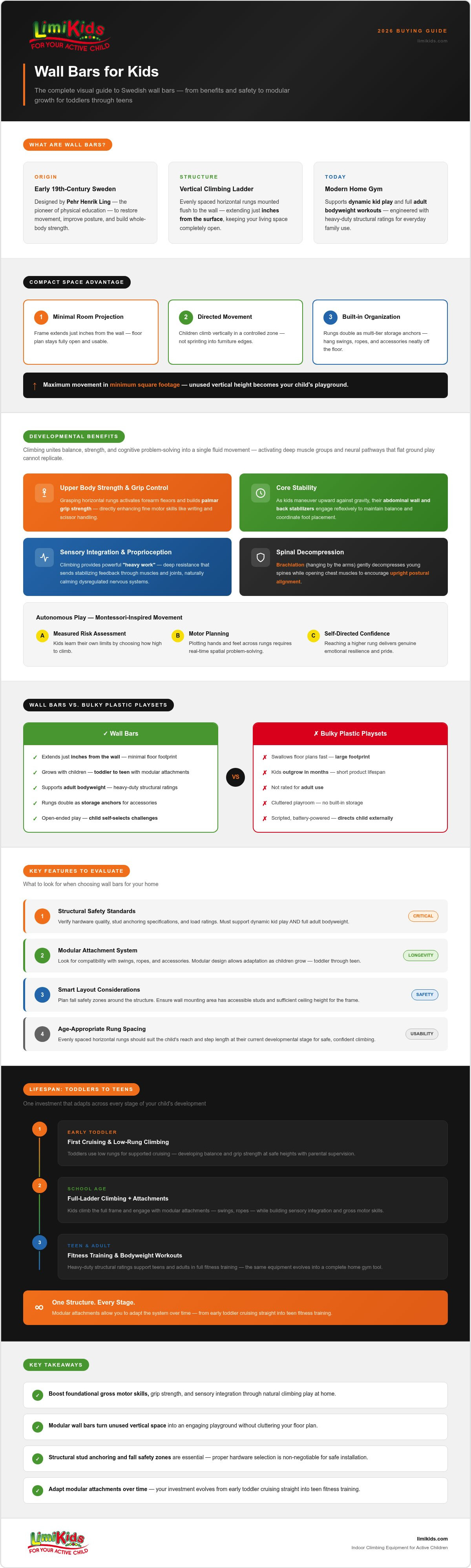
- Boost foundational gross motor skills, grip strength, and sensory integration through natural climbing play at home.
- Learn how modular wall bars turn unused vertical space into an engaging playground without cluttering your floor plan.
- Gain complete peace of mind with clear guidance on structural stud anchoring, hardware selection, and fall safety zones.
- Discover how to adapt modular attachments over time, taking your investment from early toddler cruising straight into teen fitness training.
What Are Wall Bars and Why Are They Essential for Active Homes?
At their core, wall bars are vertical climbing ladders built with evenly spaced horizontal rungs mounted securely flush against a wall. If you explore what are wall bars historically, you'll find they trace back to early nineteenth-century Sweden. Physical education pioneer Pehr Henrik Ling designed them to restore movement, improve posture, and build whole-body strength. Today, these sturdy structures bring that same therapeutic brilliance directly into modern living rooms and play spaces.
For Canadian families facing long stretches of sub-zero temperatures and rainy afternoons, they are an absolute sanity-saver. Instead of bouncing off the walls, children channel their pent-up energy into climbing them! You get an all-weather indoor sensory gym that builds foundational physical literacy, balance, and coordination, all within a footprint that respects your home.
The Evolution from Swedish Gymnastic Stalls to Modern Home Gyms
Traditional European physical therapy originally relied on stall bars for targeted spinal decompression, corrective posture drills, and functional core strength. Modern residential engineering takes those classic biomechanics and adapts them for everyday family play. Today, these systems anchor a complete indoor home gym for kids without looking like sterile therapy gear. Heavy-duty structural ratings ensure they handle dynamic kid play while easily supporting full adult bodyweight workouts.
Solving Compact Play Area Challenges with Vertical Footprints
Bulky plastic playsets swallow floor plans fast. Wall bars solve that problem by taking play upward:
- Minimal room projection: The frame extends just inches from the wall, keeping your living space completely open.
- Directed movement: Children climb vertically in a controlled zone rather than sprinting across the room into furniture edges.
- Built-in organization: Horizontal rungs double as multi-tier storage anchors for hanging swings, ropes, and accessories neatly off the floor when play finishes.
You claim unused vertical height and give your kids a dedicated climbing playground. It is maximum movement in minimum square footage.
Physical and Developmental Benefits of Wall Bars for Growing Children
Climbing is nature's blueprint for foundational physical literacy: it unites balance, strength, and cognitive problem-solving into a single fluid movement. While typical fitness retailers pitch stall bars as niche workout gear for adults, installed wall bars serve a far greater purpose for young children. Every vertical pull and rung transition demands full-body engagement, activating deep muscle groups and neural pathways that flat ground play simply cannot replicate.
Building Upper Body Strength, Grip Control, and Core Stability
Every climb triggers vital biomechanical development. Grasping smooth horizontal rungs activates forearm flexors and builds palmar grip strength, which directly enhances fine motor skills like writing and scissor handling. Brachiation, or hanging by the arms, gently decompresses young spines while opening chest muscles to encourage upright postural alignment. As kids maneuver upward against gravity, their abdominal wall and back stabilizers engage reflexively to maintain balance and coordinate foot placement.
Sensory Integration and Proprioceptive Feedback Indoors
Climbing provides powerful proprioceptive input, often called "heavy work," which sends stabilizing feedback through muscles and joints. This deep resistance naturally calms dysregulated nervous systems after long school days or cold afternoons trapped indoors. Pairing your ladder with specialized sensory motor equipment for home creates an enriching physical space where vestibular balancing systems activate dynamically during climbing, swinging, and controlled inversion play.
Encouraging Autonomous Play Inspired by Montessori Principles
Wall ladders embody open-ended movement. Unlike scripted battery-powered toys that direct the child's attention externally, these structures empower children to self-select challenges that match their developmental readiness:
- Measured risk assessment: Kids learn their own limits by choosing how high to climb.
- Motor planning: Plotting hands and feet across rungs requires real-time spatial problem-solving.
- Self-directed confidence: Reaching a higher rung delivers genuine emotional resilience and pride.
Aligning your play area with authentic Montessori play equipment lets children lead their own physical discovery. Following established coaching standards for safely using wall bars, such as establishing clear boundaries and maintaining active supervision, ensures this autonomy flourishes safely. If you want to transform an ordinary room into an active developmental zone, exploring high-quality setups from LIMIKIDS gives your kids the ultimate platform for lifelong healthy movement habits.
Key Features to Evaluate When Choosing Wall Bars for Your Home
Selecting the right climbing setup requires balancing physical safety with everyday usability. Not all ladders are created equal. When evaluating indoor wall bars, look beyond visual styling and focus on engineering standards that withstand energetic daily play. Multi-point wall anchoring brackets, proper rung profiles, and certified load capacities separate authentic developmental equipment from temporary novelty toys.
Material Breakdown: Premium Wood vs Heavy-Duty Metal Construction
Your choice of framing material sets the foundation for both room aesthetics and durability. Solid hardwoods like beech deliver an organic, tactile grip that blends effortlessly into Scandinavian-inspired interiors. Meanwhile, high-grade powder-coated steel frameworks offer maximum resistance to wear, making them ideal for heavy multi-user play. Dive deeper into our comparison of a wooden vs metal indoor jungle gym to decide which structural medium best matches your home environment and humidity conditions.
Weight Capacity, Rung Spacing, and Ergonomic Proportions
Always inspect the load ratings and bar geometry before installing:
- Dual-user weight ratings: Insist on frames that support adults as well as children. Heavy-duty structural ratings ensure you can demonstrate climbing techniques or perform your own pull-ups with complete confidence.
- Kid-friendly rung spacing: Vertical gaps must prevent entrapment while matching the natural stride of shorter limbs. Standard spacing around 7 to 8 inches keeps transitions intuitive and safe.
- Ergonomic rung shape: Rounded or contoured rungs fit smaller hands comfortably. This design reduces palm fatigue and lets young climbers build grip strength without painful calluses.
Modular Accessories: Expanding Functionality Over Time
The smartest home gyms evolve alongside your children. A standalone vertical ladder is fantastic, but modular attachments multiply its developmental value. Adjustable pull-up bars can be positioned low for toddler chin holds or shifted overhead for teen training. Gymnastic rings and dynamic climbing ropes introduce thrilling agility challenges, while detachable incline slides convert climbing rungs into instant toddler ramps. Choose modular wall bars early on to ensure your setup adapts as your family grows.
Safety Standards, Wall Anchoring, and Home Installation Requirements
Installing indoor climbing gear in your home requires zero guesswork. Kids don't just climb rungs passively; they swing, drop, and launch their body weight with enthusiasm. Dynamic leverage forces easily multiply static weight during active play. Proper anchoring of your wall bars provides the structural integrity needed for absolute peace of mind.
Follow these five non-negotiable steps during installation:
- Step 1: Locate structural wooden studs or solid masonry using a dependable sensor before drilling.
- Step 2: Align your mounting brackets directly over the structural members using heavy-duty lag bolts.
- Step 3: Tighten all hardware securely and verify vertical plumb with a spirit level.
- Step 4: Establish a dedicated clearance perimeter free of hard furniture edges and door swings.
- Step 5: Place certified high-density impact safety mats directly beneath the climbing station.
Structural Fastening: Why Hollow Drywall Anchors Are Never Acceptable
Drywall anchors and toggle bolts belong on lightweight picture frames, not climbing structures. Hollow sheetrock cannot handle dynamic shear stress and will tear out under sudden loads. Fastening directly into solid wood framing or poured concrete masonry is strictly mandatory. If your home's stud spacing doesn't match the frame bracket width, anchor horizontal hardwood mounting stringers across two adjacent studs first, then mount your ladder directly into the reinforced stringers.
Establishing Safety Clearances and Impact Attenuation Matting
Clear floor space is just as critical as sturdy bolts. Maintain a dedicated fall zone extending at least five to six feet outward from the climbing face, keeping the perimeter clear of sharp corners or radiator covers. High-density foam crash mats are non-negotiable beneath the ladder. They absorb impact shock, protect growing joints during jumps, and give hesitant climbers the confidence to explore higher rungs. Multi-fold mats fold away effortlessly when you need quick floor cleanup.
Routine Hardware Inspections and Ongoing Maintenance Protocols
Reliable equipment requires consistent oversight. Set a monthly calendar reminder to check bolt tension and confirm wall brackets remain rigid against the wall. Wipe down horizontal rungs with a clean, slightly damp cloth to prevent sweat and dust buildup from slicking the grip surface. Always inspect accessory ropes, carabiners, and swing straps for early fiber wear. If you want engineered indoor systems backed by experienced Canadian customer support, browse secure climbing setups with LIMIKIDS and build your home gym on a rock-solid foundation.
Maximizing Longevity: Adapting Wall Bars from Toddlers to Teens
Most children's play equipment ends up in a donation bin or landfill within eighteen months. Single-stage plastic playsets get outgrown fast, turning your hard-earned dollars into temporary clutter. Investing in heavy-duty wall bars breaks that cycle. Because a stall bar is an open-ended climbing structure rather than a rigid toy, it evolves alongside your child's physical capabilities from early exploration to advanced athletic training.
Stage-by-Stage Movement Progression for Every Family Member
A single climbing framework unlocks years of progressive movement across multiple age groups:
- Toddlers (ages 1 to 3): Lower rungs serve as an organic cruising bar. Toddlers practice pulling to stand, stepping laterally, and gaining tactile grip confidence close to the ground.
- Elementary Kids (ages 4 to 9): Children tackle full vertical ascents, cross-body traverses, and suspended hangs. Adding hanging gymnastic rings or a climbing rope turns the ladder into an indoor obstacle course.
- Teens (ages 10+): The system converts into a serious calisthenics station. Teens build functional upper-body power through pull-ups, hanging leg raises, and core hollow-body holds.
- Parents: Adults don't need a separate gym pass for back care. Daily dead-hangs decompress spinal discs after desk work, while high rungs provide stable anchoring for deep hamstring and hip stretches.
Why LIMIKIDS Swedish Wall Gyms Lead Canadian Homes
Selecting equipment that withstands years of energetic multi-kid use comes down to construction standards. A Canadian family-owned brand supporting active children since 2008, LIMIKIDS engineers indoor home gyms with the structural integrity required to handle energetic young climbers and adult workouts alike. You don't have to rebuild your play space every couple of years as your kids grow.
Our modular architecture lets you swap accessories effortlessly. Click in a wooden swing or rope ladder when your children are small, then transition to pull-up bars and dip stations as their athletic ambitions grow. With reliable nationwide shipping across Canada and dedicated customer setup support, turning your compact room into a screen-free haven has never been easier. Choose adaptable, enduring equipment that keeps your entire family moving joyfully for years to come.
Transform Your Home Into an Active Family Launchpad
Creating an active indoor sanctuary doesn't require knocking down walls or surrendering your living room floor. By anchoring certified wall bars directly into your wall framing, you give your children a permanent outlet for sensory regulation, grip development, and confident gross motor exploration. It's a practical, space-saving investment that replaces short-lived toy clutter with years of joyful, screen-free play.
Whether you're guiding a toddler through their first supported climbing steps or watching a teen master bodyweight conditioning, modular systems adapt to every stage of growth. Proudly supporting Canadian families since 2008, LIMIKIDS provides heavy-duty indoor setups engineered to accommodate energetic children and exercising adults alike. Ready to conquer rainy days and long winter afternoons for good? Explore Canadian Indoor Wall Gyms at LIMIKIDS and unlock your family's physical potential with reliable nationwide shipping and dedicated setup support.
Frequently Asked Questions
What is the main difference between Swedish ladders and wall bars?
There is no structural difference; the terms are used interchangeably. "Swedish ladder," "stall bars," and wall bars all describe the exact same vertical frame fitted with evenly spaced horizontal climbing rungs. Originating in Sweden for gymnastics and physical therapy, these systems share identical biomechanical benefits. In modern homes, the name often shifts depending on whether a brand markets them for pediatric play or adult calisthenics conditioning.
Can wall bars be mounted safely onto standard residential drywall?
No, you should never mount climbing equipment directly into hollow drywall alone. Dynamic loads created by swinging and climbing easily rip drywall anchors out of gypsum board. You must anchor the mounting brackets directly into solid wood wall studs or poured masonry using heavy-duty lag bolts. If your stud spacing doesn't align with your ladder brackets, install horizontal wood backing stringers across studs first.
What is the recommended age for children to start using wall bars?
Children can begin interacting with low rungs around 12 to 18 months under direct adult supervision. At this early stage, toddlers use the lowest bars to pull up, cruise, and practice balance. Structured independent climbing typically starts around ages three or four as grip coordination matures. Always place high-density impact mats below the ladder and set climbing height limits based on your child's confidence and motor control.
How much ceiling height is required to install indoor wall bars?
Most residential setups require standard 8-foot (about 2.4-meter) ceilings for optimal clearance. You need sufficient headroom between the top rung and the ceiling so kids don't bump their heads during pull-ups or climbs. For basements or rooms with lower ceilings, compact wall frames or adjustable-height models provide a safe fit while still giving growing kids plenty of vertical climbing range.
Can adults exercise on indoor wall bars designed for kids?
Yes, provided the manufacturer specifies heavy-duty structural weight capacities. Quality home wall bars are engineered to support adult loads, often rated for 220 to 330 pounds or more. Parents can comfortably use the rungs for spinal decompression hangs, daily mobility stretching, resistance band anchoring, and pull-up workouts. Always check the certified load rating on your specific frame before beginning your own strength routine.
What accessories can be attached to modular wall gym systems?
Modular systems support a wide variety of developmental add-ons that clip directly onto the rungs. Popular options include adjustable pull-up bars, gymnastic rings, hanging climbing ropes, and wooden swings. For younger children, detachable incline slides and climbing ramps transform vertical ladders into gentle obstacle courses. These interchangeable attachments keep play fresh without requiring extra floor space as your child's motor skills evolve.
How do wall bars support children with sensory processing needs?
Climbing provides intense proprioceptive and vestibular feedback, known as "heavy work," which helps organize the central nervous system. Pulling against gravity and holding firm rungs activates deep joint receptors, exerting a grounding, calming effect on sensory-seeking or overstimulated kids. Adding dynamic components like swings or suspension rings offers rhythmic movement that sharpens spatial awareness, balance, and bilateral coordination in a safe home setting.