






Best Play Equipment for an Autistic Child: A Parent’s Guide
What if the “best play equipment for autistic child” isn’t a special category at all, but the equipment that fits your child? It’s easy to feel unsure whether to start with movement, sensory play, or both, especially when product descriptions make big promises. Your child’s interests, comfort, and abilities are a more useful starting point than a label.
Some children love climbing, swinging, or hanging; others prefer sensory experiences they can explore at their own pace. Preferences can vary from child to child, too. The right fit should invite enjoyable, self-directed play without asking your family to squeeze an impractical setup into your home or overlook safe use.
This guide compares indoor movement options, such as climbing equipment and monkey bars, with sensory play equipment. You’ll learn how to weigh the features your child enjoys, their current abilities, available space, supervision, and safety. Then you can make a thoughtful choice for an active home play space that feels exciting for your child and manageable for your family.
Key Takeaways
- The best play equipment for autistic child is guided by that child’s interests, abilities, and safe-use needs, not assumptions about autism.
- Compare climbing structures, Swedish wall gyms, monkey bars, and sensory play by the kinds of activities your child enjoys.
- Consider room size and supervision alongside play features to find an option that works in your home.
- Plan the setup carefully and follow the manufacturer’s instructions for installation, use, inspection, and age or weight limits.
- Explore LIMIKIDS indoor climbing and sensory play categories to plan a home play space around your child’s preferences.
What makes play equipment a good fit for an autistic child?
A good fit starts with the child, not a product label. The best play equipment for autistic child matches what they enjoy, what they can use comfortably, and the supervision needed for safe play. That might be a climbing challenge, a quieter sensory activity, or space to choose between different kinds of play.
In brief: Suitable play equipment offers an appealing, accessible experience that can be used safely at home. It doesn’t need to promise a developmental result to be worthwhile.
Autistic children don’t share one sensory profile or set of play preferences. A sound, texture, or movement that one child seeks may feel uncomfortable or overwhelming to another. The term sensory processing disorder is sometimes used to describe differences in processing sensory input, but it shouldn’t be treated as a shortcut for predicting what a particular autistic child will enjoy.
Start with what your child chooses, avoids, and enjoys
Watch what your child does during everyday play. Do they return to climbing, jumping, or balancing, or choose hands-on exploration and quieter activities? Notice their reactions to textures, sounds, and movement. What do they seek out, move away from, or approach only when they can control the pace?
Also note when play tends to be active, quiet, solitary, or shared. A child may enjoy having someone nearby without wanting that person to join in. Make room for their preferred ways of communicating and participating, whether they use words, gestures, or another communication method. Their choices over time can offer more useful clues than a broad product category.
Think in terms of play goals, not diagnostic labels
Get specific about the experience you’re considering: climbing, practising balance, enjoying movement, or exploring sensory materials. These goals help narrow the options without assuming autism points to one type of equipment. One child may eagerly seek physical activity; another may prefer familiar, predictable play with fewer sounds or sensations.
Keep the goal centred on access and enjoyment. Equipment can create an opportunity to play, move, and explore, but it shouldn’t be presented as a treatment or a guarantee of developmental progress. If your child’s interests change, revisit the choice. A good play space leaves room for them to opt in, take a break, or choose another activity.
Which play equipment supports movement and sensory exploration?
Movement equipment and sensory play offer different ways to explore, and some children enjoy both. To compare them, start with the play your child chooses, then consider their abilities, the room available, and the supervision each activity needs. No category is automatically the right one because a child is autistic.
Climbing structures, wall gyms, and monkey bars
For a child drawn to active movement, indoor climbing structures offer routes to climb and physical challenges to explore at their own pace. Swedish wall gyms provide a wall-based climbing option, while monkey bars centre on moving across overhead bars. Consider whether your child enjoys climbing, hanging, or trying different movements. For more factors to weigh when choosing a home setup, see the indoor home gym selection guide.
Sensory play equipment and movement preferences
Sensory play equipment is a broad category, not one standardized experience. Some options invite tactile exploration; others may involve movement or quieter engagement. Sensory preferences vary from child to child, so follow your child’s cues rather than assuming what they’ll enjoy. Notice whether they seek movement, explore textures, return to a familiar activity, or prefer a calmer play choice. A child’s interest and comfort matter more than a product’s broad sensory label.
Home sensory equipment can create opportunities for exploration and play, but it shouldn’t be confused with clinical care or presented as a treatment. Sensory integration therapy refers to a therapeutic approach, not a guaranteed effect of using play equipment at home. For ideas focused on home play, explore the sensory motor equipment guide.
The best play equipment for autistic child fits the child’s own interests and abilities as well as the space and supervision your home can support. Compare indoor climbing and sensory play equipment with those criteria in mind.
How do you compare play equipment for your child and your home?
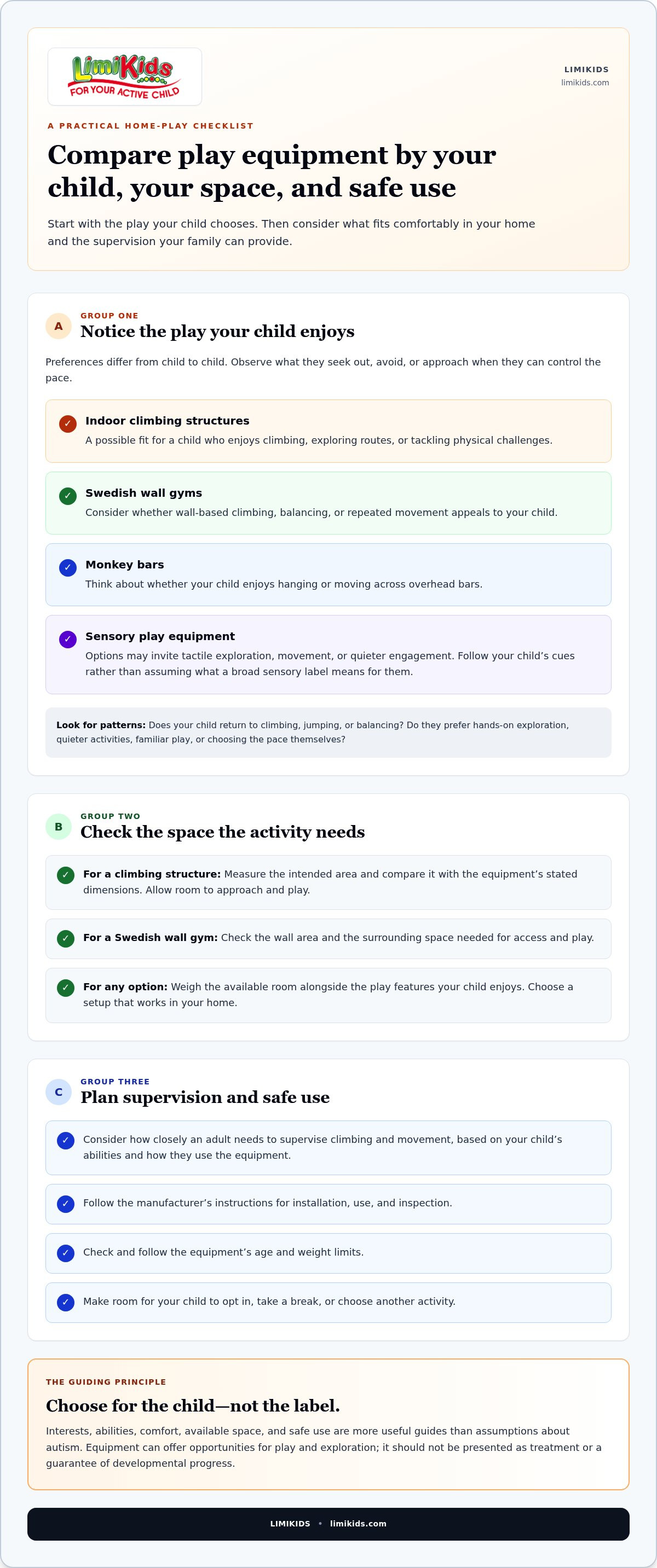
A side-by-side comparison can turn observations into a practical choice. Your child’s observed preferences are a more useful starting point than a label. Look at the play experience each option offers, then check how it fits your room and the supervision your family can provide.
| Equipment category | Child’s interest to consider | Space needs | Supervision considerations |
|---|---|---|---|
| Indoor climbing structure | Climbing, exploring routes, or tackling physical challenges | Measure the intended area and compare it with the equipment’s stated dimensions; account for room to approach and play. | Consider how closely an adult needs to supervise the child’s climbing and movement. |
| Swedish wall gym | Wall-based climbing, balancing, or repeated movement | Check the wall area and the surrounding space needed for access and play. | Plan supervision around the child’s abilities and how they use the structure. |
| Monkey bars | Hanging or moving across overhead bars | Review the equipment’s dimensions and ensure the room layout allows access without blocking household routines. | Consider the child’s experience with this kind of movement and the adult attention it requires. |
| Sensory play equipment | Tactile exploration, quieter activities, or other sensory experiences | Check where the activity will fit and whether it needs a dedicated play area. | Think about the child’s comfort, preferred level of support, and ability to pause or move on. |
Match the equipment to the child’s interests and abilities
Use what your child already chooses as your guide. Notice whether they approach climbing, balance, or movement with curiosity, and which sensory activities they return to or avoid. A product category can suggest possibilities, but it can’t predict an individual child’s response. Keep choice central: let your child participate in a way that feels comfortable, and make stopping or switching activities part of the plan.
Also consider predictability and intensity. A familiar activity may feel easier to approach than one with several new sensations or steps. Some children enjoy energetic play; others prefer a quieter pace or time to observe before joining in.
Check fit with available space and adult supervision
Measure the intended area and compare it with the equipment’s stated dimensions. Think beyond the footprint: check access, surrounding clearance, flooring, and how the setup will work with everyday household routines. Then consider what active supervision looks like for your child and the activity. If you’re exploring climbing frames with slides, the indoor climbing frame with slide buying guide offers more category-specific considerations.
The best play equipment for autistic child balances the child’s interests and abilities with a realistic fit for your home and supervision plan. No single category needs to win; choose what makes enjoyable, manageable play possible.
How can you set up indoor play equipment thoughtfully and safely?
A well-planned play area gives your child room to explore while helping you stay attentive to safe use. Start with the child’s preferences, then assess the space and your supervision plan before setting up equipment. Keep participation optional. A child can watch, try an activity briefly, take a break, or choose something else.
Plan the play area before choosing a setup
Use this sequence to make the decision manageable:
- 1. Observe first. Note which activities your child chooses, avoids, or returns to, and whether they prefer a predictable routine or more variety.
- 2. Match the activity to your child. Consider the specific play experience, such as climbing or sensory exploration, along with your child’s current abilities and comfort. Don’t pressure them to use equipment or try a sensory activity.
- 3. Measure the room. Check the intended area against the equipment’s stated dimensions. Consider movement paths, surrounding furniture, access to the play space, and how the activity will fit into household routines.
- 4. Read the manufacturer’s instructions. Follow the stated installation requirements and clearance guidance. Use the equipment only as directed, including any age or weight limits.
- 5. Plan supervision and checks. Decide what active supervision looks like for this child and activity. Follow the manufacturer’s instructions for inspection, and make visual checks for wear or changes as directed.
A clearly defined play area may help some children understand where an activity happens. Others may prefer easy access to choices. Let your child’s communication and participation cues guide how you arrange the space, and adjust if the setup isn’t working for them.
Keep play child-led, supervised, and adaptable
Stay nearby at the level of attention the activity and your child require. Observe their response as they play. If they show discomfort or lose interest, pause, offer a change, or end the activity. Play equipment should invite exploration, not create an expectation to participate.
Safety reminder: Pair appropriate adult supervision with the manufacturer’s instructions for installation, use, inspection, and age or weight limits whenever you plan a setup. For child-specific safety concerns, seek individualized guidance from a qualified professional who understands your child’s needs.
As you consider what fits your child and space, compare indoor play equipment for home.
How can LIMIKIDS help create an indoor play space that fits?
A home play space can make room for movement and exploration without assuming every child wants the same experience. LIMIKIDS sells indoor climbing equipment, Swedish wall gyms, monkey bars, and sensory play equipment for families. Match those categories to the activities your child chooses, then weigh the fit with your room, routines, and supervision needs.
Explore active and sensory play options for home
Start with what your child is drawn to. If they seek climbing or active movement, compare indoor climbing options and Swedish wall gyms. If hands-on exploration interests them, consider sensory play equipment. Your child’s cues can help narrow the choices; the category alone can’t predict what they’ll enjoy. For more home-focused ideas, read the guide to sensory motor equipment for home.
LIMIKIDS is a Canadian retailer that has helped families create indoor play spaces since 2008. Its home-focused range includes space-saving options and dedicated support for families across Canada. That focus can help you compare active-play structures with sensory equipment, or decide whether either category fits your child’s interests and abilities.
Choose a play space that can grow with your family
Interests and household routines can shift over time. An adaptable play area can leave room for a child to return to familiar activities, try something new when ready, or take a break. Think about how equipment will fit the room and everyday life, not just how it looks on its own. Keep the setup flexible enough to respect your child’s choices.
For families searching for the best play equipment for autistic child, LIMIKIDS’ indoor options provide categories to compare through a child-led lens. Browse by play interest, then consider the space and support your home can offer. There’s no need to choose a category just because it’s commonly associated with autism.
Ready to explore options for your home? Explore LIMIKIDS indoor play equipment and find a starting point that fits your family.
Make room for play that fits your child
The best play equipment for autistic child reflects your child’s interests, abilities, and comfort, not assumptions based on a diagnosis. Compare active choices, such as indoor climbing structures, Swedish wall gyms, and monkey bars, with sensory play equipment. Then consider your available space, safe use, and supervision needs.
Start with what your child chooses and how they like to participate. Play should remain flexible and optional, with room to pause, switch activities, or explore at their own pace. A thoughtful setup can make everyday play more inviting while adapting as your child’s interests and family routines change.
LIMIKIDS is a Canadian company that has supported families since 2008 with indoor climbing structures, Swedish wall gyms, monkey bars, and sensory play equipment, along with dedicated customer support across Canada. Explore LIMIKIDS indoor play equipment and take the next step toward a play space shaped around your family.
Frequently Asked Questions
What is the best play equipment for an autistic child?
The best play equipment for an autistic child suits that child’s interests, abilities, and safe-use needs. Some children enjoy climbing or active movement; others prefer quieter sensory exploration, and some like a mix. Notice what your child chooses and avoids, then consider the room available and the supervision the activity requires. No single equipment type is right for every autistic child.
Is climbing equipment suitable for autistic children?
Climbing equipment can be suitable if a child enjoys climbing or movement and can use the equipment safely with appropriate supervision. Indoor climbing structures, Swedish wall gyms, and monkey bars offer different ways to move, so consider your child’s abilities and comfort with each activity. Check the equipment’s instructions, including installation requirements and age or weight limits, and let your child choose whether to participate.
Can play equipment help an autistic child with sensory needs?
Play equipment can offer opportunities for movement or sensory exploration, but each child’s response is individual. A child may enjoy an activity, prefer to observe, or decide it isn’t comfortable. Follow their cues and keep the experience optional. Home play equipment isn’t a treatment and can’t guarantee developmental outcomes. If you have questions about your child’s sensory needs, seek guidance from a qualified professional familiar with them.
How do I choose sensory play equipment for home?
Choose sensory play equipment by observing what your child seeks out, avoids, and returns to. Consider whether they seem interested in tactile exploration, movement, or quieter activities, without assuming a particular response based on diagnosis. Compare the equipment’s intended play experience with your child’s preferences, abilities, available space, and supervision needs. Keep the activity easy to pause or leave, and follow the manufacturer’s instructions for safe use.
What should I consider before setting up indoor climbing equipment?
Measure the intended area and compare it with the equipment’s stated dimensions. Consider access, surrounding furniture, movement paths, flooring, and how the setup will fit household routines. Follow the manufacturer’s instructions for installation, use, inspection, and any age or weight limits. Plan appropriate adult supervision based on the activity and your child’s abilities. If you have child-specific safety concerns, seek individualized guidance from a qualified professional.
Does every autistic child have the same sensory preferences?
No. Autistic children are individuals, and sensory preferences can differ from child to child. One child may enjoy movement or certain textures, while another may prefer familiar, quieter activities or avoid those same sensations. Avoid choosing equipment based only on a diagnosis or broad category. Instead, observe what your child approaches, enjoys, or moves away from, and let their communication and participation preferences guide the play space.
Can indoor play equipment replace occupational therapy?
No. Indoor play equipment isn’t a replacement for occupational therapy or individualized professional care. It can provide opportunities for enjoyable movement or exploration at home, but it shouldn’t be treated as therapy or as a guaranteed way to achieve developmental outcomes. If your child receives occupational therapy or has specific support needs, discuss relevant play goals with their occupational therapist. Keep home play child-led and follow equipment instructions for safe use.