






Climbing Gym for a Small Apartment: How to Choose the Right Setup
The smallest climbing gym isn’t always the best fit for a small apartment. A compact setup can still crowd a room or become impractical if the ceiling is too low or the mounting requirements don’t suit your walls. Choosing a climbing gym for small apartment living starts with usable clearance, not footprint alone.
When every square metre matters, it’s natural to focus on floor space. But you’ll also want to check how much room a child needs to climb and move, what installation requires, and whether your lease allows mounting equipment. The right setup should invite active play without making everyday routines harder.
This guide compares space-efficient options, including vertical climbing formats, and explains what to measure before buying. You’ll learn how to assess ceiling height, wall type, mounting requirements, clearances, age guidance, and load limits in the product documentation. With those details in hand, you can weigh play value against safety and convenience, then explore LIMIKIDS indoor climbing equipment and home gym options with a clearer sense of what may fit your home.
Key Takeaways
- Choose a climbing gym for small apartment living by considering usable clearance and mounting fit, not just the equipment’s footprint.
- Compare vertical wall gyms, compact climbing frames, and floor-based equipment to find the format and setup that suit your room.
- Map doors, windows, furniture, and household walkways before choosing a location.
- Check wall suitability, installation requirements, age guidance, and load limits in the product documentation before buying.
- Use your measurements and family’s play preferences to narrow down options, then confirm product details with the retailer.
Climbing Gym for a Small Apartment: Start with the Space You Actually Have
A small-apartment climbing gym is equipment chosen to suit the room’s usable area, the clearance needed for active play, and the home’s mounting conditions. The footprint is the space the equipment occupies; play clearance is the additional open area a child needs to approach, climb, move, and get down. Measure both before comparing options.
A narrow frame may take up little floor space but still obstruct a walkway or sit too close to furniture. A vertical setup can preserve open floor area, but only if the room has enough height and a suitable mounting surface. Whether a product fits depends on its specifications and your apartment, not simply on the label “compact.”
What counts as a compact indoor climbing setup?
Options include wall-mounted Swedish wall gyms, compact climbing frames, and smaller floor-based equipment. Wall-based formats use vertical space. Frames and floor-based options may be easier to place without making a wall the main play surface, though they still need room around them. Some children may enjoy a simple traverse, while others prefer climbing features that support varied movement. Bouldering describes rope-free climbing on shorter walls, but home equipment is different, so follow the selected product’s instructions for use and safety.
There’s no universal size or clearance for these formats. Check the manufacturer’s dimensions, required open space, mounting hardware, and installation specifications for the specific model. Don’t assume a wall can support climbing equipment just because it looks solid.
Which apartment constraints should parents consider first?
Make a quick room-and-family inventory before browsing. Note ceiling height and usable wall width, then mark door swings, windows, furniture, and the routes people use to cross the room. Consider your child’s age, abilities, and play preferences, and check the product’s age guidance and load limits in its documentation.
- Room: Record the space at the potential location, including overhead clearance and nearby obstacles.
- Child: Consider the kind of movement the setup should encourage and whether the product guidance suits your child.
- Home: Decide whether drilling or a more permanent installation is acceptable. Check your rental agreement and building requirements before drilling or mounting anything.
Keep installation preferences separate from play space. A renter may prefer to avoid drilling, but a floor-based option still needs usable clearance. A wall-mounted format may preserve floor area, but only if the wall and installation conditions are appropriate. Start with what the room and home can accommodate, then compare equipment.
Compare Apartment-Friendly Climbing Gym Formats Before You Buy
There’s no single best format for every apartment. A climbing gym for small apartment living needs to match the available wall or floor area, the household’s tolerance for permanent mounting, and the kind of play your child enjoys. Compare setup requirements first, then weigh play style and everyday convenience.
| Format | Space use | Wall or floor requirements | Play style | Questions to verify |
|---|---|---|---|---|
| Vertical wall gym | Uses wall height and may preserve open floor area | Requires a suitable wall and model-specific mounting | Climbing, hanging, and movement along a fixed structure | What wall construction, fixings, installation instructions, and clearances does the manufacturer specify? |
| Compact climbing frame | Occupies a defined floor area, with room needed around it | Usually placed on the floor; check whether the product also requires securing | Climbing on a freestanding structure | What is the full assembled footprint, and can it stay clear of doors and walkways? |
| Smaller floor-based equipment | Uses floor space that may also serve other household needs | Needs an appropriate surface and open play area | More limited or focused movement, depending on the equipment | Does it need to be moved or stored, and how much clear space does use require? |
When does a vertical wall gym make sense in an apartment?
A wall-mounted Swedish wall gym may suit a home where floor area is limited and there’s a suitable wall. Vertical placement can leave more of the floor open, but it doesn’t remove clearance needs or make every wall appropriate for installation. Check the product’s wall requirements, fixings, clearances, and instructions. For broader selection questions, see a guide to choosing an indoor home gym for kids.
How do compact frames and floor-based options compare?
Freestanding equipment can be easier to position around household routines, but it uses floor area and may narrow circulation routes. Whether it can be moved or stored depends on the particular product, so don’t assume it will tuck away between play sessions. Consider how the room is shared and whether walkways stay open. If material is part of your decision, a wooden-versus-metal indoor jungle gym guide can help frame that comparison.
Whichever format you consider, review its instructions for safe placement and use. The U.S. Consumer Product Safety Commission’s home playground safety guidance discusses installation, protective surfacing, and hazards. It’s a reference, not a substitute for Canadian requirements or the product’s own directions.
Once you know which setup style could work, explore LIMIKIDS’ indoor gym categories and compare product-specific specifications. If a detail is unclear, customer support can help clarify specifications before you decide.
Will a Climbing Gym Fit Safely in Your Small Apartment?
A compact climbing gym may suit an apartment, but a small footprint doesn’t guarantee a safe or workable setup. The equipment, its installation requirements, your room conditions, and the child using it all matter. Check the product documentation before deciding whether a particular spot will work.
Let the product’s mounting and clearance instructions guide setup. General room-planning tips can help you shortlist a location, but they can’t confirm that a wall can support a particular structure or replace the manufacturer’s installation directions. If a specification is unclear, ask the retailer or manufacturer before purchasing or installing the equipment.
How should you check wall, ceiling, and floor conditions?
Start by identifying the wall construction at the proposed location. Don’t choose mounting hardware based on appearance or assume one type of fixing suits every wall and product. Compare the wall requirements in the manual with your home’s actual construction, and get qualified advice if you can’t verify suitability.
Next, compare the product’s exact height and installation dimensions with the ceiling. Account for overhead obstructions such as light fixtures, beams, or shelving. Check the floor surface and any placement instructions, too. If you rent, confirm permission with your landlord and check applicable building requirements before drilling, attaching hardware, or making other alterations. A removable or freestanding option still needs to meet its own setup and placement instructions.
What play clearance and supervision should parents plan for?
Measure the area around the installed equipment, not just the frame or wall unit. Consider where a child will approach, climb, move, and get down. Keep furniture and household traffic out of any space the manufacturer identifies as necessary. Don’t improvise a clearance measurement when the product documentation provides one.
Follow the supplied age guidance, use instructions, and supervision recommendations. A child’s experience and abilities matter, so a setup that suits one family may not suit another. Check that the supervising adult can see and reach the play area, and use the equipment according to its instructions.
The U.S. Consumer Product Safety Commission’s CPSC playground safety guidelines offer general context on playground hazards and safety. They are not a substitute for product instructions or Canadian requirements. For any climbing gym for small apartment living, assess the specific equipment and home rather than relying on compact dimensions alone.
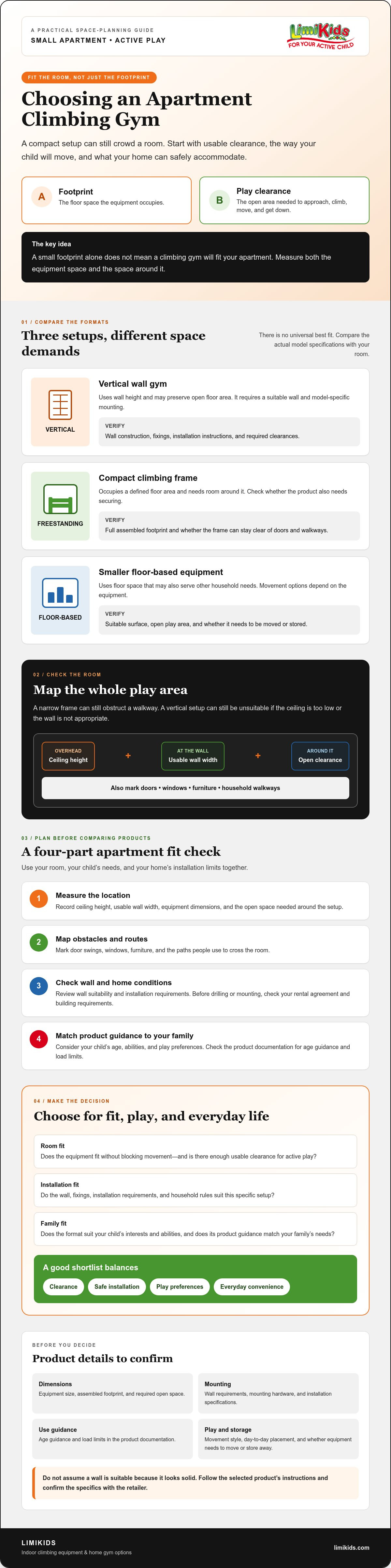
Measure and Plan Your Apartment Climbing Gym in Four Steps
A quick room sketch can prevent a costly mismatch. Before choosing a climbing gym for small apartment living, measure the intended spot and plan how play will fit around the routines that keep your home working.
- Measure the room at the intended location. Record usable wall width, floor depth, and ceiling height where the equipment might go. Note nearby doors, windows, heaters, light fixtures, shelves, and other obstacles. Measure at the exact installation point rather than relying on a general room estimate.
- Map the footprint and activity clearance separately. On a simple sketch, mark the equipment’s stated footprint, then leave a separate area for the product’s required play clearance. Add furniture, door swings, and regular household walkways. This makes it easier to see whether a setup blocks access or competes with another everyday use of the room.
- Assess the mounting conditions. If you’re considering a wall-mounted option, identify the wall construction and compare it with the product’s mounting requirements. Check your rental agreement and building requirements before planning alterations. For floor-based equipment, note the available floor area and any placement or surface instructions.
- Compare your plan with the product specifications. Check the exact dimensions, installation guidance, required clearances, age guidance, and load limits in the manufacturer’s documentation. If the listed measurements or mounting details don’t match your sketch, don’t assume the equipment can be adjusted to fit. Ask the retailer or manufacturer to clarify uncertain specifications before ordering.
Will the setup work in daily life?
Test the layout against more than playtime. Could someone still open a closet, reach a window, clean the floor, and move through the room without squeezing past the equipment? In a shared room, consider whether the setup conflicts with seating, storage, or another family routine. A compact climbing frame with a slide, for example, may need a different layout from a vertical gym. A related indoor climbing frame with slide buying guide can offer another perspective on room-fit trade-offs.
Once your sketch and the product instructions agree, you’ll have a clearer basis for comparing options. Explore LIMIKIDS indoor climbing equipment and review the specifications for any setup you’re considering.
Choose a LIMIKIDS Climbing Gym That Fits Your Apartment and Family
Make the decision in this order: available space first, mounting fit second, then your child’s needs and preferred style of play. After those checks, compare product details. This keeps an appealing feature from distracting you from the basics: the equipment must suit your room and the way your family will use it.
Which LIMIKIDS equipment categories are worth exploring?
LIMIKIDS offers indoor climbing equipment and Swedish wall gyms for home play. These vertical formats can make use of wall space, depending on the room, product dimensions, mounting requirements, and required clearance. Montessori-inspired play systems may also appeal to families looking for active, independent play. Consider whether your child is drawn to climbing, exploring different movement challenges, or returning to a familiar activity. The right category is the one that fits both their interests and your available space.
If you’re comparing play approaches, consider how much variety and independence you want the setup to encourage, as well as how it fits into everyday family routines. A product’s category alone can’t tell you whether it’s suitable for your apartment or child. Use it as a starting point for checking the specific documentation.
What should you confirm before placing an order?
Use your room measurements to check the exact product dimensions, required clearance, mounting details, and installation instructions. Review the product’s age guidance and load limits, too. Confirm that the wall or floor conditions suit the setup and that the equipment won’t obstruct doors, furniture, or regular walkways. If you rent or live in a building with alteration requirements, confirm permission before planning a mounted installation.
Questions about specifications? LIMIKIDS provides dedicated customer support to clarify product details before you choose. The retailer ships across Canada, so confirm current shipping information and product availability before ordering. These checks help you move from a promising category to a more informed decision.
Ready to compare options? Explore LIMIKIDS indoor climbing equipment, then check the selected setup’s specifications against your home and family’s needs.
Make Room for Play with a Setup That Fits
The right climbing gym for small apartment living is the one that fits your actual room and your family’s routines, not simply the one with the smallest footprint. Compare formats, plan for play clearance, and confirm that the mounting conditions and product instructions suit your home before choosing.
With those checks in hand, you can focus on equipment that supports your child’s movement and play without overlooking everyday convenience. LIMIKIDS has supported families since 2008 and offers space-saving indoor play and climbing equipment. Its dedicated customer support can help clarify product specifications. Confirm current shipping details across Canada and product availability before ordering.
Explore LIMIKIDS indoor climbing equipment and check the specifications for a setup you’re considering. A thoughtful fit check can help you make room for active play at home.
Frequently Asked Questions
Can you have a climbing gym in a small apartment?
Yes, a climbing gym can work in a small apartment if the room, installation conditions, and play area suit the specific equipment. A vertical wall gym may preserve floor space, while a compact frame uses a defined area of the floor. Measure the intended location and surrounding clearance, then check mounting requirements and the product’s age and use guidance before deciding. Compact dimensions alone don’t establish that a setup is suitable.
What is the best climbing gym for a small apartment?
The best climbing gym for a small apartment is the one that fits the usable space, mounting conditions, and child’s needs. A vertical wall gym may suit a room where floor space is limited, provided the wall can support the specified installation. A freestanding frame may suit households that prefer not to mount equipment, but it occupies floor area. Compare exact dimensions, clearances, instructions, and play style rather than choosing by size alone.
How much space do you need around an indoor climbing gym?
There isn’t one clearance measurement that applies to every indoor climbing gym. The space needed depends on the equipment’s design and the manufacturer’s instructions. Check whether the documentation specifies an activity area around the structure, then mark it separately from the equipment footprint on a room sketch. Include nearby furniture, door swings, and household walkways. If the required clearance isn’t clear, ask the retailer or manufacturer before positioning or using the equipment.
Can an indoor climbing gym be installed in a rental apartment?
Possibly, but first check your rental agreement and confirm permission before drilling, mounting hardware, or making alterations. Also review building requirements and the product’s installation instructions. A freestanding option may avoid wall mounting, but it still needs enough room and must be used according to its setup guidance. Don’t assume equipment described as removable is automatically permitted or appropriate for your apartment.
Are wall-mounted climbing gyms suitable for apartment walls?
They can be suitable only when the specific wall and installation meet the equipment’s requirements. Wall construction can vary, so appearance alone isn’t enough to select fixings or confirm mounting suitability. Check the manufacturer’s instructions for wall type, hardware, and installation conditions. If you can’t verify the wall construction or the instructions don’t address your situation, get qualified advice before installing the equipment.
What should I measure before buying a climbing gym for an apartment?
Measure the usable wall width, floor depth, and ceiling height at the intended location. Note doors, windows, furniture, overhead fixtures, and everyday walking routes. On a sketch, show the equipment footprint separately from any play clearance specified by the manufacturer. Then compare your measurements with the product’s dimensions and installation guidance. Also check mounting conditions, age guidance, and load limits in the product documentation before ordering.
Is a wall gym or a freestanding climbing frame better for a small apartment?
Neither format is best for every household. A wall gym can use vertical space and leave more floor open, but it depends on suitable walls and an appropriate installation. A freestanding climbing frame doesn’t rely on wall mounting in the same way, but it takes up floor area and may affect furniture placement or walkways. Compare the full setup requirements with your room, lease conditions, and child’s preferred play style.