






Best Climbing Frame for Basement Playrooms: 2026 Guide
What if your cramped, low-ceiling basement is actually the ultimate untapped launchpad for your kids' daily physical development? Finding the right climbing frame for basement playrooms often feels like an impossible puzzle when you're staring up at low ductwork and looking down at unforgiving concrete.
You want a weatherproof indoor haven where kids can burn boundless energy and build functional strength through freezing winters, but structural doubts get in the way. Low joists restrict equipment height, hard slab floors heighten fall risks, and drilling into masonry can make any parent hesitate.
You don't have to compromise on safety or active fun. Discover how to choose, fit, and safely install the perfect indoor climbing frame for your basement playroom without losing valuable floor space. We'll explore compact vertical designs, essential impact-rated flooring, and heavy-duty modular attachments engineered to grow alongside your child.
Key Takeaways
- Learn how to measure critical overhead clearance beneath low joists, support beams, and exposed HVAC ductwork before buying.
- Discover why space-saving Swedish wall gyms make the best climbing frame for basement playrooms with limited square footage.
- Understand the exact structural anchoring methods required for solid concrete foundation walls versus finished drywall with wood studs.
- Master fall zone planning and impact-absorbing flooring strategies to eliminate injury risks over hard concrete slabs.
- Select expandable, modular equipment that adapts to your child's age, motor skills, and physical development over time.
Why a Basement Climbing Frame Is the Ultimate Indoor Energy Burner
Sub-zero winter freezes shouldn't trap growing kids in front of sedentary screens. Installing a dedicated climbing frame for basement play transforms raw, underused square footage into an active developmental sanctuary. Basement environments offer a rare architectural advantage: a self-contained zone completely separate from main-floor living areas. While upstairs family rooms require constant tidying, a subterranean gym gives energetic children the freedom to push their physical limits daily in a secure, weatherproof environment.
Physical and Sensory Motor Development Underground
Climbing builds functional strength from the fingertips down to the core. Every vertical ascent challenges hand grip endurance, activates shoulder stabilizers, and recruits deep abdominal muscles essential for coordination. Much like dynamic equipment found in modern playgrounds, indoor climbing apparatus stimulates both the vestibular and proprioceptive systems. As children climb, hang, and pull their own body weight, their joints and muscles process deep sensory feedback known as heavy work. This physical resistance grounds overstimulated nervous systems, helping energetic kids self-regulate their emotions while conquering critical motor milestones.
Converting Underutilized Basement Square Footage
Basements effortlessly solve two major household headaches: sound travel and floor clutter. Subterranean foundation slabs naturally absorb impact, meaning energetic drops and joyful shouts won't echo across main-floor living areas. You don't need a massive commercial layout to make a transformative impact, either. Space-efficient Swedish wall gyms turn blank perimeter walls into compact vertical arenas, preserving valuable open floor space for other activities. Utilizing modular attachments like monkey bars, gymnastic rings, and rope ladders allows a climbing frame for basement playrooms to adapt to awkward alcoves with ease. The living room stays tidy, and the basement becomes an empowering movement lab built for daily discovery.
Evaluating Basement Constraints: Ceilings, Joists, and Concrete
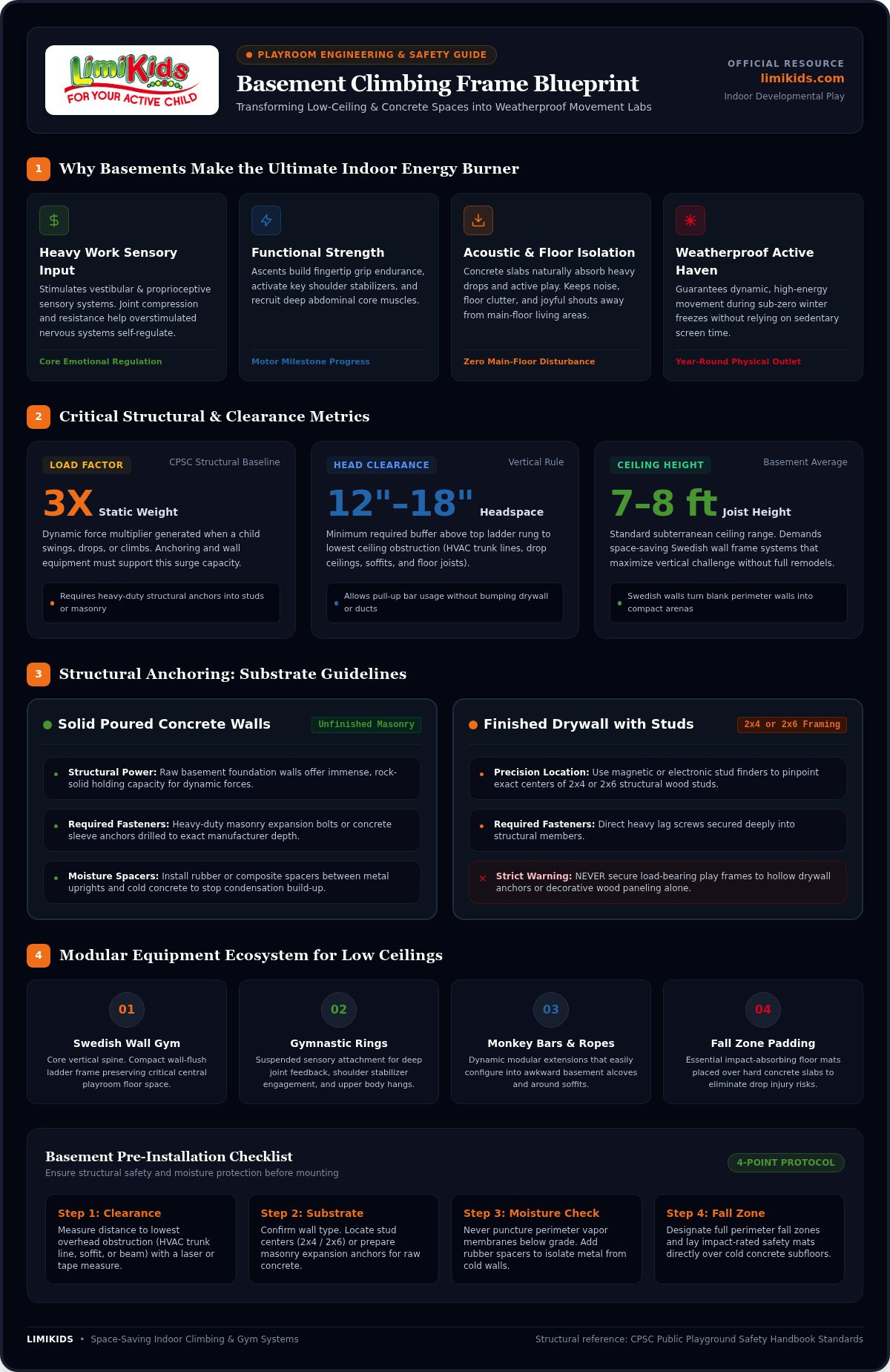
Basements present architectural hurdles you won't find on upper floors. Low clearances, structural steel I-beams, drop ceilings, and boxed-in ductwork all eat into vertical space. A child swinging or climbing generates dynamic loads up to three times their static weight. Selecting the right climbing frame for basement play requires factoring in dynamic forces, building materials, and physical overhead obstacles before drilling a single hole.
Navigating Low Ceilings and Overhead Obstructions
Grab a laser measure or tape and check the clearance to the lowest obstruction, not just the subfloor overhead. HVAC trunk lines and soffits often hang well below standard seven-to-eight-foot floor joists. You need at least 12 to 18 inches of headspace above the top ladder rung so kids can use pull-up bars without bumping their heads against ducts or drywall. Choosing compact systems designed specifically around lower vertical clearances ensures active clearance without requiring structural home renovations.
Mounting Surfaces: Poured Concrete vs. Stud Framing
Anchoring techniques depend entirely on whether your walls are finished or raw masonry. Never secure load-bearing play equipment into hollow drywall anchors or decorative wood paneling alone. Fasteners must bite deep into structural elements:
- Solid Poured Concrete: Unfinished foundation walls offer immense structural holding power. Use heavy-duty masonry expansion bolts or concrete sleeve anchors drilled to the exact depth recommended by the manufacturer.
- Finished Stud Walls: Run a magnetic or high-precision electronic stud finder across the drywall to locate the centers of 2x4 or 2x6 wood framing studs. Fasten mounting brackets directly into these structural members using heavy lag screws.
- Moisture and Vapor Barriers: Basement walls run cooler and hold dampness. Avoid puncturing perimeter waterproofing membranes below grade, and ensure small rubber or composite spacers sit between raw metal uprights and cold concrete to prevent condensation buildup.
Safe installation keeps indoor play exciting rather than nerve-wracking. Principles outlined in the CPSC Public Playground Safety Handbook emphasize structural stability and secure anchoring above all else. If you are balancing awkward corner posts and low ductwork, investing in dedicated space-saving indoor climbing equipment gives your kids maximum vertical challenge while maintaining rock-solid structural integrity.
Key Types of Indoor Climbing Frames for Basement Layouts
Every basement floor plan has quirks, from support columns to narrow perimeter pathways. Selecting an indoor climbing frame for basement layouts comes down to balancing floor footprint against vertical wall utility. Bulky, static playsets monopolize precious open area, while smart wall-mounted or modular designs preserve functional living zones.
Swedish Wall Gyms: The Ultimate Space-Saving Wall Unit
Wall-mounted stall bars stick out less than two feet into your room, leaving the floor completely open when not in use. These vertical timber rungs provide a rock-solid foundation for chin-up bars, incline boards, and dip stations. Check our comprehensive guide on choosing an indoor home gym for kids to see how vertical wall systems optimize basement recreational space.
Modular Jungle Gyms and Monkey Bar Systems
Expanding your setup beyond basic ladders introduces overhead horizontal rungs that develop brachiation skills, spatial awareness, and upper-body endurance. Modular metal designs let you swap out suspended accessories like gymnastic rings, cargo climbing nets, and sensory swings as interests shift. Review our wooden vs metal indoor jungle gym breakdown to evaluate structural weight limits and durability over concrete floors.
Montessori-Inspired Low Climbing Systems for Toddlers
Early walkers and preschoolers benefit from low-profile climbing arches, folding triangles, and reversible balance ramps. These ground-level wooden pieces foster confidence and gross motor exploration without pushing critical fall heights beyond safe limits. Discover age-aligned designs through our guide to Montessori play equipment for active home exploration.
- Material Selection: Solid hardwood rungs offer warm sensory tactile feedback, whereas powder-coated steel uprights deliver maximum rigidity and heavy dynamic weight ratings.
- Accessory Versatility: High-grade rope ladders, swings, and climbing ropes keep older kids physically challenged across developmental growth spurts.
- Clearance Compliance: Align your apparatus spacing with CPSC home playground safety standards to eliminate pinch points and head entrapment gaps.
Selecting the best climbing frame for basement recreation means matching the framework directly to your family's daily routine. Compact, multi-functional wall stations let your children build upper-body strength while your basement stays organized, open, and adaptable.
Essential Safety Standards, Impact Mats, and Fall Zones
Unforgiving concrete subfloors demand uncompromising impact protection. A residential climbing frame for basement recreation must be paired with safety surfacing that accounts for critical fall heights. According to CPSC historical injury data, falls account for roughly 80 percent of all playground-related injuries at home. When the surface beneath is unyielding poured foundation slab, standard household area rugs or decorative foam puzzle tiles simply won't cut it.
Protecting Against Concrete Subfloors
Drop zones require dedicated shock absorption. Look for gymnastics-grade landing mats constructed with cross-linked polyethylene foam cores wrapped in heavy-duty, puncture-resistant vinyl. This dense closed-cell composition disperses downward kinetic energy instantly upon impact. Check that mats include a textured rubber or non-skid backing so they won't slide across slick sealed concrete during aggressive landings.
Establishing Clear Perimeter Fall Zones
Surrounding clearance is just as critical as the padding directly underfoot. Position your equipment so that kids have a dedicated perimeter free of secondary impact hazards:
- Six-Foot Clearance Buffer: Follow standard safety recommendations by extending impact surfacing at least six feet beyond all active climbing, hanging, and dismount edges.
- Obstacle Elimination: Clear low coffee tables, storage bins, shelving units, and structural basement support posts from the trajectory of swings and dismount zones.
- Routine Hardware Audits: Set a calendar reminder every thirty days to inspect bracket tightness, ensure wall anchors haven't backed out under dynamic loads, and check rope attachments for surface wear.
- Supervised Play Rules: Establish clear boundaries early, such as requiring one climber per overhead ladder at a time and enforcing two-handed grips on high transfers.
Transforming your lower level into a worry-free activity center is straightforward with the right protective setup. Pair your wall gym with safety mats and shock-absorbing flooring by exploring kids fitness equipment engineered for home safety, ensuring every daring jump ends on a soft, confidence-building landing.
How to Choose the Right Basement Climbing Frame for Your Home
Every household has distinct developmental targets, structural boundaries, and play styles. Picking the ideal climbing frame for basement recreation requires looking past generic store displays to examine real daily use. Begin with a thorough audit of your available floor space, structural anchoring points, and your children's physical trajectory over the next several years.
Matching Equipment to Age and Skill Progression
Toddlers and preschoolers need closely spaced rungs, low balance ramps, and stable handholds that build early coordination without inducing fear. As kids enter grade school, their growing motor skills demand heavier resistance. They crave challenging overhead monkey bars, gymnastic rings, and climbing ropes that test grip strength and spatial agility. Choosing high-capacity frames ensures the setup handles vigorous teenage workouts and multi-child play without losing structural rigidity.
Long-Term Value: Adaptability and Modular Upgrades
Static playsets quickly lose their appeal once children outgrow basic movements. Modular indoor play systems solve this by evolving alongside your family. Swap in hanging accessories, attach new rope ladders, or reconfigure gymnastic elements as your children gain confidence and strength. A well-engineered climbing frame for basement play turns an empty room into an enduring athletic hub that serves your home for years.
- Ceiling Height Compatibility: Confirm the frame height clears overhead floor joists and ductwork while leaving sufficient overhead room for safe pull-ups.
- Structural Material Quality: Select high-gauge powder-coated steel or solid furniture-grade hardwood finished with non-toxic, child-safe coatings.
- Certified Weight Capacities: Prioritize equipment engineered with heavy dynamic ratings to accommodate simultaneous play among siblings and friends.
- Modular Expansion Potential: Verify that the base unit accepts interchangeable add-ons down the road to keep play challenging and fresh.
Bring purpose-built fitness into your living space with gear designed specifically for lower residential clearances. You can browse certified indoor home gyms engineered to support safe, active indoor exploration across every stage of your child's physical development.
Transform Your Basement into an Everyday Adventure Zone
Low ceilings, exposed HVAC ductwork, and solid concrete slabs don't have to sideline daily physical development. By measuring overhead clearances carefully, anchoring into structural framing, and laying down certified high-density crash mats, you eliminate the safety guesswork. Selecting the right climbing frame for basement playrooms unlocks boundless active movement while preserving open floor space for the entire family.
LIMIKIDS has spent over 15 years helping Canadian families stay active indoors through freezing winter months. Engineered with high structural integrity and heavy dynamic weight capacities, our systems feature space-conscious footprints tailored directly to lower residential basements. Whether your kids are scaling vertical Swedish rungs, traversing monkey bars, or hanging from sensory ropes, they will build functional strength and lasting confidence right at home. Ready to transform underused square footage into an active developmental haven? Explore certified indoor climbing frames at LIMIKIDS and bring energetic play home today!
Frequently Asked Questions
Can you install a climbing frame in a basement with low ceilings?
Yes, you can install a compact climbing frame for basement spaces even with ceilings as low as seven feet. Space-saving Swedish wall gyms and low-profile modular structures are engineered specifically for residential basements with low clearance. Make sure to position the unit away from low-hanging ductwork or drop-ceiling tiles. This setup guarantees that children have ample overhead headroom when executing pull-ups or reaching the top ladder rungs safely.
How do you anchor an indoor climbing frame into basement concrete walls?
Anchoring into solid concrete requires heavy-duty masonry expansion bolts or concrete sleeve anchors rather than standard wall screws. First, pre-drill pilot holes using a hammer drill and a masonry bit sized precisely to the anchor manufacturer's specifications. Clear dust completely from each hole before tapping the sleeve into place. Tighten the bolts firmly against the frame brackets to create an unyielding mechanical bond that withstands heavy dynamic swinging loads.
What kind of safety mats are needed for basement climbing frames?
Basement setups require dense, gymnastics-grade crash mats made with cross-linked polyethylene foam. Standard play tiles or thin yoga mats don't absorb the blunt shock of falls onto unyielding concrete slabs. Look for folding mats at least two inches thick with heavy-duty vinyl covers. Non-skid rubber backing is equally vital, as it stops the landing surface from skidding out across polished or sealed basement floors during active dismounts.
Are indoor climbing frames safe for toddlers and older children together?
Indoor climbing frames are safe for mixed-age play when you establish clear supervision boundaries and staggered activities. Toddlers should use low-level balance rungs, sensory ropes, and climbing arches, while older siblings tackle overhead monkey bars. Avoid allowing multiple children on the same hanging component simultaneously. Choosing a modular unit allows you to adjust accessory heights to match differing gross motor milestones and prevent accidental collisions during high-energy play sessions.
How much clearance space is required around a basement climbing frame?
You need at least six feet of unobstructed clearance extending in all directions around the active perimeter of your climbing frame for basement playrooms. This safety buffer must remain completely free of structural posts, storage shelving, low tables, and hard toy bins. Maintaining this open perimeter ensures kids land entirely on shock-absorbing mats if they swing, drop, or leap off the apparatus during fast-paced play.
Can a climbing frame be installed on unfinished basement ceiling joists?
Yes, exposed dimensional lumber floor joists provide exceptional structural anchor points for suspended indoor play equipment. Fasten overhead brackets or cross-bracing timbers using heavy structural lag screws centered directly into solid wood joists. Never anchor climbing loads into engineered I-joist flanges or thin web panels without consulting manufacturer load guidelines. Always avoid hanging play gear from plumbing lines, electrical conduits, or sheet metal HVAC trunk lines.
How do I protect the climbing frame from basement humidity or dampness?
Prevent basement dampness issues by installing rubber isolation pads beneath steel posts and maintaining indoor relative humidity below fifty percent. Running a reliable basement dehumidifier prevents mold growth on natural wood components and stops surface condensation on powder-coated metal. Keep equipment mounted slightly off exterior masonry walls if there is any history of foundation moisture or vapor penetration through subterranean concrete.