






Encouraging Risky Play Safely: A Practical Guide for Parents
What if keeping play safe doesn’t mean removing every challenge? When a child tests a climb or figures out how to land, they’re learning to judge their abilities. It’s natural to worry about a fall. Encouraging risky play safely means preserving age-appropriate challenges while reducing hazards a child can’t recognize or manage.
If you’ve wondered whether to step in, stand back, or change the setup, you’re not alone. The goal isn’t to eliminate uncertainty or leave children to fend for themselves. It’s to make thoughtful choices that let them explore while you stay ready to support them.
This guide shows you how to match challenges to your child’s age, abilities, and confidence, and how to distinguish them from genuine hazards. You’ll learn to prepare play spaces, supervise without taking over, and use simple prompts that help children pause, assess, and try again. Whether play happens at home or uses indoor climbing equipment, small, considered steps can support confidence, judgement, and physical skills.
Key Takeaways
- Recognize the difference between a child-led challenge and a hazard that calls for you to step in.
- Explore different forms of risky play, from climbing and speed to rough-and-tumble play, at a pace that suits your child.
- Use a quick caregiver checklist to observe, scan the space, adjust the challenge, and supervise thoughtfully.
- Make indoor play more engaging with small, adjustable movement challenges. Equipment can offer opportunities, but it doesn’t replace hazard checks or supervision.
- Use practical ways of encouraging risky play safely to help children practise confidence and judgement.
What Does Encouraging Risky Play Safely Actually Mean?
Watching a child test their limits can feel thrilling and unsettling at the same time. They may climb higher, move faster, or try a new way to balance, while you picture what could go wrong. Encouraging risky play safely doesn’t mean ignoring that concern. It means making room for manageable challenges while acting on hazards a child can’t reasonably see or handle.
A challenge is a play opportunity a child can attempt with support; a preventable hazard is an unmanaged danger that calls for an adult to step in. The aim isn’t to remove every challenge or promise there’ll never be a bump or fall. Instead, consider the child, the activity, and the play space, then adjust or intervene when needed.
Risk is not the same as a hazard
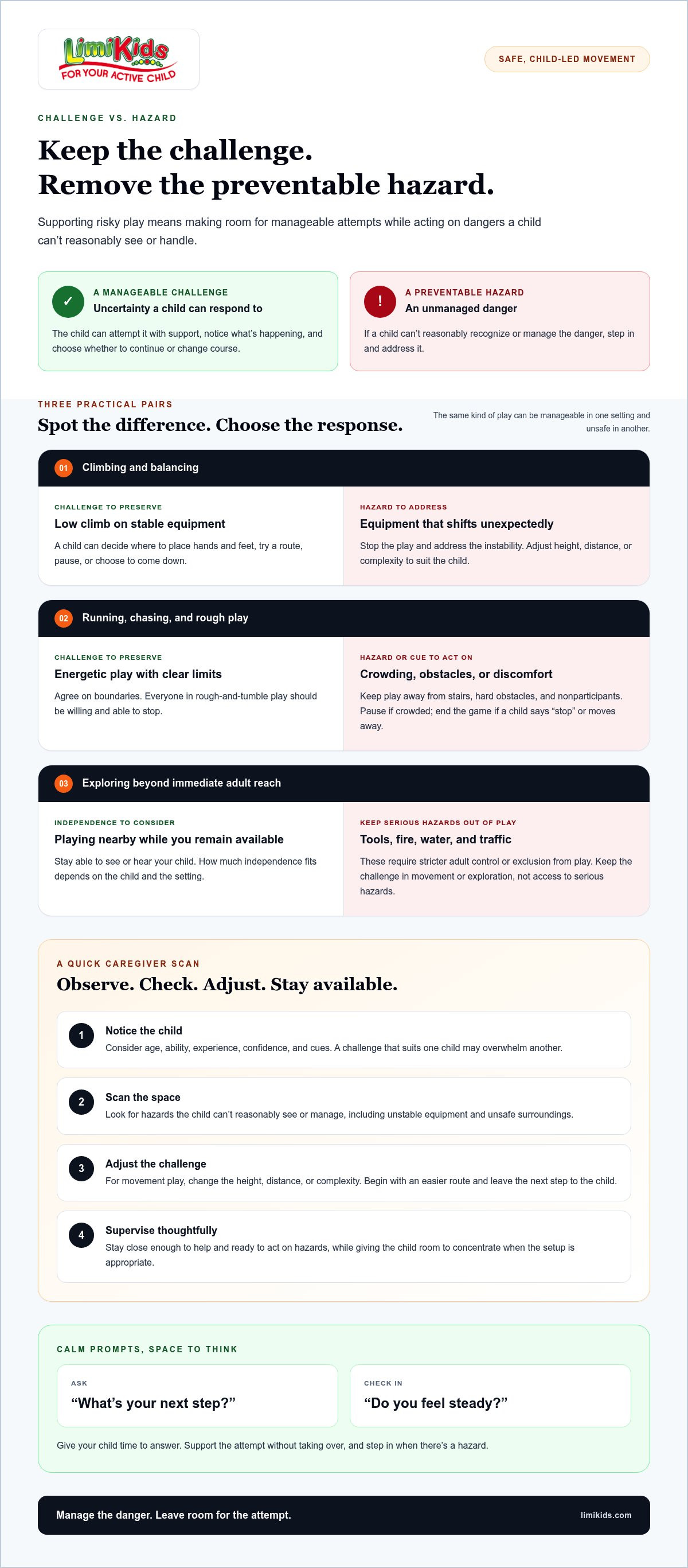
A risk involves uncertainty, but a child may be able to notice the challenge and respond to it. A low climb on stable equipment, for example, lets a child decide where to place their hands and feet. Unstable equipment is different: it can shift unexpectedly, so stop the play and address the danger. The same activity can be manageable in one setting and unsafe in another.
Age, ability, experience, and confidence all matter. A challenge that feels exciting and achievable for one child may feel overwhelming to another. Stay close enough to help, and don’t assume a child can judge a hazard just because they’re eager to try.
Why children seek physical challenges
Play gives children room to explore, make choices, and engage with the world around them. For a broad introduction to the role of play in development, see the overview of play as an activity. Risky play adds excitement and uncertainty, but it isn’t the only valuable kind of play, and no child needs to try every type.
During a climb, balance attempt, or energetic movement game, a child can try, pause, and adjust. They might test a handhold, reconsider a step, or choose to come down. These moments offer practice in movement and decision-making, without guaranteeing a particular outcome. They let children engage with their abilities in real time.
Support the attempt without taking over. Try calm prompts such as “What’s your next step?” or “Do you feel steady?” Then give your child time to answer. Thoughtful supervision keeps you available to act on hazards while leaving space for child-led exploration.
Which Types of Risky Play Can Children Explore?
Risky play can look different from one child to the next. Common examples include exploring height, speed, tools, energetic physical play, or spaces just beyond an adult’s immediate reach. These are possibilities, not a checklist every child needs to complete. The Canadian Paediatric Society discusses how outdoor risky play can be essential for healthy child development, while emphasizing the importance of considering children’s abilities and surroundings.
The same activity can feel manageable for one child and too difficult for another, depending on their experience, confidence, abilities, and environment. Follow your child’s cues. A challenge should invite an attempt, not push them past what they can handle.
Climbing, balancing, and movement challenges
Climbing a low, stable structure, balancing along a wide surface close to the ground, or stepping between nearby supports lets children practise movement at their own pace. Adjust the challenge by changing the height, distance, or complexity. Start with an easier route, then let your child decide whether to try a little more. Stay close if they’re new to the activity or need help; give them room to concentrate when the setup is appropriate and they seem steady. Indoor climbing equipment can provide an option for active play at home, with supervision and hazard checks still essential.
Speed, rough play, and exploring boundaries
Running and chasing bring excitement, but they need clear boundaries. Set rules about where children can move, keep play away from stairs, hard obstacles, and people who aren’t participating, and pause if the space becomes crowded. For rough-and-tumble play, everyone involved should be willing and able to stop. Agree on simple limits, watch for signs that someone is uncomfortable, and end the game when a child says “stop” or moves away.
Exploring beyond immediate adult reach might mean a child plays nearby while you remain able to see or hear them. How much independence fits depends on the child and the setting. Tools, fire, water, and traffic require stricter adult control or exclusion from play, since children may not be able to recognize or manage those dangers. Keep the challenge in the movement or exploration, not in access to serious hazards.
For a movement challenge at home, indoor climbing structures and sensory play equipment can create opportunities to adapt play to your space and child. Explore indoor play equipment for active movement as one option, not a replacement for attentive supervision.
Does Risky Play Mean Accepting Injuries? Separating Challenge from Danger
No. Supporting a child’s attempt doesn’t mean ignoring hazards, overlooking distress, or treating an injury as proof that play was worthwhile. It means allowing room for a manageable challenge while staying ready to reduce dangers adults can anticipate. A child might practise deciding whether to continue a climb, for example, but unstable equipment or an unsafe landing area calls for adult action.
Trying, pausing, and changing course can give children opportunities to practise movement, judgement, and communicating their limits. But risky play doesn’t prevent injuries or guarantee confidence or resilience. Falls and bumps can happen, so prepare the space, supervise in a way that fits the activity, and respond seriously if a child is hurt. Encouraging risky play safely means balancing meaningful challenge with hazards you can prevent.
When to watch, coach, or step in
Use your child’s actions and the situation to guide your response. If they’re focused, appear capable, and can pause or change course, watching quietly may be enough. If a small adjustment could help, offer a calm prompt such as, “Can you find a steadier place for your foot?” Give them a moment to think and answer.
Step in if danger is immediate, a clear boundary is crossed, or your child needs help. That might mean stopping play near a sharp edge or moving another child out of the path of a fast-moving game. Intervening doesn’t mean the challenge has failed. You can make the setting safer, then decide whether play can continue in an adjusted form.
Respect different children and changing circumstances
There’s no single risk level that suits every child. Consider age, experience, confidence, disability, fatigue, and the signals your child gives you. A tired child may have more difficulty managing a familiar movement challenge, while a child who uses mobility supports may need a different setup to explore it comfortably. Focus on what the individual child can do and what support the activity requires.
Conditions matter, too. A route that feels manageable when the space is clear may become harder when it’s crowded, distracting, slippery, or wet. Pause and reassess instead of relying on how play went last time. If you have questions about your child’s development, movement, or ability to take part in an activity, speak with a qualified health professional. The aim is thoughtful support, not pressure to attempt a challenge that doesn’t feel right for your child.
How to Encourage Risky Play Safely: A Practical Caregiver Checklist
A quick routine can help you make steady decisions without taking over the play. Remember five steps: observe, scan, assess, adapt, supervise. Repeat them whenever the activity or conditions change. Encouraging risky play safely doesn’t mean stopping whenever you feel uncertain. First consider whether a small change to the space or challenge can keep the play manageable.
- Observe: Notice your child’s energy, focus, confidence, and cues. Are they choosing the challenge, or do they seem overwhelmed or tired?
- Scan: Look over the play area and equipment for hazards before play and whenever conditions change.
- Assess: Consider what the child is trying, what could go wrong, and whether they can pause or change course.
- Adapt: Adjust the setup, clear an obstacle, or make the challenge simpler if that keeps play appropriate.
- Supervise: Stay available at a distance that fits your child, the activity, and the surroundings.
Stop and reset if equipment is broken or unstable, the surface is unsafe, or there’s immediate danger. Pause the activity, address the issue, and resume only if the hazard is resolved and the play still makes sense for your child. Uncertainty alone doesn’t always require ending play; sometimes changing the environment is enough.
Prepare the play space before activity begins
Check that equipment appears stable and follow its current instructions for setup and use. Clear nearby furniture, toys, and other obstacles. Keep play away from windows, sharp edges, cords, and other hazards. Consider the space around a climb or movement activity, including what’s beneath and beside it. Choose a clear, suitable landing area, but remember that no surface can promise injury prevention.
For indoor climbing equipment, use the manufacturer’s guidance and make hazard checks part of the routine. Repeat the check if the setup or surroundings have changed.
Use supervision that supports independence
Stay close enough to respond, then adjust your distance to your child’s age, ability, and the activity. A new or challenging movement may call for closer attention; familiar play in a clear space may allow more room. Set a simple boundary, such as “Stay on this side of the room,” then let your child try.
Offer questions, not a running commentary: “Does your grip feel steady?” or “What’s your next move?” Give your child time to notice their balance and decide what to do. For home play spaces that invite adjustable movement challenges, explore indoor climbing equipment as one play option, alongside supervision and regular hazard checks.
Make Indoor Risky Play Work at Home with Progressive Challenges
Indoor play doesn’t need to turn your living room into an obstacle course. Everyday routines can offer small movement challenges: step over a rolled towel placed on a clear floor, reach for a toy while standing, or try a simple movement game in an open space. Keep the setup manageable and change one element at a time, such as the distance to reach or the number of steps. A challenge should invite your child to explore, not require them to push through fatigue or worry.
Encouraging risky play safely at home starts with your child’s interests and abilities. Offer a choice: would they rather practise balancing, try a climbing activity, or invent a movement game? Let them set the pace. If they seem tired, overwhelmed, or unsure, pause or simplify the activity. Climbing structures and sensory play equipment can add options, but they aren’t prerequisites for active, meaningful play.
Build challenge gradually with indoor play
Begin with a version your child can attempt comfortably, then adjust one feature if they’re ready. For example, they might first step over a low object, then try a slightly longer step while staying on a clear, stable surface. Keep the change modest, and let your child decide whether to continue. If the activity stops feeling manageable, return to an easier version or take a break.
Choose equipment and routines with safety in mind
Think about your available space, your child’s abilities, and how closely you can supervise before choosing an activity or equipment. Follow the manufacturer’s instructions for setup and use, and consider whether the equipment suits your child. Keep surrounding areas clear and check the play space before each session. An indoor home gym guide can help you consider what to look for in an indoor home gym for kids, while a related indoor climbing frame with slide guide explores another equipment category.
Equipment creates a play opportunity, not a substitute for attentive supervision or hazard checks. Stay available, observe how your child responds, and adapt the challenge as needed. If you’re looking for ideas for an active play space at home, explore indoor play equipment and choose options that fit your family’s space and play needs.
Make Room for Confident, Active Play
Encouraging risky play safely isn’t about removing every challenge. It’s about matching play to your child, checking for preventable hazards, and staying close enough to respond while leaving room for them to try. Observe their cues, adjust the setup when needed, and step in when there’s immediate danger. Small, age-appropriate challenges can give children space to practise movement and decision-making at their own pace.
You don’t need a room full of equipment to make active play part of home life. Familiar routines and clear spaces can offer simple ways to move, climb, and balance. If you’d like more options, LIMIKIDS offers indoor climbing structures, Swedish wall gyms, monkey bars, and sensory play equipment to help families create active play spaces at home. Whatever the setup, equipment is a play opportunity, not a substitute for hazard checks and age-appropriate supervision.
Explore indoor play equipment for active play at home, and find options that fit your family’s space and play needs.
Frequently Asked Questions
Is risky play safe for children?
Risky play can be supported thoughtfully, but no activity is completely free from injury risk. The aim is to preserve a manageable challenge while reducing preventable hazards through suitable space, equipment checks, and supervision. Match the activity to your child’s abilities and cues. If the setting becomes unsafe or danger is immediate, pause the play and address the problem before deciding whether it can continue.
What is the difference between risky play and dangerous play?
Risky play offers a challenge a child can attempt and respond to, while dangerous play involves hazards they can’t reasonably recognize or manage. A child climbing stable, low equipment may be testing their balance and choices. An unstable structure or a climb beside a sharp edge introduces a preventable danger. Consider the child, activity, and surroundings together; the same play can be appropriate in one setting and unsafe in another.
At what age can children start risky play?
There isn’t one age when every child should begin a particular kind of risky play. Start with movement challenges suited to your child’s current abilities, understanding, and confidence, and adjust your supervision accordingly. A simple balance attempt may suit one child but overwhelm another of the same age. For equipment-based play, follow the manufacturer’s age and use guidance. If you have developmental concerns, ask a qualified health professional for individual advice.
How can I encourage risky play without hovering?
Prepare a clear play area, set a simple boundary, and stay close enough to respond if needed. Then give your child time to try instead of offering instructions at every step. Watch their focus and body cues. A calm question such as “Do you feel steady?” can prompt them to assess their next move without taking over. Move closer or step in if the activity changes, a hazard appears, or they need help.
Can indoor climbing equipment support risky play?
Yes. Indoor climbing equipment can give children a chance to explore climbing and movement challenges at home when the setup and activity suit their abilities. It’s an option, not a requirement for active play. Follow the manufacturer’s instructions for setup and use, check the surrounding space, and supervise in a way that fits your child and the activity. Equipment doesn’t remove the need for hazard checks or attentive adult support.
What should I do if my child gets scared during risky play?
Pause and respond calmly. Let your child know they can stop, come down, or take a break; don’t pressure them to finish or try again. If they need help, support them safely, then consider whether anything about the activity or environment felt uncomfortable. You can make the challenge simpler or choose a different activity. A child’s hesitation is useful information, and it’s okay to end play for now.
Should parents let children climb higher as they gain confidence?
Not automatically. Confidence is one factor, but also consider your child’s coordination, ability to pause or change course, the stability of the equipment, and the space around it. If you adjust a challenge, change one element at a time and stay within the equipment’s manufacturer guidance. Let your child choose whether to try, and watch for signs of uncertainty or fatigue. Stepping back to an easier level is always a reasonable choice.