






Floor-to-Ceiling Tension Mounted Gym: A Parent’s Buying Guide
What if the best indoor climbing setup for your child isn’t the one with the most features, but the one your room can safely support? A floor to ceiling tension mounted gym can make active play possible without wall anchors, but only when the floor, ceiling, room height, and installation conditions suit the exact model. Before choosing one, measure the space and read the product’s requirements.
It’s natural to wonder whether the structure will stay secure, whether it will fit your room, and how it compares with wall-anchored or freestanding options. Start with the room and the product instructions, rather than assuming that a no-drill design fits every home.
This guide explains how tension-mounted gyms work and what to check before choosing one, including floor and ceiling suitability, clearance, installation, and play space. You’ll also learn how to compare mounting styles by their space requirements and flexibility. Then you can weigh those options against other indoor climbing equipment, including space-conscious play systems and Swedish wall gyms, to find a setup that suits your home and your child’s interests.
Key Takeaways
- Understand how a floor to ceiling tension mounted gym uses pressure to stay in place, and why the floor and ceiling still need to meet the product’s requirements.
- Measure the ceiling height, check floor and ceiling conditions, and plan the equipment’s placement and play space.
- Compare tension-mounted, wall-anchored, and freestanding gyms by installation needs, permanence, and room fit.
- Review the exact model’s adjustment range, materials, components, accessory compatibility, and product documentation.
- Compare indoor climbing, Swedish wall gym, and Montessori-inspired options to find equipment suited to your home and your child’s play.
What Is a Floor-to-Ceiling Tension Mounted Gym, and How Does It Work?
A floor to ceiling tension mounted gym is held upright by pressure between the floor and ceiling. Rather than fastening the main structure to a wall, its product-specific mechanism creates and maintains tension. This can provide an alternative mounting option for indoor climbing and play, but “no-drill” doesn’t mean “fits every room.” The surfaces, measurements, and setup must all meet the exact model’s requirements.
Compare this style with two other common options. A wall-anchored gym is secured to a wall using the specified fixings, while a freestanding frame rests on its own base. Each has different space and installation needs. Don’t assume one style is automatically safer or more suitable. The product details and your home determine the fit.
How does a floor-to-ceiling tension system stay in place?
Depending on the design, adjustable components press between the floor and ceiling to hold the frame in position. Follow the manufacturer’s instructions for placement and adjustment. Uneven, delicate, or incompatible surfaces may not provide the intended support. The ceiling height must also fall within the model’s stated adjustment range.
Before choosing a location, check the product’s requirements for both surfaces. A ceiling or floor that looks solid may still be unsuitable for a particular frame. If the room doesn’t meet the model’s installation conditions, don’t force the fit. Consider another location or compare a different mounting style.
What activities can a tension-mounted indoor gym support?
The activities a gym supports depend on what the specific structure is designed and documented to do. Some models may accommodate accessories, which may be separate from the main frame. Read the product details to see what’s included, which accessories are compatible, and how each component is intended to be used.
Think about the play your child enjoys. For body-weight movement, calisthenics exercises offer context for activities such as hanging and controlled climbing. A children’s gym should only be used for activities permitted by its instructions. A family focused on climbing may prioritize different features from one interested in hanging or accessory play.
Don’t apply one product’s age guidance or capacity rating to the whole category. These limits are specific to the model, not universal standards for tension-mounted gyms. Use the guidance for the exact product and make sure its documented activities, included components, and compatible accessories suit your intended use.
Will a Tension Mounted Gym Fit Your Ceiling, Floor, and Room?
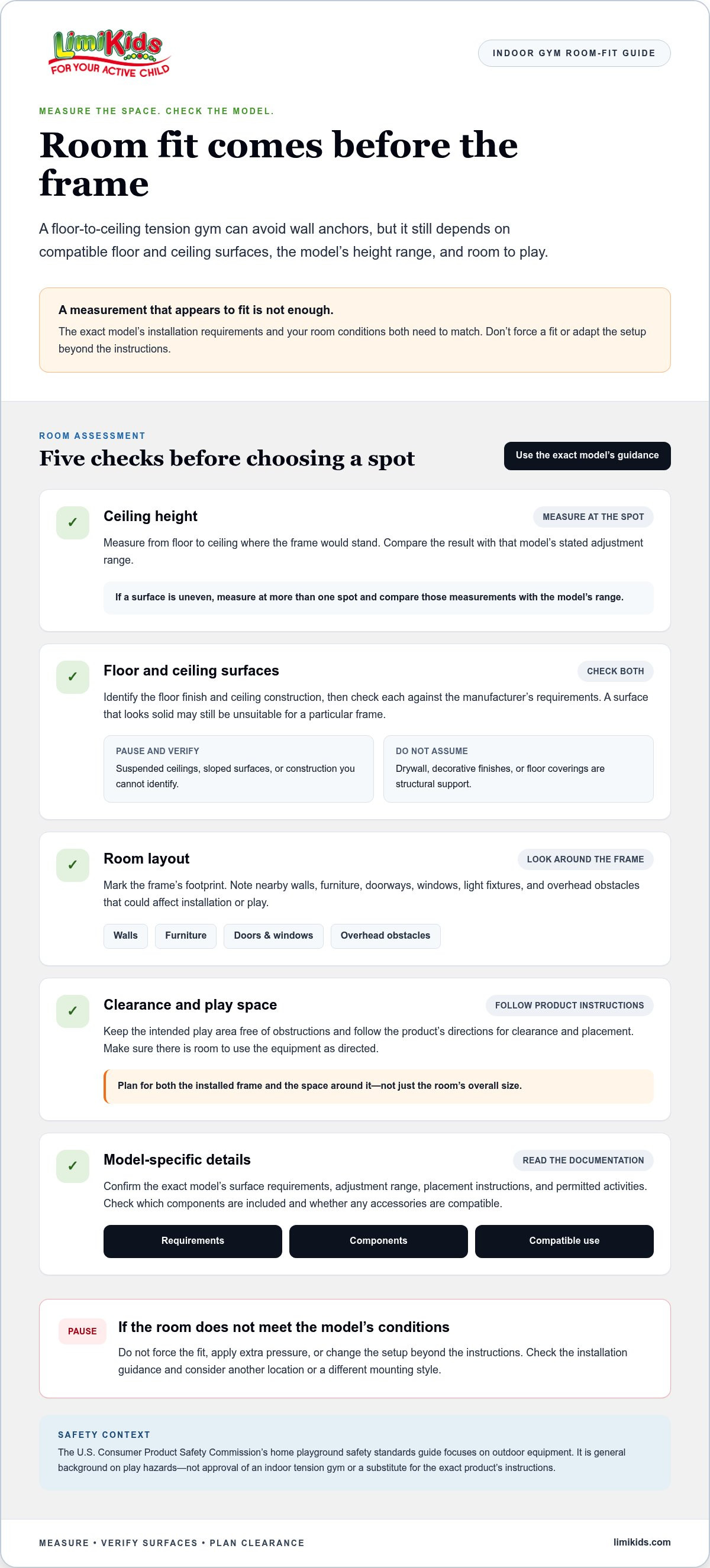
Measure the exact spot where the frame would stand rather than estimating from the overall room size. A floor to ceiling tension mounted gym must fall within the model’s height range and meet its installation requirements. A measurement that appears to fit isn’t enough if the floor, ceiling construction, or available play space is unsuitable.
Which room measurements should parents take first?
Measure from floor to ceiling at the intended installation point. If either surface is uneven, take measurements at more than one spot and compare them with the model’s stated adjustment range. Note nearby walls, furniture, doorways, windows, light fixtures, and overhead obstacles that could affect installation or play.
Quick fit check
- Height: Measure from floor to ceiling where the gym will stand. Compare the result with the exact model’s instructions and adjustment range.
- Surfaces: Identify the floor finish and ceiling construction. Check both against the manufacturer’s requirements.
- Room: Mark the frame’s footprint and note nearby furniture, doors, and overhead obstacles.
- Play space: Follow the product instructions for clearance and keep the intended play area free of obstructions.
- Placement: Check that the proposed position leaves room to use the equipment as directed.
Which ceiling and floor conditions need careful attention?
Surface material and construction affect whether a tension system is suitable. Don’t treat drywall, a decorative ceiling finish, or a floor covering as structural support. A suspended ceiling, sloped surface, or construction you can’t identify is a reason to pause and consult the product’s installation guidance before proceeding. Don’t adapt the setup beyond those instructions.
Use the exact model’s requirements for surfaces, adjustment, and placement. If any condition doesn’t match your home, don’t assume that applying more pressure or changing the position will solve the problem. The U.S. Consumer Product Safety Commission’s home playground safety standards guide focuses on outdoor equipment. Treat it as general background on play hazards, not as approval of an indoor tension gym or a substitute for the product’s instructions.
Once you’ve checked the room, compare indoor climbing options by their documented dimensions and mounting requirements. Explore indoor climbing equipment options as you consider which setup may suit your space and your child’s play.
Tension Mounted vs. Wall-Anchored vs. Freestanding Kids Gyms
Choosing a mounting style is a home-fit decision, not a contest with one winner. A floor to ceiling tension mounted gym may suit a room where you want to avoid permanent wall fixings, but it still requires compatible floor and ceiling surfaces and correct setup. Wall-anchored and freestanding designs have different installation and space considerations.
| Style | Mounting method | Room requirements | Permanence and flexibility |
|---|---|---|---|
| Tension-mounted | Pressure between floor and ceiling, using the model’s specified mechanism. | Must meet the model’s height range and surface requirements, with suitable clearance. | Can avoid permanent wall fixings where instructions allow. Still requires correct setup and compatible surfaces. |
| Wall-anchored | Secured to a wall with the specified fixings. | Depends on suitable wall structure, installation requirements, and room clearance. | More fixed in position; moving it may mean addressing the original fixings and installing it elsewhere. |
| Freestanding | Supported by its own frame and base. | Needs floor space for the footprint and the play area around it. | May be easier to reposition than an anchored system, depending on its design and instructions. |
When might a tension-mounted gym be the practical fit?
Consider this style if you’d prefer to avoid permanent wall fixings and the product is designed for your room’s surfaces. Measure the installation point and compare the floor-to-ceiling height with the model’s stated range. A no-drill design still needs proper installation and isn’t suitable for every ceiling or floor. Follow the exact setup instructions rather than assuming that pressure alone ensures a secure fit.
How do wall-anchored and freestanding gyms differ?
A wall-anchored system depends on a suitable wall structure and correct installation. A freestanding frame doesn’t need wall attachment, but its base takes up floor space and can affect furniture placement. Either style may suit your home, depending on the intended location and the equipment’s design.
Material is another point to compare. Consider how the frame’s construction and care requirements fit your household. The wooden versus metal indoor jungle gym comparison can help you weigh those material differences. For a broader framework on features and room fit, explore the indoor home gym buying guide. Compare each product’s documented requirements, then choose the style that suits your space and play goals.
Choosing a Floor-to-Ceiling Tension Gym: Parent's Guide
Choose by fit first, then features. A floor to ceiling tension mounted gym should suit your child’s abilities, your room, and the play you have in mind. Use these five checks to compare models, remembering that one product’s specifications don’t set the rules for the entire category.
- Child: Compare the product’s age guidance and stated capacity with your child’s age, size, and current abilities. A rating from another model doesn’t apply.
- Room: Measure the intended space, including ceiling height and the area around the equipment. Compare those measurements with the exact model’s dimensions and instructions.
- Mounting fit: Check that your floor and ceiling meet the product’s installation requirements. Pause if the surfaces or construction are uncertain.
- Play goals: Decide whether your child is most interested in climbing, hanging, or using accessories. Match those activities to the product’s documented features.
- Product documentation: Review setup, inspection, use, and supervision instructions before choosing.
Which product specifications should parents compare?
Compare models side by side. Review dimensions, adjustment range, materials, stated capacity, age guidance, and included components. Check whether accessories shown or mentioned are included or sold separately, and whether the manufacturer lists them as compatible. Then consider whether these details suit your child’s age and abilities, your available space, and the activities you expect the gym to support.
Printable comparison checklist: Model ______; room height ______; adjustment range ______; footprint ______; stated age guidance ______; stated capacity ______; materials ______; included components ______; compatible accessories ______; setup and supervision instructions reviewed: yes / no.
What safety and supervision details belong in the decision?
Read the full instructions before purchase, including how to assemble, adjust, inspect, and use the equipment, along with any supervision guidance. Treat age limits, capacity, and permitted activities as directions for that specific product. Don’t assume a similar-looking frame has the same requirements.
Mats and a clear landing area can be part of planning the play space, but they don’t make unsuitable surfaces acceptable or replace correct installation. Follow the model’s documented guidance for placement, installation, inspection, and supervision.
Simple decision path: Does the room meet the model’s measurement and surface requirements? If not, or if you’re uncertain, pause and compare another mounting style. If it does, check whether the documented age guidance, capacity, activities, and instructions suit your child and intended use. If they don’t, keep comparing. If they do, review the complete setup and supervision guidance before deciding.
Ready to compare other indoor play setups for your family? Explore indoor gym options and match the equipment to your child’s interests and available space.
Explore LIMIKIDS Indoor Gym Options for Your Home
The right indoor play setup matches your room, mounting needs, your child’s interests, and the product’s documented specifications. If a floor to ceiling tension mounted gym doesn’t suit your ceiling or floor, compare other indoor climbing options rather than trying to make the room fit the equipment. Use your measurements and the activities you have in mind to guide your shortlist.
Which indoor gym category matches your family’s priorities?
For active climbing and movement, compare indoor climbing equipment and Swedish wall gym options. Review each model’s dimensions, materials, intended use, and installation requirements. A compact room may call for a different configuration from a space with more room around the equipment.
Montessori-inspired equipment gives children opportunities to explore and play, with adult supervision suited to the product and child. Focus on the equipment’s documented features and whether its activities fit your child’s interests and abilities.
Compare the product details, not just the category name. Check the exact product information for dimensions, materials, included components, and intended use. This helps you see what the setup is designed to support and how it may fit your family’s routines as children grow and their play preferences change.
What should parents do before making a final choice?
Before deciding, check the intended location again. Compare your room measurements with the selected product’s specifications, including its installation conditions and the available play area. Then read the assembly, use, care, and supervision instructions. If an important detail doesn’t fit your home or intended use, return to your shortlist.
LIMIKIDS offers indoor climbing equipment, Swedish wall gyms, and Montessori-inspired play systems, along with dedicated customer support. The company ships across Canada. Compare the product information with your room measurements to make a practical choice for your family.
Ready to explore equipment that fits your family’s priorities? Explore LIMIKIDS indoor play equipment and compare the options with your child’s play goals and home in mind.
Choose an Indoor Play Setup That Fits Your Home
A floor to ceiling tension mounted gym is a potential fit only when your room’s surfaces and measurements align with the product’s instructions. Measure first, then compare tension-mounted, wall-anchored, and freestanding designs by their installation needs, space requirements, and documented specifications. Age guidance, capacity, and intended activities vary by product, so use the exact model’s information to guide your decision.
Your child’s interests matter as much as the room. Consider which indoor play category suits your family, from climbing equipment and Swedish wall gyms to Montessori-inspired play equipment. LIMIKIDS offers these indoor play options, dedicated customer support, and shipping across Canada.
Ready to compare options for your child and your space? Explore LIMIKIDS indoor play equipment. Measure your space and consider the play your child enjoys to help find a setup that works for your family.
Frequently Asked Questions
Is a floor-to-ceiling tension mounted gym safe for kids?
It may be suitable when the exact product fits your home and is used as directed, but no mounting style is automatically safe in every space. Check that the floor and ceiling meet the manufacturer’s requirements, follow the installation instructions, and perform checks as directed. Choose equipment with age guidance suited to your child, and supervise play according to the product instructions and your child’s needs.
Can you install a tension-mounted gym without drilling?
Some tension-mounted designs use pressure between the floor and ceiling instead of permanent fixings, but installation requirements vary by model. No-drill doesn’t mean the gym suits every ceiling or floor, or that setup can be skipped. Read the exact product instructions, check the required surface types and room dimensions, and follow the specified adjustment steps. If your home’s surfaces don’t meet the requirements, don’t proceed with that setup.
How do you measure for a floor-to-ceiling tension mounted gym?
Measure the floor-to-ceiling height at the exact spot where you plan to place the gym, then compare it with that model’s adjustment range. Note nearby walls, furniture, doors, fixtures, and other obstacles that could affect placement or play space. Uneven floors or ceilings and sloped surfaces need product-specific guidance. Measure carefully before choosing a model, then use its documented dimensions and instructions to assess fit.
What happens if a tension-mounted gym does not fit the ceiling?
Don’t force, modify, or install the unit outside its stated adjustment range. That would take the setup beyond the product’s documented requirements. Pause and compare another model or mounting style with dimensions that suit your room. If you’re unsure about the ceiling’s construction or whether it meets the product’s conditions, resolve that uncertainty before installation, not after the gym is in use.
Are tension-mounted gyms better than wall-mounted or freestanding gyms?
There’s no universally best style. Tension-mounted systems depend on compatible floor and ceiling surfaces; wall-anchored gyms depend on suitable wall structure and specified installation; freestanding frames need enough floor space for their footprint. Compare each model’s requirements with your room layout, installation preferences, product documentation, and your child’s intended play. The best fit is the option your home can accommodate as directed.
What should parents check before buying a tension-mounted kids gym?
Check the ceiling height, floor and ceiling compatibility, adjustment range, stated capacity, age guidance, included components, assembly instructions, and supervision requirements. Compare the documented activities with your child’s abilities and the space available for play. Specifications differ by model, so don’t assume one gym’s age range, capacity, or accessories apply to another, even if the designs look similar. Use the exact product details to guide your choice.