






The Ultimate Guide to Choosing an Indoor Home Gym for Kids in 2026
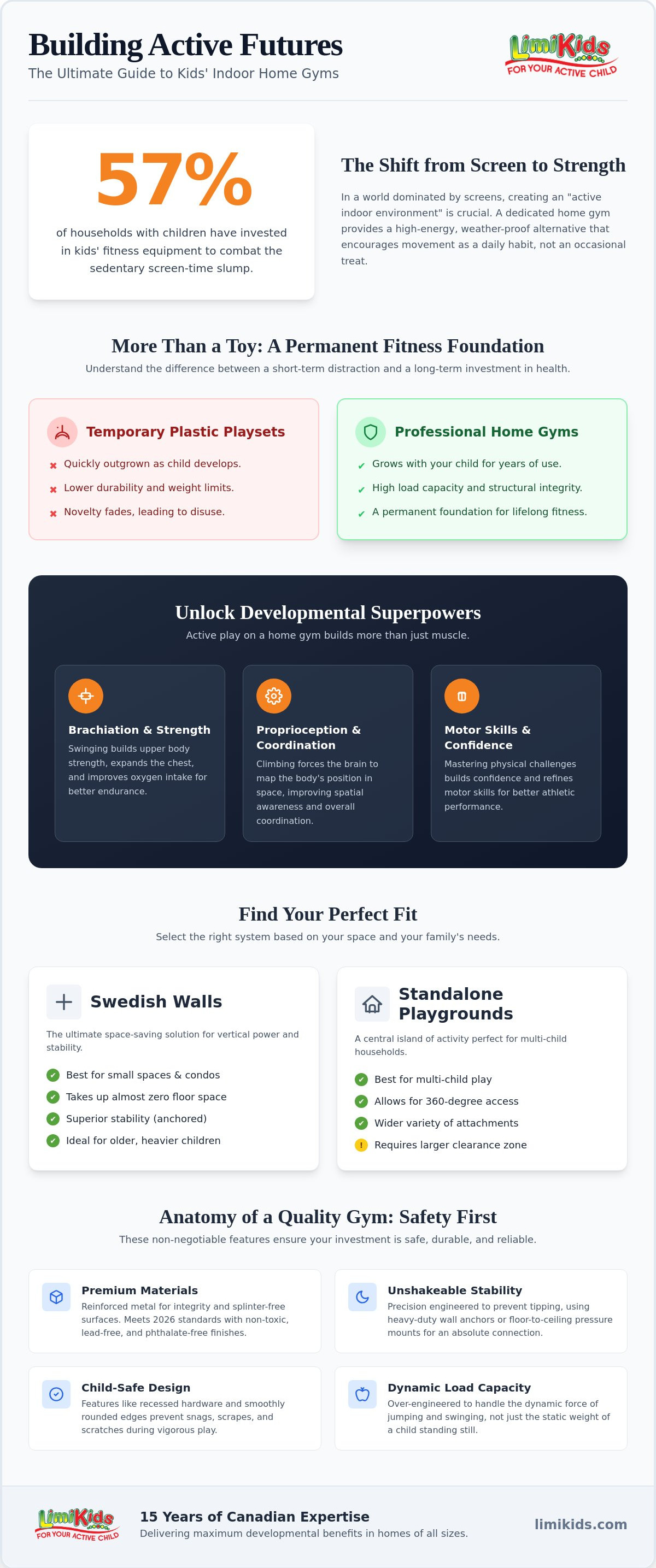
Did you know that 57% of households with children have now invested in child-specific fitness equipment to combat the sedentary screen-time slump? It’s a massive shift toward prioritizing physical development right inside the home. You want your kids to stay active and build confidence, but Canadian winters and flimsy, cluttered playrooms often make that feel impossible. Finding a reliable indoor home gym for kids shouldn't be a guessing game when your child's safety and growth are on the line.
We’re here to help you change the game. This guide reveals how to choose premium equipment that transforms your space into a year-round active play zone. You’ll discover how to build their motor skills and coordination using systems that are actually built to last. We will walk you through the updated 2026 safety standards, space-saving Swedish wall systems, and the best ways to ensure your investment grows alongside your child. Let’s turn that restless energy into real physical achievement.
Key Takeaways
- Understand why a professional indoor home gym for kids is a permanent fitness foundation that outperforms temporary plastic playsets.
- Identify the critical material choices and stability features that guarantee structural integrity and prevent equipment tipping.
- Master your floor plan by learning how to calculate clearance zones and choose the right gym size for your child's age.
- Protect your investment and your children with essential tips on secure wall-mounting and impact-absorbing safety mats.
- See how 15 years of Canadian-specific expertise ensures your home gym delivers maximum developmental benefits even in small spaces.
Defining the Indoor Home Gym: More Than Just a Playroom Addition
Stop thinking of play equipment as a temporary distraction. An indoor home gym for kids is a multi-functional climbing and fitness structure designed to turn your living space into a powerhouse of activity. Unlike the temporary plastic playsets found in big-box stores, these systems are permanent installations built for durability and growth. They represent a shift toward "active indoor environments" where movement is the default, not the exception. In a world where screen time is the biggest competitor for a child's attention, these gyms provide a high-energy alternative that works regardless of Canadian weather or outdoor conditions.
High-quality gym systems bridge the gap between simple toys and professional athletic equipment. While modern playgrounds offer great outdoor benefits, having a dedicated fitness zone inside your home ensures that your child’s physical development never hits a seasonal plateau. This is about creating a reliable foundation for health that justifies the investment through years of use rather than months of novelty.
The Developmental Science: Brachiation and Motor Skills
Physical growth is driven by challenge. Brachiation, the act of swinging from one handhold to the next using only arm strength, is a critical component of these systems. It does more than build impressive upper body strength; it expands the chest cavity and improves oxygen intake. Climbing and swinging also force the brain to map the body's position in real-time. This builds proprioception, which is the internal sense that tells your brain where your limbs are in space without you having to look at them. These movements improve spatial awareness and fine motor skills, setting the stage for better athletic performance and daily coordination.
This coordination is the foundation for navigating complex environments in the great outdoors. If you're ready to put those new skills to use on a family adventure in Iceland, click here to explore the rugged highland tours offered by Kiddi's Travel.
Swedish Walls vs. Standalone Playgrounds
Choosing between a Swedish wall and a standalone system depends entirely on your home's footprint and your family's needs. Swedish walls are vertical powerhouses. They mount directly to the wall or floor-to-ceiling, taking up almost zero floor space when not in use. This makes them the ultimate choice for condos or smaller suburban homes where every square foot counts. Because they are anchored to the home's structure, they offer superior stability for older, heavier children who need equipment that won't budge during a vigorous workout.
Standalone playgrounds, by contrast, are often better for multi-child households. They allow for 360-degree play and can accommodate several kids climbing at once. While they require a larger "clearance zone" to ensure safety, they offer a wider variety of attachments like swings and slides. If you have the dedicated square footage, a standalone system creates a centralized "island" of activity. If space is at a premium, the Swedish wall provides a sleek, professional fitness solution that blends into the room while offering elite-level training opportunities.
Anatomy of Quality: What Makes a Kids' Home Gym Safe and Durable?
Safety isn't just a feature; it's the foundation of every climb. When you invest in an indoor home gym for kids, you aren't just buying a toy. You're installing a piece of structural equipment that must withstand years of high-velocity movement. Meeting the official physical activity guidelines of 60 minutes of daily active play is only possible if the equipment remains reliable day after day. This starts with material choice. While natural wood offers a warm, Montessori-inspired aesthetic, reinforced metal systems often provide the industrial-grade integrity needed for older children. You need surfaces that are splinter-free and finishes that are strictly non-toxic. In 2026, premium equipment sets the bar with lead-free, phthalate-free, and antimicrobial coatings to keep the play zone hygienic.
Stability is the ultimate priority for any parent. High-quality gyms eliminate the risk of tipping through precision engineering. Whether it's a floor-to-ceiling pressure mount or a heavy-duty wall anchor, the connection to your home's structure must be absolute. Look for recessed hardware and rounded edges. These details prevent scratches and snags during vigorous activity. If you're looking for gear that meets these rigorous standards, you can explore professional-grade systems designed specifically for Canadian homes.
Load-Bearing Capacity and Structural Integrity
Don't confuse static weight with dynamic force. A static load is what the gym can hold while standing still. A dynamic load is the force generated when a child jumps, swings, or drops onto a bar. Premium equipment is over-engineered to handle these sudden bursts of energy. If a system is rated for 100kg, it's often tested at much higher thresholds to ensure a massive safety margin. This over-engineering is what separates a professional gym from a budget playset. It ensures the bars won't bend and the frame won't rattle when the play gets intense.
Safety Certifications and Standards
Look for the stamps of authority. In 2026, the updated ASTM F1148 standard for home playground equipment is the benchmark you need to find. These certifications ensure the equipment has passed rigorous testing for entrapment hazards, weight limits, and structural fatigue. Professional-grade components, like climbing ropes with high tensile strength and carabiners that won't accidentally open, are essential. Every bolt should be flush with the frame. Every weld should be smooth. These aren't just aesthetic choices; they're the technical details that keep your children safe while they push their physical limits.
Selecting the Right Setup for Your Space and Child's Age
Choosing the perfect indoor home gym for kids starts with a tape measure and a vision. You aren't just filling a corner; you're designing a zone for peak physical growth. Start by measuring your floor-to-ceiling height and the total available floor area. Don't just look at where the equipment sits. You must account for the "active zone" where your child will swing, jump, and land. Following CPSC safety standards ensures you leave enough room to prevent collisions with walls or furniture. A safe clearance of at least six feet around high-activity components is the gold standard for peace of mind.
Modular designs are the smart play for growing Canadian families. Start with a core climbing frame and add components like monkey bars or spider nets as your child's confidence expands. This approach respects your budget and your floor plan. It allows the indoor home gym for kids to evolve from a toddler's discovery center into a teenager's fitness hub. You want equipment that scales with their strength. Don't settle for something they'll outgrow in a single season.
Small Space Solutions: Apartments and Low Ceilings
Living in a high-rise condo or a home with cozy basement ceilings shouldn't stop the play. Vertical-heavy designs like Swedish walls are your best friends here. They hug the wall and utilize the height of the room rather than the floor width. If you have standard 8-foot ceilings, you can still install monkey bars by choosing compact, wall-mounted configurations. Look for retractable or foldable options that tuck away when the room needs to serve as a home office or guest space. Every inch counts. Make them all work for your child's health.
Age-Appropriate Features: From Toddlers to Teens
Different ages demand different challenges. For toddlers, focus on low-entry ladders and thick, high-density mats to encourage early exploration safely. Once they hit school age, it's time to level up. Add monkey bars, rope climbs, and gymnastic rings to build that critical upper-body strength. As they transition into their teens, the same Swedish wall becomes a professional-grade station for pull-ups and core conditioning. For families who want to continue this journey into high-performance hobbies, Race@Home provides advanced motion simulators that represent the next step in immersive, active home technology. This isn't just a phase. It's a lifelong commitment to movement that starts right in your living room.
Installation, Maintenance, and Creating a Safe Play Zone
A secure installation transforms a piece of equipment into a sanctuary of strength. When setting up an indoor home gym for kids, the connection to your home's structure is non-negotiable. Forget generic plastic anchors. For a professional-grade Swedish wall or climbing system, you must secure the frame directly into wooden studs or solid masonry. Drywall alone cannot support the dynamic force of a swinging child. Start by using a high-quality stud finder to map your mounting points precisely. Level the rungs to ensure even weight distribution across the hardware. This isn't just about following a manual; it's about building a foundation that won't budge under pressure.
Once the equipment is bolted down, focus on the environment. Supervise active play by acting as a spotter rather than a micromanager. Encourage your children to test their limits, but stay close enough to offer guidance on proper grip and foot placement. This builds their independence while you maintain a safety net. If you're ready to start your installation journey with the right gear, explore our full range of certified home gyms today.
The Safe Landing: Choosing the Right Gym Mats
Your floor is part of the safety system. Standard area rugs or thin yoga mats don't provide the impact absorption needed for vertical play. You need high-density EPE foam mats with at least two inches of thickness. This density is designed to disperse the energy of a fall, protecting joints and preventing injuries. Look for mats with a durable vinyl cover. They're easy to wipe down after high-traffic play sessions, keeping the zone hygienic and ready for the next workout. High-quality mats are the silent partners in every successful climb.
Structural Checkups: Ensuring Long-Term Reliability
Proactive maintenance keeps the momentum going. Inspect all hardware and anchors at least once every month to ensure nothing has loosened during vigorous play. Use this checklist for your routine checkups:
- Hardware Tension: Tighten every bolt and screw to eliminate rattles or wobbles.
- Anchor Stability: Verify that the wall mounts remain flush and haven't pulled away from the studs.
- Rope Integrity: Inspect climbing ropes and nets for any signs of fraying or thinning.
- Surface Quality: Check wooden rungs for splinters or metal bars for any scratches that need touch-ups.
A monthly inspection ensures that your indoor home gym for kids remains as safe and reliable as the day it was installed.
Why LIMIKIDS is the Gold Standard for Canadian Families
Since 2008, LIMIKIDS has defined what it means to play hard and stay safe in Canadian homes. With over 15 years of experience, we understand the specific needs of families navigating long winters and limited outdoor time. We don't just sell toys. We provide professional-grade tools for physical growth. Our "Built Tough" philosophy ensures that every indoor home gym for kids we deliver is engineered for maximum stability and permanent reliability. While third-party sellers often offer mystery materials and zero local support, we prioritize high-quality components and dedicated Canadian service. Our fast national shipping means your child's new favorite activity zone is never more than a few days away.
Empowerment is at the heart of everything we do. We believe that every child deserves a space where they can test their limits without compromise. By choosing a system designed for the Canadian market, you're investing in equipment that handles the dynamic energy of growing kids while respecting the constraints of your living space. We're here to guide you through every step of the process, from choosing the right model to ensuring a secure installation.
Sensory Integration and Montessori Alignment
Our equipment serves a deeper purpose than just burning energy. We maintain a specialized focus on sensory play, making our gyms a vital resource for children with sensory processing needs or those on the autism spectrum. The heavy work involved in climbing and the vestibular input from swinging help children regulate their nervous systems. This aligns perfectly with Montessori principles of independent discovery and self-correction. When children have the freedom to master their own movements, their confidence soars. We've seen firsthand how consistent access to a home gym leads to documented improvements in motor skills and spatial awareness. It's about building the brain just as much as the body.
A Space-Saving Investment That Grows with Your Child
A Swedish wall gym is a permanent fixture that respects your floor plan. It's a space-saving powerhouse that evolves as your family does. You aren't buying a plastic playset that will end up in a landfill by next season. You're installing a fitness foundation that transitions from a toddler's climbing frame into a teenager's pull-up station. This longevity ensures that your investment continues to pay off for a decade or more. Stop settling for low-quality clutter and start building a legacy of health in your home. Take the lead and explore the LIMIKIDS collection of indoor home gyms to find the perfect system for your family's future.
Transform Your Home Into a Launchpad for Growth
You now have the tools to choose a fitness foundation that lasts. By prioritizing structural integrity and understanding the science of motor skill development, you're doing more than just filling a room. You're creating a space where your child can thrive. Remember that a high-quality indoor home gym for kids should offer both safety and scalability. Focus on premium materials that meet 2026 safety standards and select space-saving designs that respect your home's footprint. This investment turns restless energy into measurable strength and confidence.
LIMIKIDS has been trusted by Canadian families since 2008 to deliver premium, space-saving designs. With fast national shipping across Canada, your family's new active play zone is closer than you think. Don't let another season of limited activity pass by. Build your child's confidence today with a LIMIKIDS indoor gym. It's time to unlock their full potential and watch them reach new heights right in your living room. Let's get moving!
Frequently Asked Questions
Are indoor home gyms safe for toddlers?
Yes, indoor home gyms are safe for toddlers when you choose models with low-entry ladders and pair them with high-density safety mats. Supervised play is essential at this stage to help them build confidence. These systems encourage early motor development and grip strength in a controlled environment. Always ensure the equipment is specifically rated for their age group and height.
How much space do I really need for an indoor jungle gym?
You need enough space to accommodate the equipment plus a six-foot active clearance zone in all directions. While a Swedish wall takes up almost no floor space against the wall, the area in front must remain clear for swinging and jumping. Measure your ceiling height carefully. Most Canadian homes with 8-foot ceilings can easily fit standard vertical systems without issues.
Can I install a Swedish wall gym on a drywall-only wall?
No, you cannot safely install a gym on drywall alone. Every mounting point for an indoor home gym for kids must be anchored directly into wooden wall studs or solid masonry like brick or concrete. Drywall lacks the structural integrity to handle the dynamic forces of a child climbing or swinging. Use a stud finder to ensure a rock-solid connection every time.
What is the weight limit for a premium kids' indoor gym?
Premium metal gyms typically feature a weight limit of 100kg (220 lbs) or more. This high capacity allows the equipment to grow with your child through their teenage years. It also provides a massive safety margin for dynamic movements like jumping or swinging. Always check the specific manufacturer ratings for both static and dynamic load limits before you begin use.
How do indoor gyms help children with autism or sensory needs?
Indoor gyms provide critical vestibular and proprioceptive input that helps children with sensory needs regulate their nervous systems. The heavy work of climbing and hanging offers calming sensory feedback. This type of active play is often recommended by occupational therapists to improve focus and body awareness. It turns your home into a therapeutic sanctuary for daily growth.
Do I need professional assembly for my indoor playground equipment?
You don't need professional assembly for most residential systems. These gyms are designed for straightforward DIY installation using standard household tools like a drill and level. However, precision is key. You must follow the manual exactly to ensure all hardware is tensioned correctly. If you're uncomfortable with finding studs or mounting heavy equipment, hiring a local handyman is a smart safety choice.
What is the best age to start using an indoor climbing frame?
Most children can start using an indoor climbing frame as early as 2 years old with active adult supervision. At this age, they focus on low-level exploration and basic grip strength. As they reach school age, they'll begin mastering more complex components like monkey bars and ropes. Starting early builds a lifelong foundation for physical fitness and advanced spatial awareness.
How do I maintain my indoor gym to ensure it stays safe for years?
Maintain your equipment by performing a full hardware tension check once every month. Tighten any bolts that may have loosened from the vibrations of active play. Inspect climbing ropes for fraying and check wooden rungs for any signs of wear. Keeping the equipment clean and the safety mats in place ensures your indoor home gym for kids remains a safe haven for years.