






Indoor Monkey Bars: Kids' Brachiation & Play Guide 2026
What if your living room ceiling held the secret to your child’s future reading and writing success? It sounds like a bold claim, but the science of brachiation proves that swinging by the arms is a powerhouse for neurological development. You want your children to thrive, yet the reality of limited indoor space and endless screen time during cold months often gets in the way. It’s frustrating to feel like your home isn't equipped for the high-energy play they naturally crave.
We understand the struggle of balancing developmental needs with home safety and style. You need a permanent solution that won't compromise your walls or your decor. Our guide to indoor monkey bars for kids shows you how to transform any room into a safe, high-impact growth zone. Discover how these systems build incredible upper body strength and coordination while fitting seamlessly into your life. We’ll explore the latest 2026 safety standards, structural integrity tips, and the best ways to foster endless childhood joy right at home. Let’s turn your space into a sanctuary of movement and achievement.
Key Takeaways
- Master the science of brachiation to boost your child's upper body strength and cognitive development through active, high-energy play.
- Evaluate the benefits of integrated Swedish wall systems versus standalone indoor monkey bars for kids to maximize your home's footprint efficiently.
- Identify the vital safety differences between static and dynamic load capacities to ensure a secure environment for vigorous swinging and climbing.
- Implement smart design strategies for small spaces like apartments or basements while maintaining essential height and safety clearances for landing.
- Leverage premium Canadian-built equipment designed to evolve with your child’s physical milestones from toddlerhood through their school years.
What Are Indoor Monkey Bars and Why Do Kids Need Them?
Think of your child’s favourite park feature. Usually, it's the one that challenges them to defy gravity. Indoor monkey bars for kids bring that same high-stakes excitement into your home, but within a controlled, safe environment. These aren't just simple toys. They are robust, horizontal ladders mounted to ceilings or integrated into wall systems. While a traditional Jungle gym is often confined to the backyard, these indoor versions provide year-round access to critical movement patterns regardless of the Canadian winter. They bridge the gap between energy-burning play and essential physical development.
The Science of Brachiation
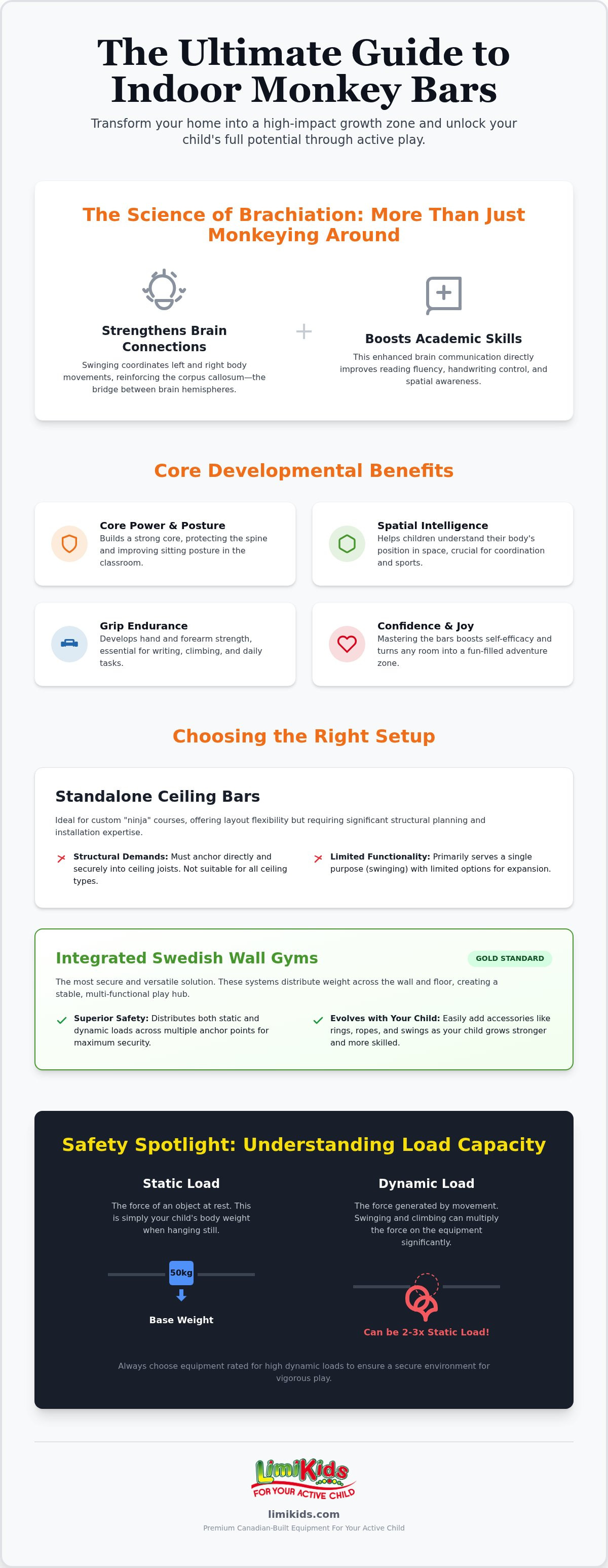
Brachiation is a foundational movement for pediatric physical literacy that involves swinging from one hand-hold to the next. It’s a rhythmic, powerful activity that does more than just tire them out. When a child swings, they are engaging in a complex neurological exercise. This movement requires the brain to coordinate alternating sides of the body, which directly strengthens the corpus callosum. This is the bridge between the left and right hemispheres of the brain. Better communication between these sides leads to improved reading fluency and spatial awareness.
Physical strength plays a surprising role in the classroom too. You might not connect swinging with handwriting, but the two are deeply linked. Developing significant upper body strength provides the proximal stability needed for distal control. In simpler terms, a child with strong shoulders and a stable core can better control their hands and fingers. This makes fine motor tasks like writing, drawing, and using scissors much easier. By installing indoor monkey bars for kids, you are supporting their academic journey through physical achievement.
Physical and Mental Benefits
The immediate physical gains are obvious, but the mental impact is where the real transformation happens. Mastering a set of monkey bars requires persistence. It takes a child from "I can't" to "Watch me!" in just a few weeks. This boost in self-efficacy translates to other areas of their life, from trying new foods to tackling difficult schoolwork. For children with sensory processing needs, the deep pressure and proprioceptive input provided by hanging and swinging can be incredibly grounding. It helps regulate their nervous system, leading to better focus and calmer moods.
- Grip Endurance: Essential for sports, climbing, and daily tasks.
- Core Power: Protects the spine and improves sitting posture.
- Spatial Intelligence: Helping kids understand where their body is in space.
- Pure Joy: Turning a boring hallway or bedroom into an adventure zone.
Choosing the Right Setup: Wall-Mounted vs. Integrated Gym Systems
Select the perfect configuration for your home by looking beyond simple floor space. You need a system that balances peak physical challenge with absolute structural security. While many parents start by looking for individual components, the real decision lies between standalone ceiling mounts and fully integrated systems. Every home has unique constraints, but your child’s safety and growth potential remain the top priorities. Making the right choice now ensures your investment evolves as your kids get taller, stronger, and more adventurous.
If you're just starting your research, The Ultimate Guide to Choosing an Indoor Home Gym for Kids in 2026 provides a deep dive into the initial planning stages. It's the best place to map out your long-term vision for active play.
Standalone Ceiling Bars
Standalone bars are often the go-to for creating a custom "ninja" style course. They offer incredible flexibility in layout, allowing you to space bars according to your child's reach. However, they come with significant structural demands. You must anchor these bars directly into ceiling joists to handle dynamic loads. A child swinging generates much more force than their static body weight. While the CPSC Outdoor Home Playground Safety Handbook focuses on outdoor setups, its principles regarding secure anchoring and fall zones are equally vital for indoor installations. Individual bars can be limiting if you have low ceilings or plaster finishes that hide the underlying structure.
Integrated Swedish Wall Gyms
Integrated Swedish wall systems are the gold standard for indoor monkey bars for kids. These systems don't just hang from the ceiling; they use the wall and floor as anchors to distribute weight evenly. This creates a rock-solid foundation for vigorous play. Because these gyms use vertical wall space, they leave a smaller footprint on your floor. This makes them ideal for multi-use rooms or smaller Canadian homes. These modular frameworks allow you to swap accessories as your child grows, moving from simple climbing to complex brachiation challenges.
When deciding on materials, consider how the frame handles daily wear. You can learn more about the durability of different builds in our Wooden vs Metal Indoor Jungle Gym: The Ultimate Parent’s Guide. Metal systems often provide the high-impact reliability needed for older children, while wood offers a softer aesthetic for younger toddlers. For a versatile setup that maximizes every inch of your playroom, consider exploring our indoor monkey bars for kids integrated into a full home gym system.
Safety and Structural Integrity: The Canadian Standard
Safety isn't just a checklist. It's the foundation of your child’s confidence. When you install indoor monkey bars for kids, the primary concern is always whether the system can withstand the sheer energy of active play. You aren't just mounting a shelf; you're building a launchpad. Understanding the difference between static and dynamic loads is the first step in ensuring your home gym remains a safe haven for years to come.
A static load is simply the weight of your child hanging still. Most basic bars can handle this easily. However, active swinging creates a dynamic load. This is the force generated by movement, which can effectively double or triple the stress placed on your wall anchors and the equipment itself. A 60lb child swinging vigorously can exert hundreds of pounds of force. This is why premium materials and professional-grade hardware are non-negotiable for any indoor setup.
Material Excellence: Metal vs. Wood
Choosing the right material depends on your child's play style and your home's aesthetic. Powder-coated steel is the heavy-hitter of the industry. It offers unmatched durability for high-intensity ninja training and can handle the most aggressive brachiation without flexing. It's built for the long haul. On the other hand, reinforced wood provides a warmer, tactile experience that many parents prefer for younger children. These Montessori-inspired designs focus on natural textures and sensory feedback. If you're leaning toward a more natural look, our Montessori Play Equipment: The Parent’s Guide to Active Discovery explores how these materials support early developmental milestones.
Safe Installation Practices
Your equipment is only as strong as its connection to your home. Identifying load-bearing studs and ceiling joists is critical. Never rely on drywall anchors or simple screws. High-quality lag bolts or structural screws are required to penetrate deep into the wooden framing of your house. This creates a permanent, secure bond that won't wiggle or pull loose over time. If you have non-standard walls, like metal studs or concrete, seek advice from a structural professional to ensure your mounting strategy is sound.
Finally, never overlook the impact zone. Even the most skilled climbers occasionally lose their grip. A high-density safety mat is a mandatory part of any indoor monkey bars for kids setup. These mats absorb the shock of a fall, protecting joints and preventing injuries. Place them directly under the entire length of the bars, extending at least two feet past the last rung to account for the momentum of a swing. Proper flooring turns a potential "uh-oh" into a soft landing, keeping the focus on fun and growth.
Maximizing Small Spaces and Low Ceilings
Don't let a compact floor plan limit your child’s physical potential. You can turn even the tightest apartment or a low-ceiling basement into a high-performance play zone. The key is thinking vertically. By using the wall as your primary anchor, you free up valuable floor space while providing a permanent outlet for energy. Indoor monkey bars for kids don't require a dedicated wing of the house; they just need a smart layout and the right equipment.
Apartment and Basement Solutions
Narrow hallways are often overlooked, but they are actually perfect for wall-to-wall mounting. This creates a "corridor of movement" that doesn't interfere with your daily foot traffic. In Canadian basements where ductwork might lower the clearance, focus on horizontal tracks that run parallel to the ceiling joists. This maximizes every inch of overhead space. For growing families, adjustable height systems are essential. These allow you to lower the bars for toddlers and raise them as your child gains height and confidence. The ideal clearance height for safe play is at least 12 inches above your child's maximum reach to ensure they can swing freely without head obstruction.
Versatility is your best friend in a small home. Look for systems where the bars pull double duty. A robust monkey bar set can easily function as a pull-up station for older kids or even a secure mount for a detachable indoor swing. This multi-functional approach ensures the equipment remains relevant as your children age, providing a long-term return on your investment in their health.
Creating a Sensory Circuit
Small spaces thrive when you design for flow. Instead of a single static station, aim to create a sensory circuit that encourages continuous movement. You can lead a child from a vertical wall ladder directly into a horizontal monkey bar track. This forces them to plan their movements and solve physical puzzles in real-time. It’s not just about strength; it's about spatial problem-solving.
Integrating different textures and challenges keeps the circuit engaging. You can combine your bars with rings, climbing ropes, or rope ladders to vary the grip and balance requirements. For a deeper look at how to build these environments, check out our Sensory Motor Equipment for Home: Parent's Guide. This approach turns a simple room into a comprehensive developmental hub. If you're ready to optimize your space, shop our space-saving indoor home gyms to find the perfect fit for your home layout.
Why LIMIKIDS is the Gold Standard for Indoor Monkey Bars
Experience matters when it comes to your child’s safety and physical growth. LIMIKIDS has led the Canadian market since 2008, providing families with premium tools for active discovery. We don't just sell equipment; we act as an Empowering Guide for your parenting journey. Our philosophy is simple: we design systems that respect your home’s aesthetic while challenging your child’s physical limits. While generic retailers often offer flimsy, standalone options, we specialize in robust Swedish wall systems. These systems serve as a permanent, space-saving anchor for high-energy play. You get a setup that stays rock-solid during the most vigorous brachiation sessions. We back every product with fast shipping across Canada and a dedicated support team that understands the unique needs of Canadian homes.
Premium Quality You Can Trust
Your peace of mind is built into every weld and bolt. We subject our indoor monkey bars for kids to rigorous safety standards and high-load testing. This ensures they handle the dynamic forces of swinging and climbing without compromise. Buying from a specialized Canadian retailer means you’re getting equipment designed for our lifestyle and our homes. Our gear is crafted from high-quality, durable materials that stand up to years of daily use. It’s an investment that grows with your family. A system that challenges a toddler today will still be a functional fitness hub for them as a teenager. This longevity is what sets us apart from temporary plastic toys or DIY solutions that lack structural certification.
Your Next Steps to Active Play
Transforming your home is easier than you think. Start by measuring your intended play area. You need to account for the vertical height of the room and a clear "impact zone" around the bars. Once you have your dimensions, you can begin the exciting process of customization. Our modular designs allow you to select the right accessories to match your child’s current developmental stage. You can add sensory rings, climbing ropes, or even extra rungs as their confidence soars. This flexibility keeps the environment fresh and the challenges engaging. Don't let another season of indoor confinement pass without a plan for movement. Take charge of your child's physical literacy now.
Transform your home today with LIMIKIDS Indoor Monkey Bars.
Ignite Their Potential with Every Swing
Transforming your home into a powerhouse for physical development is one of the best investments you can make for your child’s future. You now understand how the science of brachiation fuels cognitive growth and why integrated Swedish wall systems provide the structural integrity needed for years of vigorous play. Whether you’re working with a large playroom or a compact apartment, the right setup turns limited space into a sanctuary of achievement and joy.
Don't settle for temporary solutions when you can have a permanent anchor for your family’s wellness. Choosing the right indoor monkey bars for kids ensures that your home gym evolves with their physical milestones from toddlerhood to the teen years. We’ve been serving Canadian families since 2008 with high-quality, durable materials that prioritize maximum safety. It’s time to move beyond screen time and embrace active, year-round discovery. Explore Premium Indoor Monkey Bars and Home Gyms at LIMIKIDS and enjoy fast shipping across Canada. Give your kids the tools they need to grow strong, confident, and resilient. The adventure starts in your home today!
Frequently Asked Questions
Are indoor monkey bars safe for toddlers?
Indoor monkey bars for kids are safe for toddlers when installed at an appropriate height and used under active supervision. These systems help younger children develop foundational grip strength and spatial awareness early in their development. Our Swedish wall gyms provide a stable, adjustable anchor for lower rungs, allowing toddlers to climb and hang safely. Always ensure a high-quality safety mat is present to protect them during their initial discovery phase.
How much weight can indoor monkey bars typically hold?
The weight capacity of indoor monkey bars for kids depends on the material quality and the security of the installation. Premium metal systems integrated into Swedish wall gyms are engineered to handle high-load capacities, including both static and dynamic forces. While individual bars might have lower limits, our reinforced systems are designed to support active play for children well into their teen years. Always verify specific model ratings to ensure they meet your family's needs.
Do I need a professional to install indoor monkey bars?
You don't need a professional installer to set up your home gym equipment. Most parents successfully complete the installation themselves by identifying load-bearing studs and ceiling joists. Using high-quality hardware ensures a permanent, secure bond with your home's structure. While we don't provide on-site assembly services, our detailed guides and dedicated Canadian support team help you achieve a rock-solid setup that prioritizes your child’s safety and your peace of mind.
Can I install monkey bars in a room with low ceilings?
You can definitely install monkey bars in rooms with low ceilings or basements. The most effective strategy is mounting horizontal tracks parallel to the ceiling joists to maximize overhead clearance. Maintain at least 12 inches of space above your child's reach to prevent head obstruction during a swing. This space-saving approach allows you to transform even a compact Canadian basement into a high-performance active play zone without compromising safety.
What is the best age for a child to start using monkey bars?
Children can start engaging with climbing equipment as early as toddlerhood, usually around age two or three. While full brachiation typically develops as coordination improves, younger kids benefit immensely from simple hanging and climbing. Our equipment is specifically designed to grow with your child. You can adjust the difficulty and height of the challenges as they move from basic exploration to complex ninja-style movements and advanced strength training.
Do I need a safety mat under my indoor monkey bars?
A high-density safety mat is a mandatory requirement for any indoor play setup. Even the most confident climbers can lose their grip during vigorous play. A proper mat absorbs the shock of a fall and protects developing joints from impact. Place the mat directly under the entire length of the bars. Ensure it extends at least two feet past the landing zone to account for the momentum of a child’s swing.
How do indoor monkey bars help with sensory processing?
Swinging and hanging provide essential proprioceptive and vestibular input that aids sensory processing. This deep pressure helps regulate the nervous system, which is particularly beneficial for high-energy or neurodivergent children. By mastering the rhythmic movement of brachiation, kids improve their body's ability to organize sensory information. This leads to better focus, calmer moods, and improved motor planning skills that serve them well in the classroom and during daily tasks.
Can monkey bars be installed on drywall?
Monkey bars cannot be installed directly onto drywall alone. The dynamic force of a swinging child will easily pull anchors out of gypsum board, creating a significant safety risk. You must anchor the system directly into the wooden studs or ceiling joists of your home’s frame. This ensures the structural integrity of the installation. For homes with non-standard wall types, specific masonry anchors are required to maintain a secure, permanent fit for your indoor monkey bars for kids.