






Indoor Jungle Gym vs. Montessori Climber: Which is Best for Your Home in 2026?
Stop watching your child scale the dangerous bookshelves and start building a foundation for lifelong physical confidence! You want a home that inspires movement without looking like a chaotic plastic warehouse. The debate of indoor jungle gym vs montessori climber often leaves parents feeling stuck between two worlds. One offers beautiful, minimalist discovery for toddlers, while the other provides a high-octane athletic outlet that lasts for years. Choosing the wrong one means wasting money on a bulky structure your child might outgrow in just six months.
It's frustrating to invest in equipment that ends up as a safety hazard or a cluttered mess. You deserve a play solution that evolves alongside your child’s milestones and fits your living room aesthetic. We're going to break down the critical differences in structural integrity, weight limits, and developmental benefits for 2026. You'll discover exactly how to balance Montessori principles with the long-term durability of a professional-grade jungle gym. Let's transform your home into a safe, high-energy zone where your kids can climb, swing, and thrive every single day.
Key Takeaways
- Identify the core differences between an indoor jungle gym vs montessori climber to ensure your investment matches your child's developmental pace.
- See why Montessori climbers are the ultimate tool for nurturing early independence and "manageable risk" during those first toddler milestones.
- Unlock the science of brachiation and upper body strength that only a high-performance indoor jungle gym provides for growing kids.
- Solve your space dilemmas by comparing floor-based models with wall-mounted Swedish wall gyms that grow with your family.
- Get a clear roadmap for choosing equipment based on whether your child is a natural climber, a swinger, or a high-energy athlete.
Decoding the Indoor Play Dilemma: Montessori vs. Jungle Gyms
Your home is a launchpad for your child's future. When you evaluate the indoor jungle gym vs montessori climber, you aren't just picking out furniture; you're choosing a developmental philosophy. Both systems share a vital mission: prioritizing active play over passive screen time. They turn your living room into a landscape of movement. However, they serve very different stages of child development. Understanding the "Growth Gap" is essential. Many parents invest in a simple climber for their toddler, only to realize by age three that their high-energy child needs more vertical challenge and structural variety.
Don't let your investment gather dust. A Montessori climber is a beautiful introduction to movement, but it has a ceiling. An indoor jungle gym is built to evolve. It scales with your child's ambition. Whether you have a tiny crawler or a budding gymnast, the right choice ensures your home remains a space of growth rather than a cluttered warehouse of outgrown toys.
What Defines a Montessori-Inspired Climber?
Montessori-inspired climbers, like the classic Pikler triangle or wooden arches, focus on low-to-the-ground discovery. These structures use natural materials and open-ended designs to invite toddlers to test their limits. They are specifically engineered for the "sensitive period" of movement in children aged six months to three years. It's about self-directed play. Your child decides when to climb and when to retreat. This builds confidence through manageable risk. Because they are floor-based, they are perfect for developing early balance and core stability in a safe, controlled way.
What Defines a Modern Indoor Jungle Gym?
Think bigger. Think vertical. A modern indoor jungle gym, such as a Swedish wall system, is a comprehensive athletic center. These aren't just ladders; they are multi-functional tools featuring monkey bars, climbing ropes, gymnastic rings, and Swedish ladders. They are designed for high-energy play and long-term durability.
- Verticality: They utilize wall space, leaving your floor clear and your child reaching for new heights.
- Strength Training: These systems encourage brachiation, the science of swinging from bar to bar, which builds incredible upper body and grip strength.
- High Capacity: Built with robust materials, they handle much higher weight limits. This makes them ideal for multi-child households and children up to age 12 or beyond.
A jungle gym transforms a corner of your home into a permanent fitness zone. It transitions seamlessly from a toddler's play area into a serious training ground for older kids. If you want a solution that lasts a decade rather than a season, the jungle gym is the powerhouse you need.
The Montessori Climber: Nurturing Early Independence
Imagine your toddler’s face when they conquer their first summit. It’s a moment of pure, unadulterated triumph. When deciding between an indoor jungle gym vs montessori climber for a child under four, the climber is often the superior choice for fostering early self-reliance. These structures create a "Yes" space where your child can explore without constant parental intervention. This builds confidence through manageable risk. Your child learns to trust their own body, making decisions about how high to go and when to step back. It’s a psychological masterclass in independence delivered through play.
Climbing at this age isn't just about fun; it’s a critical developmental bridge. It supports gross motor skill milestones like walking and balance by strengthening the core and lower body. Every time your child grips a rung, they receive vital sensory feedback. This tactile experience helps the brain map out physical capabilities. For children in the "first steps" to age four range, these climbers provide the perfect level of challenge without overwhelming their developing nervous systems.
Key Features of Montessori Climbing Sets
Modern sets are designed with the realities of home life in mind. Many feature adjustable angles, allowing you to increase the difficulty as your child grows more confident. You can transform a simple ladder into a complex bridge by integrating slides or ramps. This variety keeps the play patterns fresh and engaging. Space is often a concern, so look for models designed to fold away. A high-quality Montessori play equipment setup should be easy to store under a bed or in a closet when play time is over, keeping your home aesthetic intact.
Developmental Wins for Toddlers
The benefits go far beyond the visible climb. Moving rung-by-rung demands intense hand-eye coordination and focus. It also provides essential proprioceptive input. Proprioception is the sixth sense of body awareness. By pushing and pulling against the bars, children learn exactly where their limbs are in space. This sensory integration is the foundation for more complex athletic movements later in life. You aren't just buying a toy; you're providing a tool that sharpens the mind and the body simultaneously. It’s an investment in their physical literacy that pays dividends for years to come.
The Indoor Jungle Gym: Building Strength for Growing Kids
Your child isn't a toddler forever. While a simple climber is a great start, there comes a moment when they need to hang, swing, and challenge their limits. This is the core of the indoor jungle gym vs montessori climber debate. Older children require high-energy play that targets advanced muscle groups and coordination. They need an environment that rewards their growing strength with complex physical puzzles. You aren't just providing a toy; you're building a home environment that demands movement and rewards effort.
Brachiation is the secret weapon of the indoor jungle gym. This scientific term describes the movement of swinging from one handhold to another. It isn't just fun. It builds incredible grip strength, shoulder stability, and core power. While a Montessori climber focuses primarily on the legs and balance, monkey bars demand upper body dominance. This shift in focus is vital for kids aged five and up who are ready to develop true athletic foundations. They'll gain the physical literacy needed for sports, gymnastics, and everyday confidence.
Beyond the physical, these systems build mental grit. Overcoming a difficult climbing route or finally reaching the top of a Swedish ladder teaches resilience. Your child learns that persistence pays off. Because these structures support higher weight limits and offer more complexity, they remain a focal point of your home from age 3 to 12 and beyond. You’re investing in a decade of activity, not a six-month phase. It's a long-term solution for a high-energy household.
Components of a Premium Indoor Gym
A professional setup isn't just a pile of wood; it's an engineered system designed for performance. Swedish wall gyms are the gold standard for modern homes. They provide a vertical playground while taking up almost zero floor space. Add monkey bars to develop that essential brachiation skill and shoulder health. Rope accessories like climbing nets or gymnastic rings add a sensory and balance challenge that keeps the workout unpredictable. These elements ensure the gym remains exciting as your child’s skills evolve.
Why Verticality Matters in Home Play
Space is a premium in Canadian homes. You don't need a massive basement to provide a world-class play area. By using your wall space, you maximize the footprint of your room and keep the floor clear for other activities. Verticality also improves safety. It encourages kids to climb up and down in a controlled, deliberate manner rather than running across furniture. To learn more about selecting the right fit for your specific room dimensions, check out The Ultimate Guide to Choosing an Indoor Home Gym for Kids in 2026. Building up instead of out is the smartest way to transform your living space into a high-performance growth zone.
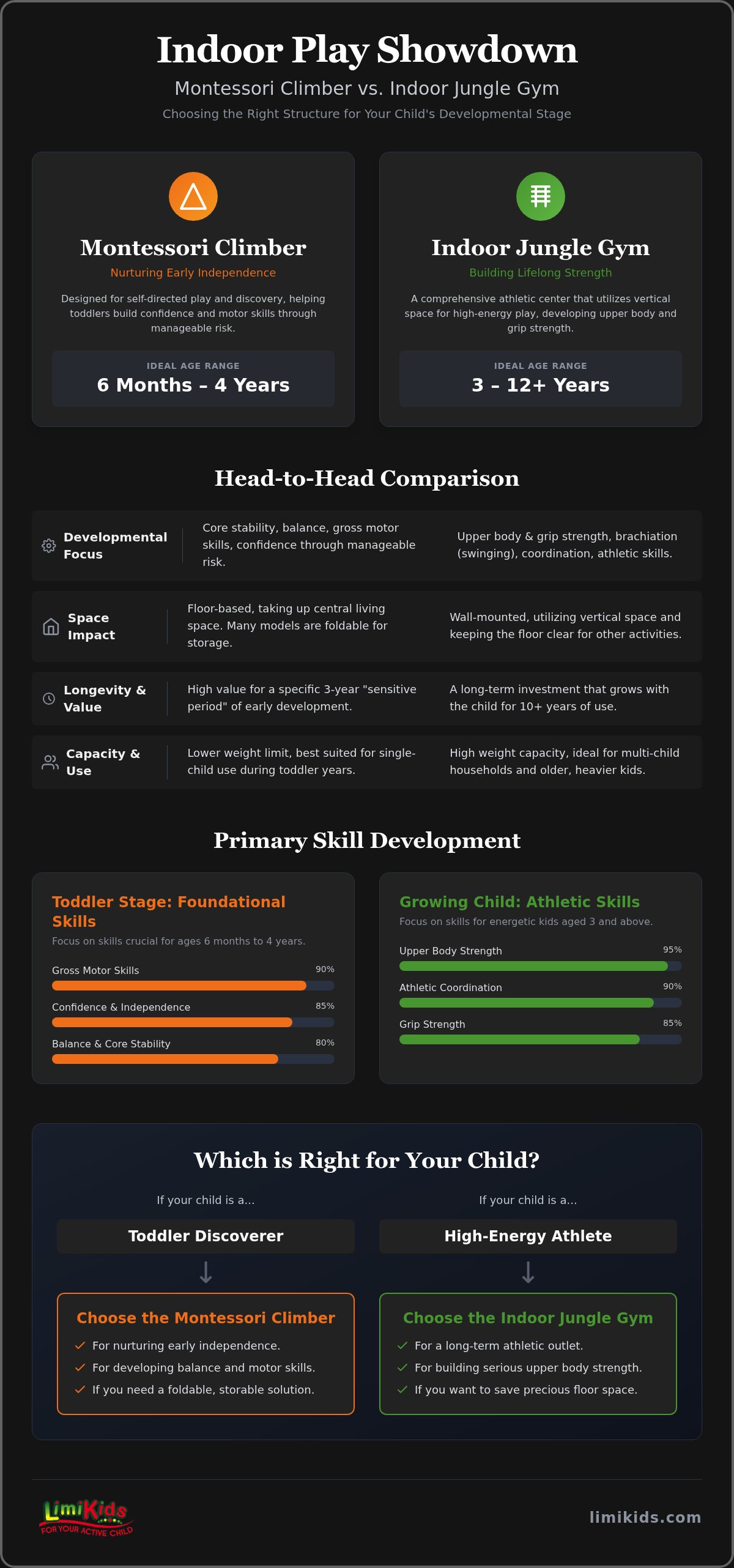
Head-to-Head: Comparing Space, Longevity, and Impact
Stop viewing these as rival toys. View them as a developmental progression. When you evaluate an indoor jungle gym vs montessori climber, you have to look at the long game. A Montessori climber is your child's first taste of height. It's safe, low, and encouraging. But children grow at lightning speed. If you want a solution that doesn't end up in a garage sale within two years, you need to weigh the investment against the years of active use. You're choosing between a temporary phase and a permanent fitness foundation.
The physical outcomes differ as much as the equipment itself. Montessori climbers excel at refining balance and basic coordination. They are the perfect "starter" gym for toddlers. Indoor jungle gyms push much further. They challenge children in the realms of grip strength, endurance, and complex motor planning. You're choosing between a tool that helps them stand tall and a system that helps them soar. Both have their place, but only one evolves into a full-scale athletic outlet for your growing family.
The 'Footprint' Comparison
Floor space is often the deciding factor for modern families. Montessori sets, like Pikler triangles, often require a significant open floor area to be used safely, typically swallowing up 10 to 15 square feet of your living room. In contrast, Swedish wall gyms offer a permanent, low-profile solution for apartments and smaller homes. They mount directly to the wall, occupying less than 2 square feet of floor space while providing a massive vertical play zone. While a Montessori set takes up more floor space when in use, a wall-mounted gym stays completely out of the way of your daily foot traffic.
Age and Weight Limits
Safety isn't just about soft edges; it's about structural integrity and weight capacity. Typical Montessori limits often hover around 100 lbs, which is perfect for the toddler years. However, high-performance indoor jungle gyms feature limits up to 220 lbs or more. These higher weight capacities are crucial for safety during vigorous play and allow multiple children to climb simultaneously without compromising the structure. If you're focusing on the younger demographic, check out our guide on Montessori Play Equipment to see how these early tools build a foundation for discovery.
Ready to transform your home into a high-octane growth center? Explore our full range of indoor playground equipment and find the perfect fit for your child's next milestone.
Making the Right Investment for Your Child's Future
Choosing the right equipment is about more than just filling a room; it’s about fueling a future. When you weigh the indoor jungle gym vs montessori climber, you are deciding which physical challenges will shape your child’s daily routine. Start by assessing your child’s current temperament. Are they a 'climber' who finds peace in the rhythmic ascent of a ladder? Or are they a 'swinger' who lives for the momentum of rings and ropes? Identifying these natural inclinations ensures your investment becomes a beloved staple of their childhood rather than a forgotten corner piece.
You don't have to choose a side. A 'Hybrid' approach allows you to integrate Montessori principles, like low-level discovery and open-ended play, into a high-performance jungle gym setup. This creates a play space that scales in difficulty as your child gains confidence. At LIMIKIDS, we’ve specialized in this evolution since 2008. Our equipment is designed by experts who understand that structural integrity is the bedrock of fun. We focus on high-quality materials that handle the weight and energy of growing kids, ensuring your home remains a safe sanctuary for movement and growth.
Questions to Ask Before You Buy
Logistics often dictate the best fit for your family. How much floor space can you permanently dedicate to play? If your living area is multi-functional, a wall-mounted Swedish gym provides a massive play zone without cluttering the carpet. Specifically designed for the space constraints of Canadian homes, our systems turn empty walls into active zones. Do you want equipment that you have to fold and put away every night? Many parents find that permanent fixtures encourage more spontaneous, frequent activity. Finally, ask if your child is ready for the challenge of vertical climbing. If they are already testing their limits on furniture, it is time to give them a dedicated, safe outlet for that energy.
Why Quality Materials Save Money
It is tempting to opt for 'disposable' plastic play gyms, but they rarely survive the transition from toddlerhood to school age. They lack the permanence and reliability required for truly vigorous play. High-quality materials, such as solid wood and reinforced steel, offer a level of safety that plastic simply cannot match. We prioritize non-toxic finishes and smooth, splinter-free surfaces because your child’s health is as important as their strength. Investing in premium gear now prevents the cost and waste of replacing broken toys later. Build it once, build it right, and watch your child thrive.
Ready to level up your home play space? Explore our range of indoor jungle gyms and start your active journey today!
Build a Home Where Play Never Stops
You now have the roadmap to transform your living space into a powerhouse of physical development. The choice between an indoor jungle gym vs montessori climber depends on your child's current milestones and your vision for their future activity. While Montessori sets nurture early independence, high-performance jungle gyms build the lifelong athletic foundations children need to thrive. Don't let limited square footage stop you from creating an environment that rewards movement and builds grit. By choosing vertical, space-saving solutions, you can provide a world-class play area in any home.
As trusted Canadian experts since 2008, we understand that safety and longevity are your top priorities. Our equipment features high-capacity weight limits and premium materials designed to withstand years of high-energy play. You deserve a solution that evolves with your family and inspires your children to reach new heights every day. The right tool turns a simple room into a launchpad for growth and confidence.
Transform your home into an active discovery zone with LIMIKIDS. Get started today and watch your children conquer their next big physical challenge with joy!
Frequently Asked Questions
Is a Montessori climber worth it for a 4-year-old?
Most 4-year-olds are beginning to outgrow the physical challenge of a standard Montessori climber. While it still offers open-ended play, they typically crave the verticality and complexity of an indoor jungle gym. If you're deciding between an indoor jungle gym vs montessori climber at this age, the jungle gym provides a better long-term investment. It offers the higher weight limits and diverse accessories needed for an older child's developing strength.
Can I install an indoor jungle gym in a small apartment?
Yes, you can successfully install a high-performance gym in a compact living space by choosing a wall-mounted Swedish ladder system. These designs are specifically engineered to maximize verticality while occupying less than two square feet of floor space. This makes them a superior space-saving solution compared to floor-based equipment. You turn an unused wall into a vibrant fitness zone without sacrificing the flow of your apartment or creating unnecessary clutter.
What is the weight limit for a typical Swedish wall gym?
Most premium Swedish wall gyms are built to support significant weight, often ranging from 220 lbs to 290 lbs depending on the specific model and installation. This high capacity ensures the structure remains stable during vigorous, high-energy play. It also means the equipment is safe for older children or multiple siblings to use at once. Always verify the manufacturer's specific rating for the 2026 model year to ensure it meets your family's needs.
How do indoor climbing frames help with sensory processing?
Climbing frames provide intense proprioceptive and vestibular input, which are essential for healthy sensory processing. As children pull their weight and balance on rungs, they receive deep pressure feedback that helps them understand their body's position in space. This type of active play can be particularly grounding for children who seek sensory stimulation. It builds the neural pathways required for better focus, motor planning, and emotional regulation in their daily lives.
Are indoor monkey bars safe for toddlers?
Indoor monkey bars are safe for toddlers when they are installed at an appropriate height and used under adult supervision with proper safety mats. While younger children are still developing the grip strength needed for full brachiation, they can start by hanging or reaching. This early exposure builds the shoulder stability and hand strength they'll need for more advanced climbing later. Ensure the equipment is scaled correctly for their reach and physical ability.
What is the best age to start using a Montessori climber?
The ideal age to introduce a Montessori climber is around six to eight months, or whenever your child begins to pull themselves up to a standing position. These low-to-the-ground structures are designed for the earliest stages of mobility. They provide a safe environment for infants and toddlers to practice crawling, stepping, and balancing. This early start fosters a sense of physical independence and confidence before they transition to more complex systems.
Do I need safety mats for an indoor jungle gym?
You should always use high-quality safety mats under and around any indoor climbing equipment to prevent injuries from accidental falls. Thick foam mats provide the necessary impact absorption required by safety standards like ASTM F1148. This is a non-negotiable part of a safe home setup, especially when children are using vertical elements like Swedish ladders or monkey bars. Proper padding gives children the confidence to test their limits without fear of a hard landing.
How do I choose between wood and metal climbing equipment?
Choose wood if you prefer a natural aesthetic and a warmer tactile feel for younger children. Wood is a classic choice for Montessori-inspired environments. However, metal frames often offer higher weight ratings and a slimmer profile, which is ideal for older children and multi-child households. Metal structures typically provide more permanence and can handle the intense force of high-energy athletic play. Base your decision on your child’s age and your home's design.