






Basement Indoor Play Area Ideas: Transform Your Space into an Active Zone (2026)
What if your underutilised basement wasn't just a storage locker for old holiday decor, but the secret to your child's physical and developmental breakthrough? For many Canadian parents, the "zoomies" don't stop just because it's minus twenty outside. You've likely felt the frustration of a dark, uninviting lower level while your kids climb the living room furniture. It's time to reclaim your home. By installing a custom indoor playground for basement spaces, you turn a cold concrete room into a high-energy powerhouse of growth and movement.
We know you're worried about equipment being outgrown in a season or your basement feeling like a cluttered gym. You deserve a space that's functional, safe, and exciting. This guide will show you how to design a zone that evolves alongside your child. We'll explore premium active play equipment, space-saving Swedish walls, and layout ideas that prioritize gross motor skill development. Let's transform your square footage into a professional-grade active zone that keeps your family moving all year long.
Key Takeaways
- Transform your basement into a high-octane "Active Zone" that separates boisterous play from your home’s quiet living areas.
- Maximize every square inch of your indoor playground for basement spaces by using vertical Swedish Wall Gyms designed for low-ceiling layouts.
- Implement Montessori principles and sensory play equipment to build essential gross motor skills while supporting neurodiverse developmental needs.
- Secure your space with expert safety infrastructure, including high-density foam flooring and professional-grade equipment installation.
- Invest in versatile, durable gear that evolves with your family, providing a functional fitness hub from toddlerhood through the teen years.
Why the Basement is Your Home’s Secret Weapon for Active Play
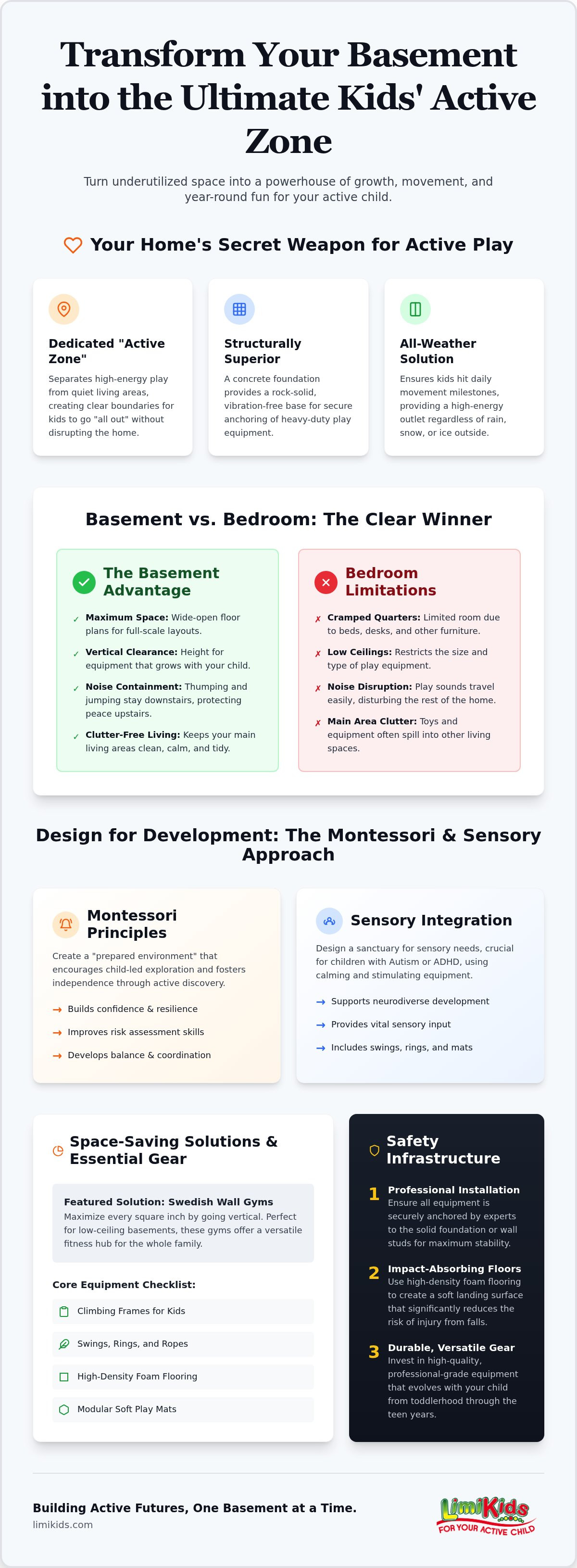
Stop viewing your lower level as a graveyard for seasonal bins and old furniture. Your basement is a developmental powerhouse waiting to be unlocked. By installing an indoor playground for basement use, you create a dedicated "Active Zone." This isn't just about having fun; it’s a strategic psychological shift. A "destination" play space helps children separate high-energy movement from the quiet, restful atmosphere of the upstairs living area. It establishes a clear boundary that allows kids to go "all out" without disrupting the flow of the rest of the house.
Physically, basements are structurally superior for heavy-duty play. The concrete foundation provides a rock-solid, vibration-free base for equipment that requires secure anchoring. You don't have to worry about floor joists creaking or ceiling lights rattling on the floor below when the jumping gets intense. For Canadian families facing six months of ice and snow, this is a lifestyle essential. It is the difference between a restless, screen-filled afternoon and a productive, high-energy workout that keeps the whole family sane during the winter months.
The Developmental Power of Indoor Movement
Active play is the fuel for gross motor skill development. When kids engage with climbing frames for kids, they aren't just playing; they are mastering balance, coordination, and grip strength. This consistent energy release is a primary tool for better focus and deeper sleep patterns. It aligns perfectly with the Montessori method by providing a "prepared environment" where children can test their limits and discover their physical capabilities independently. Recent industry data shows that children spend 90 to 120 minutes in focused play when they have access to these zones, ensuring they hit their daily movement milestones regardless of the weather outside.
Basement vs. Bedroom: Why the Basement Wins
Space is your biggest asset in the basement. Bedrooms are often cramped with beds and desks, leaving little room for a full-scale indoor playground for basement layouts. The basement offers wide-open floor plans and the vertical clearance needed for equipment that grows with your child. Noise control is the hidden bonus for parents. By moving the thumping and jumping downstairs, you protect the peace of your home office or the kitchen. Plus, the "out of sight" nature of a basement gym keeps your main living areas clutter-free. You can enjoy a clean, calm living room while your kids have their own private, high-energy retreat downstairs.
Designing for Physical Development: The Montessori and Sensory Approach
Designing an indoor playground for basement environments isn't just about filling space with toys. It’s about creating a "prepared environment" where your child is the lead architect of their own growth. Modern parents are moving away from passive entertainment and embracing "Active Discovery." This philosophy treats every climb, hang, and jump as a vital developmental milestone. By applying Montessori principles, you provide age-appropriate physical challenges that foster independence. Your child learns to assess risk, build confidence, and master their own body without constant adult intervention. It turns a simple basement into a laboratory for resilience.
Integrating Montessori Play Equipment
Success in a Montessori-inspired space depends on how you place your gear. You want to encourage child-led exploration. Start by positioning equipment to create a natural flow from simple movements to complex challenges. Using specialized Montessori play equipment ensures that every structure serves a purpose in early childhood development. We recommend a layout that mixes high-density soft play mats with structured climbing frames. This combination allows for a balance of high-intensity activity and self-directed rest. The benefits of active play are clear; it builds the cognitive and emotional foundation kids need to thrive in school and beyond.
Building a Sensory Nook in Your Basement
For children with varying developmental needs, including autism or ADHD, the basement can become a vital sanctuary for sensory integration. Identify a dedicated corner to install sensory motor equipment for home use. Integrate swings, rings, and heavy-duty mats to create an environment that is both calming and stimulating. These tools provide essential "Proprioceptive Input." This is the sensory information from muscles and joints that helps a child feel grounded and organized. Climbing and hanging aren't just for fun; they are neurological regulators. They help children process their surroundings more effectively, leading to better focus and calmer behavior throughout the rest of the day.
A well-planned indoor playground for basement spaces is a long-term investment in your child's wellness. As they grow, the equipment adapts, moving from basic motor skill practice to complex fitness routines. If you're ready to transform your home into a hub of activity, browse our selection of premium climbing sets today.
Space-Saving Solutions for Low-Ceiling Basements
Don't let a seven-foot ceiling crush your vision for an active home. Many Canadian basements feature lower overhead clearances, but this doesn't mean you have to settle for basic floor toys. You can still build a world-class indoor playground for basement zones by shifting your focus from horizontal floor space to vertical wall utility. It’s about smart engineering. High-quality systems are designed to fit standard residential heights while providing maximum engagement. You can transform even the tightest quarters into a high-energy gym with the right equipment choices.
Before you order, run through this quick measurement checklist to ensure a perfect fit:
- Measure from the concrete floor to the lowest obstruction, such as pipes, ducts, or joists.
- Account for the thickness of your safety flooring; high-density mats usually add 2 to 5 cm.
- Identify wall studs if you are opting for a wall-mounted system.
- Check for overhead lighting or ceiling fans that might interfere with swinging movements.
The Swedish Wall Gym: A Basement Essential
A Swedish Wall Gym is the undisputed champion of small-space play. These systems offer a remarkably compact footprint, often extending less than a meter from the wall. By choosing Swedish wall gyms for kids, you pack ladders, ropes, and rings into a single, streamlined unit. Even if your ceiling is tight, monkey bars can often be adjusted to a lower setting. This ensures your child still gets the benefit of hanging and swinging without hitting their head on the rafters. It’s a multi-functional powerhouse that turns a bare wall into a vertical obstacle course.
Layout Hacks for Tight Basement Quarters
Maximizing "Vertical Real Estate" is the key to keeping your basement multifunctional. Corner placements are particularly effective. They utilize the natural safety zones created by two walls and keep the center of the room clear for other family activities. When selecting your materials, consider the environment. Basements can be prone to humidity. This is where the choice between wooden vs metal indoor jungle gyms becomes critical. Metal systems often provide superior durability in damp environments and offer a sleek, industrial look that fits modern basement aesthetics.
Decide between wall-mounted and floor-to-ceiling pressure-mounted systems based on your basement's construction. Wall-mounted units are permanent and offer extreme stability for high-intensity climbing. Pressure-mounted systems are excellent for finished basements where you don't want to drill into the walls. Both options are engineered for safety and can support the weight of multiple active children. Your indoor playground for basement use should be a tool for growth, not a source of clutter.
Safety and Infrastructure: Creating a Worry-Free Zone
Safety is the bedrock of play. When you're designing an indoor playground for basement use, the #1 concern is almost always fall prevention. Concrete is unforgiving. Gravity doesn't take breaks. To build a truly worry-free zone, you must look past the equipment and focus on the infrastructure supporting it. A secure environment allows your child to push their limits while giving you total peace of mind. It’s about creating a space where the only thing "falling" is your stress level.
Structural integrity starts with anchoring. Most Canadian basements feature either wood-framed walls or concrete block foundations. If you're installing wall-mounted gyms, you must secure them directly into the center of the studs or use specialized masonry anchors for concrete. This isn't the place for guesswork. A rock-solid connection ensures that even during high-intensity climbing sessions, the equipment remains an immovable part of your home’s architecture. A rock-solid foundation is the most important part of any indoor playground for basement layouts.
Choosing the Right Safety Mats
Forget about area rugs or standard carpeting. They offer zero impact protection for active play. For a basement gym, you need high-density foam mats specifically engineered for fall absorption. The thickness of your mat should correlate with the height of your equipment. For climbing frames up to 1.5 meters, a 5 cm mat is often sufficient. Anything higher requires professional-grade padding. You should also calculate your "Fall Zone" by extending mats at least 1.5 meters in all directions from the equipment.
- Choose non-toxic, BPA-free materials to ensure a healthy environment for your kids.
- Opt for easy-to-clean vinyl surfaces that resist the dust and moisture common in lower levels.
- Ensure mats have a non-slip backing to prevent sliding on smooth concrete or laminate flooring.
Lighting and Ventilation Tips
Safety also involves visibility and air quality. Many basements are windowless, which can lead to a "dungeon" feel that dampens the mood. Upgrade to LED daylight bulbs (5000K to 6500K) to mimic natural light. This improves depth perception during climbing and boosts the overall energy of the room. Ventilation is equally critical. Active kids generate heat and moisture. Use a dehumidifier and high-velocity fans to maintain a crisp, dry environment. Finally, always partition off electrical panels, HVAC units, and water heaters. These are "no-go" zones that should be physically separated from the active play area with gates or walls.
Ready to build a secure foundation for your family’s fitness? Explore our safety-certified kids' gym equipment designed specifically for Canadian homes.
Transform Your Basement with LIMIKIDS: The Ultimate Solution
Reclaim your square footage and unleash your child’s potential. Choosing an indoor playground for basement use is more than a home improvement project; it’s a commitment to your family’s long-term physical and mental resilience. While cheap alternatives offer temporary distraction, premium gear provides a permanent laboratory for growth. You are investing in a space where "I can't" turns into "I just did." It’s time to stop letting your basement sit idle and start using it as a launchpad for your child's developmental breakthroughs.
We believe every Canadian home deserves a dedicated zone for high-energy play. Our systems meet rigorous quality standards, ensuring that every bolt and bar stands up to the most enthusiastic climbers. You don't have to be a professional contractor to create this environment. We prioritize ease of assembly so you can move from unboxing to active play without the stress. It’s a proactive solution for modern parents who value safety, durability, and the infectious joy of childhood achievement.
Durability That Grows with Your Family
Plastic sets often end up in landfills after a single season of heavy use. In contrast, our high-grade metal and wood systems are engineered to endure the unique environment of a Canadian basement. These materials resist the wear and tear of daily high-impact sessions. Because our equipment features superior weight capacities, it adapts as your children grow. A system that challenges a toddler today will serve as a functional fitness hub for a teenager tomorrow. A premium Swedish wall gym provides a lifetime of physical value by evolving from a simple climbing frame into a sophisticated home workout station for the entire family.
Ready to Start Your Basement Transformation?
The first step toward a more active home is just a measurement away. Take out your tape measure, check your ceiling height, and imagine the possibilities. You can browse our full range of indoor home gyms to find the perfect configuration for your specific layout. We offer fast national shipping across Canada, bringing professional-grade equipment right to your door. Our team acts as your "Empowering Guide," providing the support you need to choose, install, and enjoy your new active zone.
- Explore space-saving designs that fit even the most challenging basement footprints.
- Benefit from expert advice tailored to the needs of Canadian parents and caregivers.
- Invest in equipment that supports gross motor skill development for years to come.
Don't let another winter pass with restless kids and underutilized space. Transform your home into a powerhouse of movement and discovery today. Your basement is waiting to become the most exciting room in the house.
Unlock Your Basement’s Full Potential
Your basement is more than a storage room; it's a launchpad for your child's physical success. By installing a custom indoor playground for basement areas, you provide a year-round refuge for active discovery. You've learned how vertical Swedish walls solve the challenge of low ceilings and why high-density safety mats are non-negotiable for concrete floors. These aren't just design choices. They are essential investments in your child's confidence, resilience, and gross motor development. Every climb and every swing builds the foundation for a healthier, more focused future.
Trust the experts who have empowered Canadian families since 2008. Our space-saving designs and high-weight capacity systems ensure your equipment grows as your children do. We prioritize safety-tested materials so you can enjoy total peace of mind while they explore their limits. Don't let another long winter slow down your child's progress. Reclaim your square footage and transform that quiet lower level into a high-energy powerhouse of movement and joy today.
Shop Premium Indoor Home Gyms for Your Basement
Frequently Asked Questions
How do I make a play area in a basement with low ceilings?
Focus on vertical space-saving units rather than bulky floor structures. Swedish wall gyms are ideal because they have a compact footprint and adjustable features. You can often set monkey bars at a lower height to accommodate specific overhead clearances. Measure your space from the concrete floor to the lowest joist or pipe. Choosing equipment designed for residential heights ensures your kids have enough room to swing and climb safely without hitting the ceiling.
What is the best flooring for a basement indoor play area?
High-density foam mats are the superior choice for concrete basement floors. Concrete offers zero impact absorption, so you need a dedicated safety layer to protect against falls. Specialized play flooring or EVA foam tiles provide the necessary cushioning for high-intensity movement. Ensure your mats are at least five cm thick for climbing areas. Look for a non-slip backing to keep the mats secure on smooth basement surfaces during vigorous activity.
Are indoor jungle gyms safe for toddlers in a basement?
Yes, indoor jungle gyms are safe for toddlers when they feature age-appropriate challenges and professional-grade materials. Look for Montessori-inspired systems that encourage independent discovery at a lower height. Safety-tested equipment from trusted Canadian retailers ensures structural integrity and peace of mind. Always pair your gym with thick safety mats and supervise your toddler. This helps them build the confidence and coordination needed for more complex climbing as they grow older.
How much space do I need for an indoor climbing frame?
The required space depends on the specific model, but a standard indoor playground for basement use generally needs a 1.5-meter safety perimeter. This "fall zone" should remain clear of walls, furniture, and sharp corners. While the equipment itself might have a compact footprint of only one square meter, the surrounding area must be cushioned with mats. Always measure your total floor area before selecting a multi-functional climbing frame to ensure a safe layout.
Can I install a Swedish wall gym on basement concrete walls?
You can absolutely install a Swedish wall gym on concrete walls using specialized masonry anchors. Concrete provides an incredibly stable foundation for high-weight capacity equipment. If your basement is finished with drywall, you must anchor the system directly into the wooden studs for maximum security. Both methods ensure the gym remains an immovable part of your home. This allows for vigorous activity without the risk of the unit shifting or loosening over time.
How do I prevent my basement play area from feeling damp or dark?
Use LED daylight bulbs to mimic natural sunlight and instantly brighten a windowless space. This improves depth perception and safety during active play. To combat dampness, run a high-capacity dehumidifier to maintain a crisp, dry environment. Proper air circulation from fans also prevents the area from feeling stuffy when kids are active. Choosing vibrant equipment colors helps transform a dark lower level into an inviting, high-energy indoor playground for basement adventures.
What age is indoor playground equipment suitable for?
Most indoor playground equipment is designed for children aged two to twelve, though many systems support weights that allow older kids to exercise too. Toddlers benefit from low-profile Montessori steps, while older children master monkey bars and rope ladders. High-quality metal and wood systems offer the durability to grow with your family. This long-term utility ensures your investment provides physical developmental benefits from the early years right through to the start of adolescence.
How do I choose between wooden and metal equipment for my basement?
Metal equipment is often preferred for basements because it handles humidity better and offers a sleek, industrial look. It provides exceptional structural integrity for high-intensity use. Wooden systems offer a warmer, natural aesthetic that aligns perfectly with Montessori principles. Both materials are excellent choices if they are safety-tested. Consider your basement's moisture levels and your home's decor style when deciding which premium material best supports your child's daily fitness and play routine.