






10 Science-Backed Benefits of Climbing for Kids (2026)
What if your living room wasn't just a place for scattered toys, but a high-performance lab for your child’s brain and body? It is a bold idea, but the latest research is clear. When kids engage in vertical movement, they aren't just burning off steam. They are rewiring their nervous systems for better coordination. Exploring the benefits of climbing for child development reveals that this isn't just play. It is a "full-system reboot" for their growing physical and cognitive architecture.
We understand the frustration of those long Canadian winters when outdoor play feels impossible and household chaos reaches a breaking point. You want your kids to stay active. You worry about motor skill delays or a lack of focus. You aren't alone in seeking a better way to channel that high energy. This article shows you exactly how indoor climbing equipment provides a safe, year-round outlet for growth and sensory regulation.
Discover how active play transforms physical strength, emotional regulation, and sensory health. We are breaking down ten science-backed advantages that turn a confined space into a zone of discovery. Build strength. Improve focus. Boost confidence. You'll empower your child with the tools they need to reach new heights.
Key Takeaways
- Learn how vertical movement activates every major muscle group to build functional strength far beyond traditional ground-level play.
- Discover how climbing acts as a mental puzzle that sharpens problem-solving skills and strengthens executive function through sequence planning.
- Understand the science-backed benefits of climbing for child development, specifically how it regulates the vestibular system and provides essential proprioceptive input.
- See how navigating heights in a controlled environment builds lasting self-esteem by teaching children to manage healthy risks with confidence.
- Explore why consistent daily access to indoor climbing equipment provides a superior developmental advantage over occasional, weather-dependent park visits.
Mastering the Physical: Gross and Fine Motor Skill Acceleration
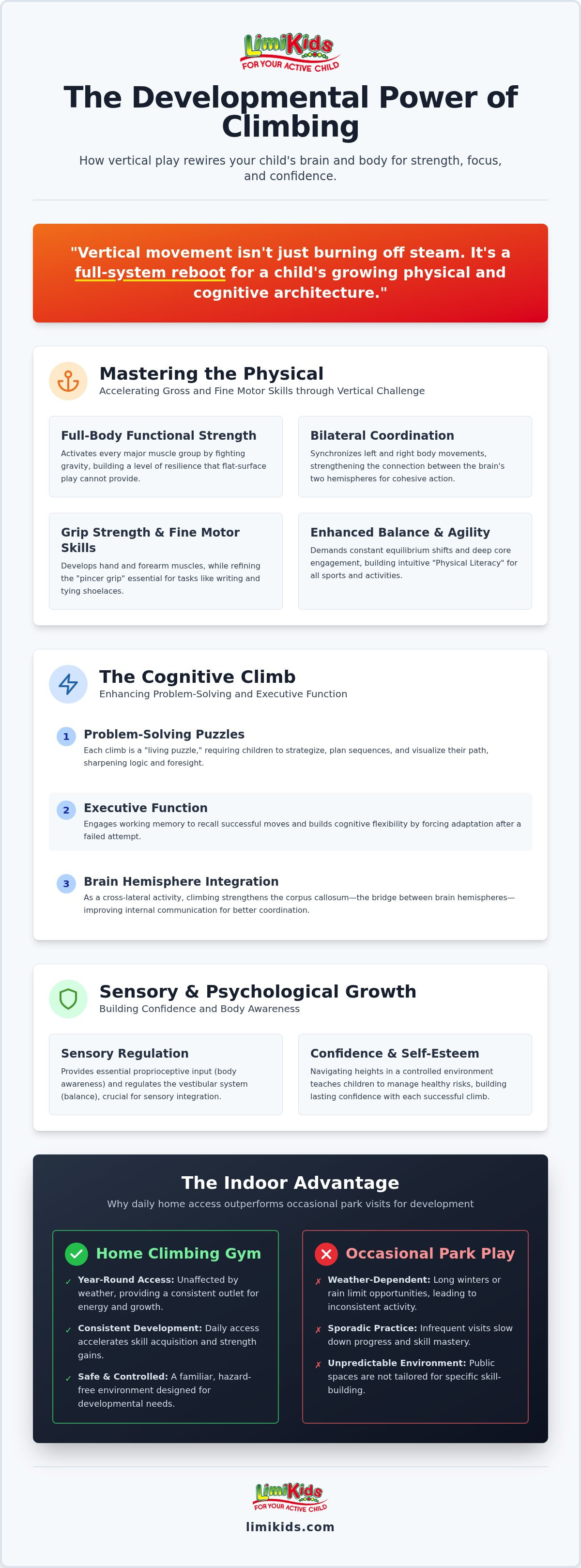
Climbing isn't just a fun activity. It is a rigorous, full-body workout that hits every major muscle group from the core to the fingertips. While traditional ground-level play is great, it often misses the vertical resistance needed to build true functional strength. By fighting gravity, children develop a level of physical resilience that flat surfaces simply cannot provide. This is one of the most immediate benefits of climbing for child development. It forces the body to work as a single, cohesive unit.
Using both sides of the body in a synchronized pattern is known as bilateral coordination. Every time your child reaches for a new rung on an Indoor Home Gym for Kids, their brain must coordinate the left and right hemispheres to ensure a successful move. Climbing develops grip strength by requiring the hand and forearm muscles to maintain a firm hold against gravity while supporting the body's weight during movement. These movements are foundational to overall motor skill development, providing the building blocks for more complex athletic feats later in life.
The Power of Brachiation and Upper Body Strength
Brachiation, or the act of swinging from one point to another, is a primal movement that does wonders for a child's anatomy. Using Monkey Bars for Kids isn't just about fun. It actively expands the chest and improves posture by stretching and strengthening the latissimus dorsi and pectoral muscles. This creates a stable base for the shoulders. Strong shoulders are the secret to better handwriting and precision tasks. When the shoulder joint is stable, it allows for greater fine motor control in the hands. As children navigate varied climbing hold shapes, they refine their "pincer grip" by using the thumb and forefinger. This skill is essential for everything from tying shoelaces to using a pencil with ease.
Refining Balance and Agility
Climbing is a game of micro-adjustments. Every move requires balance. Unlike horizontal running, vertical movement demands constant equilibrium shifts. Your child's core must fire in new, unpredictable ways to keep them steady on the frame. This deep core engagement is far more intense than what you'll see on a soccer field or a playground slide. Understanding these benefits of climbing for child development helps parents see why a Swedish wall gym is a vital investment for long-term health.
This process builds what experts call "Physical Literacy." It is the ability to move with confidence and poise in any environment. By mastering their own weight on Indoor Climbing Equipment, kids gain an intuitive sense of agility that translates to every other sport they might try. They become more coordinated, more reactive, and significantly more capable in their daily physical lives. Growth happens one rung at a time.
The Cognitive Climb: Enhancing Problem-Solving and Executive Function
Think of every climbing route as a living, breathing puzzle. Your child isn't just moving; they are strategizing. Every step requires a mental map, demanding foresight and sequence planning. This is where executive function takes center stage. To reach the top, a child must engage their working memory to recall which foot placement worked and which led to a slip. It is a constant, real-time exercise in sharpening cognitive skills through play.
One of the most profound benefits of climbing for child development is brain hemisphere integration. Climbing is a cross-lateral activity. The left side of the brain controls the right side of the body, and vice versa. By crossing the midline, children strengthen the corpus callosum, the bridge between the two hemispheres. This improves communication within the brain, leading to better coordination and logical thinking. When a child "fails" a route, they don't just stop. They reassess. This builds cognitive flexibility, the ability to switch between different concepts or adapt to new information on the fly.
Vertical Puzzle Solving and Logic
In climbing, the path to the top is called the "beta." Before the first move, children often stand back and visualize their journey. They look at the handholds. They predict their weight shifts. This trial and error process is essential for logic development. If a handhold is out of reach, they must pivot. The feedback loop is immediate. Success is felt in the muscles and the mind the moment they reach that next rung. If you want to see this logic in action, explore our range of Indoor Jungle Gyms designed to challenge young minds.
Focus, Concentration, and Patience
Climbing demands a "flow state." This is a level of deep immersion where the outside world fades away. To stay on the wall, a child must be fully present. There is no room for impulsivity. Every movement must be calculated and deliberate. This practice translates directly to the classroom. By learning to slow down and focus on a single task, children improve their academic attention spans. They learn that patience isn't just a virtue; it's a tool for success. Deliberate movement on a climbing frame today builds the concentration needed for complex math or reading tomorrow. These benefits of climbing for child development reach far beyond the play room.
Sensory Integration: Developing Proprioception and Spatial Awareness
Climbing is a sensory powerhouse. It delivers intense "deep pressure" input to the joints and muscles, which is technically called proprioception. This feedback tells the brain exactly where every limb is positioned at any given moment. Sensory-seeking children benefit from vertical play because it provides the heavy, grounding input their nervous systems need to feel organized and secure. Without this specific type of physical feedback, many kids feel "floppy" or restless, leading to the high-energy chaos that often disrupts home life.
Beyond muscles, climbing targets the vestibular system located in the inner ear. Every tilt, swing, and ascent helps the brain process balance and movement through space. By gripping different textures like cool metal or warm wood, children refine their tactile "body map." They learn the precise amount of tension needed to grip a rung or balance on a beam. These benefits of climbing for child development are essential for kids who struggle with sensory processing or simply need a more stimulating environment to thrive.
Understanding the Body in Space
Navigating an Indoor Home Gym requires constant 3D spatial reasoning. Your child must judge the distance between rungs and the height of the next platform in real time. This practice sharpens depth perception and helps them understand their own volume in space. They aren't just moving up; they are learning to map their surroundings in three dimensions. This skill is vital for sports, driving, and even simple tasks like navigating a crowded hallway. For a deeper dive into creating the perfect environment for these milestones, read our Sensory Motor Equipment for Home: Parent's Guide.
Sensory Regulation and Emotional Calm
Occupational therapists often call climbing "heavy work." This activity puts a healthy load on the skeletal system, which acts as a natural sedative for overstimulated children. It's a proactive way to manage daily energy levels. Instead of a meltdown, your child has a productive, physical outlet. The home gym becomes a safe haven where sensory processing happens naturally and safely. Integrating these benefits of climbing for child development into your daily routine can transform your home's atmosphere. Try using the climbing frame as a transition tool. A quick session on the monkey bars can help a child shift from the noise of the school bus to the quiet focus needed for dinner or sleep.
Psychological Growth: Building Confidence Through Measured Risk
Risk is often a scary word for parents. However, there is a massive difference between a hazard and a healthy risk. A hazard is a hidden danger your child cannot see; a healthy risk is a visible challenge they can choose to tackle. Mastering these benefits of climbing for child development allows your child to test their limits in a controlled space. They learn to evaluate their own safety. They decide where to put their hands and feet. This autonomy is the foundation of a resilient mind.
Overcoming the fear of height translates directly to real-world self-esteem. When a child reaches the top of a frame, they aren't just high up; they've conquered a mental barrier. Climbing is a solitary achievement. There are no teams or coaches to lean on in the middle of a move. The child is their own competition. This internal drive fosters a deep sense of persistence. They learn that the "summit" requires effort and multiple attempts. This grit is one of the most empowering benefits of climbing for child development, teaching kids that success is earned through sweat and focus.
The Power of Perceived Risk
Children need to feel the thrill of height to build trust in their own physical abilities. Indoor climbing provides a "perceived risk" where the thrill is high but the environment is strictly controlled and safe. Our equipment is built with structural integrity to ensure that while your child feels like an explorer, they are always supported by professional-grade safety standards. Building this trust in their own judgment early on is vital. For more on selecting the right setup for your home, check out The Ultimate Guide to Choosing an Indoor Home Gym for Kids in 2026.
Independence and Self-Reliance
Watch the transformation as your child moves from "Watch me, Mommy!" to independent, self-directed play. This shift is a core Montessori principle. By providing a safe, tested structure, you allow the child to discover their own limits without constant interference. It reduces the need for "helicopter parenting" because the environment is designed for their success. They learn to rely on their own strength. They solve their own physical puzzles. This independence builds a "can-do" attitude that stays with them long after they climb down. Explore our durable Indoor Climbing Equipment to start building your child's confidence today.
The Indoor Advantage: Why Home Climbing is a Developmental Game-Changer
Canadian winters are legendary for their length and intensity. While outdoor parks are fantastic in the summer, they become inaccessible for nearly half the year. This seasonal gap often leads to a "winter slump" where physical activity drops and screen time rises. By bringing the playground inside, you ensure 365 days of uninterrupted growth. Consistent access is one of the most significant benefits of climbing for child development. It transforms an occasional treat into a daily habit of movement and discovery.
Frequency matters more than duration. A child who climbs for fifteen minutes every day builds more functional strength and coordination than a child who visits a park for two hours once a week. Daily "micro-sessions" keep the nervous system engaged. They allow for the "little and often" approach that pediatric experts recommend for motor skill mastery. Your home becomes a living laboratory for physical literacy. This is equipment that grows with your family. A system that challenges a toddler's balance today will support a teenager's pull-ups five years from now.
Year-Round Physical Literacy
Winter doesn't have to be a setback for your child's milestones. Indoor climbing serves as a core component of a healthy home routine, providing the high-intensity "heavy work" kids crave when they are stuck indoors. It keeps muscle tone high and joints flexible. To find the perfect fit for your aesthetic and durability needs, read our guide on Wooden vs Metal Indoor Jungle Gym: The Ultimate Parent’s Guide to Choosing Right (2026). Choosing the right material ensures your investment stands up to years of enthusiastic play.
Designing an Active Home Environment
Modern Canadian homes often have limited floor space. You don't need a massive basement to reap the benefits of climbing for child development. Swedish walls are the ultimate space-saving solution. They utilize vertical "dead space" on your walls, leaving the floor clear for other activities. LIMIKIDS structures are designed to encourage spontaneous, natural movement. Your child might climb a few rungs just passing through the room. This integration of play into the daily flow of life is what makes a home truly active. You get the peace of mind that comes with premium, safety-tested gear. We've been crafting these systems since 2008 with a focus on structural integrity and family-centric design. Empower your children to move, explore, and succeed within the safety of your own four walls.
Elevate Your Child’s Potential Every Single Day
Climbing is far more than a simple way to burn off extra energy. It is a fundamental tool for total growth. You now understand how vertical play builds a resilient core while simultaneously sharpening executive function and logic. By bringing these movements into your home, you provide the essential "heavy work" required for sensory regulation and emotional calm. The long-term benefits of climbing for child development are undeniable. It transforms your living space into a year-round hub of discovery and achievement.
Don’t let another long winter stall your child’s physical or cognitive progress. Since 2008, LIMIKIDS has been trusted by Canadian families to provide high-quality, space-saving Swedish wall designs that fit perfectly into modern homes. Our durable equipment is backed by fast shipping across Canada, so you can start building a more active environment immediately. Explore our range of premium indoor climbing gyms and transform your home today! Your child’s next major milestone is just one climb away. Let’s help them reach new heights together!
Frequently Asked Questions
Is climbing safe for toddlers as young as two?
Yes, climbing is safe and highly beneficial for toddlers starting around age two when using age-appropriate Indoor Playground Equipment. For children aged 2 to 5, safety standards recommend structures with lower platform heights to ensure a secure environment. Early climbing encourages the development of fundamental balance and grip strength. Always supervise your toddler and ensure you have a thick safety mat in the fall zone to provide maximum peace of mind.
How does climbing help a child with ADHD or sensory processing issues?
Climbing provides essential "heavy work" that organizes a child's nervous system through deep pressure input to joints and muscles. This proprioceptive feedback is a major factor in the benefits of climbing for child development, especially for those with ADHD or sensory processing needs. It helps regulate the vestibular system, which can reduce restlessness and improve a child's ability to focus on tasks after a session of active play.
Can indoor climbing equipment really fit in a small apartment?
Absolutely, our Swedish wall gyms are specifically designed to maximize vertical space in smaller Canadian homes and apartments. These structures occupy very little floor area because they mount directly to the wall or secure between the floor and ceiling. This space-saving design allows you to transform a narrow hallway or a corner of a bedroom into a high-value developmental zone without cluttering your living space or requiring a dedicated playroom.
What is the best age to start a child on a Swedish wall gym?
Most children can begin exploring basic climbing structures as soon as they are steady on their feet, typically around age two. The best part about an Indoor Home Gym for Kids is its longevity. These systems are modular and durable, meaning they grow alongside your child. A toddler might start with low rungs, while a ten-year-old will use the same frame for complex pull-ups and core training sessions.
How does climbing improve a child’s performance in school?
Climbing sharpens the executive functions required for academic success, such as planning, working memory, and impulse control. Navigating a vertical route is a mental puzzle that trains the brain to stay present and focused. Improved bilateral coordination also supports cognitive integration between the brain's hemispheres. This mental discipline often translates to better attention spans and improved problem-solving skills in the classroom setting, helping kids tackle complex subjects with more confidence.
What safety features should I look for in an indoor climbing frame?
Look for equipment that explicitly adheres to safety standards like ASTM F1148 for home playground gear. Prioritize structural integrity by choosing frames made from high-quality wood or metal that can support significant weight limits. Ensure the system has secure mounting hardware and no sharp edges or entrapment hazards. Always pair your frame with a professional-grade gym mat that extends at least 3 to 6 feet around the structure to protect against falls.
Does climbing help with fine motor skills like writing?
Yes, climbing is a secret weapon for improving handwriting and other fine motor tasks. It builds massive shoulder stability, which is the physical foundation for hand control. As children grip varied rungs and holds, they strengthen the small muscles in their hands and refine their pincer grip. These benefits of climbing for child development ensure your child has the manual dexterity and endurance needed for long writing or drawing sessions at school.
How do I encourage a cautious child to start climbing?
Focus on "perceived safety" by staying close and offering gentle encouragement without pressure. Start with the lowest rungs and let your child explore at their own pace. Sometimes just sitting on a low bar or hanging for a few seconds is a huge win. Model the behavior yourself or let them watch siblings play. Once they feel the structural integrity of the equipment, their confidence will naturally grow into more adventurous climbing.