






Indoor Monkey Bars: Parent’s Guide to Active Play 2026
Indoor monkey bars are not just toys; they are essential tools for brachiation that unlock your child’s physical and cognitive potential. You know the struggle when the Canadian winter hits and your living room turns into a chaotic wrestling match. It's tough to keep kids active when it's freezing outside. You want them to burn energy, but you don't want your ceiling to come crashing down. Finding the right indoor monkey bars for home use shouldn't feel like a structural engineering exam. We understand the need for a solution that builds serious gross motor skills without compromising your home's integrity.
This guide will show you how to transform your space into a developmental powerhouse with a system that prioritizes growth and safety. We'll explore the latest in modular Swedish wall designs, safety standards like ASTM F1148, and how to choose equipment that actually grows with your family. Get ready to turn your home into a high-energy zone where your kids can climb, swing, and thrive every single day. Let's build a safe, durable environment that keeps your family moving all year long.
Key Takeaways
- Learn how the physical act of brachiation directly impacts cognitive growth and essential fine motor skills like writing.
- Decipher the pros and cons of wall-mounted versus ceiling-mounted systems to maximize your home's vertical space.
- Master the technical requirements of safe installation, including how to verify joists and manage dynamic weight loads for active play.
- Discover the best indoor monkey bars for home setups that turn limited square footage into a high-intensity playground.
- Find out why space-saving Swedish wall designs are the gold standard for families seeking equipment that grows with their children.
Why Every Home Needs Indoor Monkey Bars for Kids
Canadian parents know the feeling. Snow hits. The living room becomes a disaster zone. High-energy kids need an outlet that doesn't involve jumping off the sofa or running laps around the kitchen island. Installing indoor monkey bars for home use changes the entire dynamic of your household. You aren't just buying a toy. You're installing a pressure-relief valve for your child's boundless energy. It's about reclaiming your space while giving them the movement they crave.
Solving the Indoor Energy Crisis
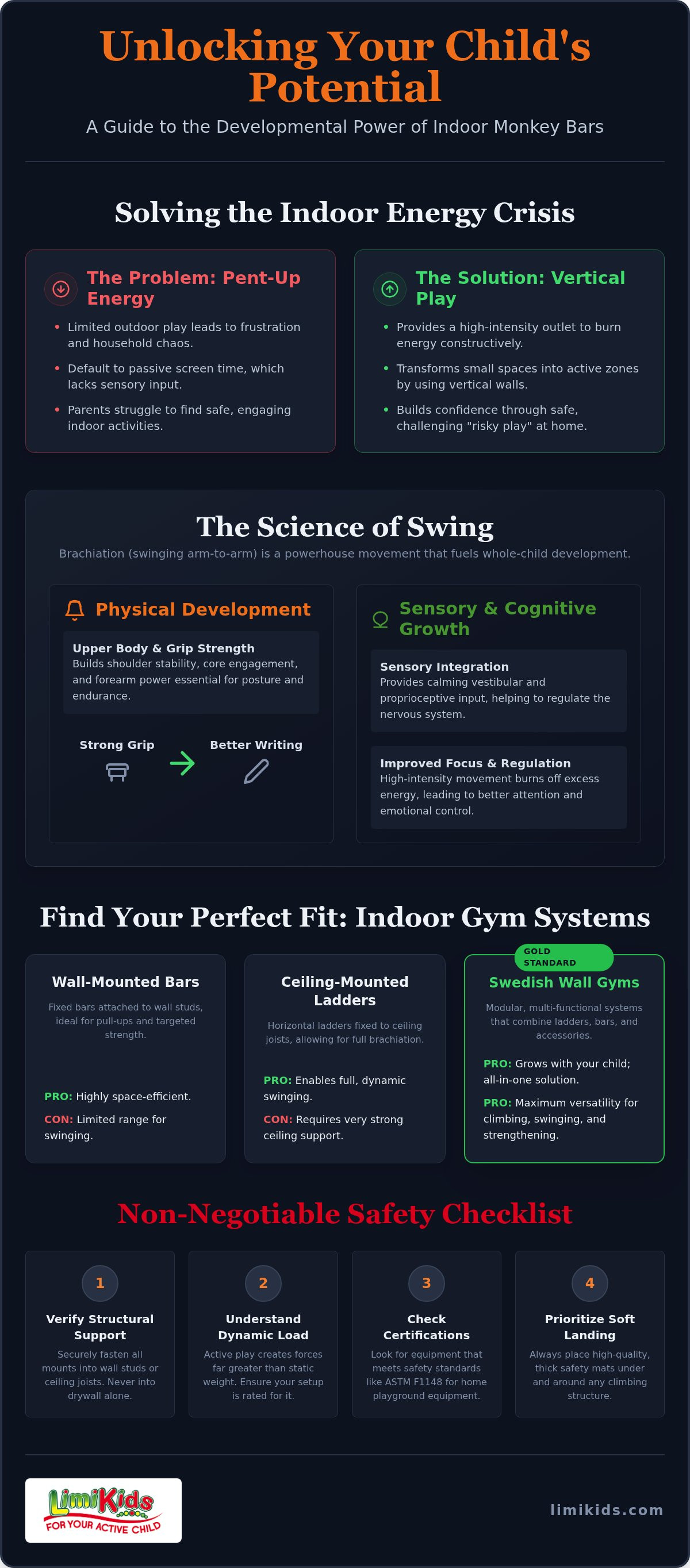
Children are built to move. When outdoor play isn't an option, they often resort to passive screen time. This doesn't provide the sensory input their growing bodies require. Vertical play spaces allow kids to engage in brachiation, the scientific term for swinging from bar to bar. This high-intensity movement burns calories and builds muscle faster than floor-based play. It bridges the gap between rare sunny park visits and the reality of daily home life. Best of all, it gives parents a break. When kids have a dedicated, safe zone to test their limits, parental stress levels drop. You can finally finish that cup of coffee while they conquer their latest climbing challenge.
Transforming Small Spaces into Active Zones
You don't need a sprawling mansion to build a developmental powerhouse. In fact, indoor monkey bars for home are the ultimate space-saving hack for apartments or finished basements. By leveraging vertical space, you preserve your precious floor area for other activities. Modern systems are modular. They adapt to your room's layout rather than forcing you to renovate. If you're looking for a comprehensive setup, an indoor home gym for kids offers a holistic solution. These systems integrate climbing, swinging, and core strengthening into one compact, professional footprint.
There's also a psychological edge to "risky play." In a controlled home environment, children learn to assess their own abilities and overcome fears. This builds grit. They fall onto a soft mat; they get back up; they try again. This cycle of achievement boosts confidence in a way that sedentary games never can. It's about empowering your child to discover what they're capable of right in the comfort of your home. You provide the tools, and they provide the courage.
The Physical and Sensory Benefits of Brachiation
Brachiation is the act of swinging from bar to bar using only the arms. Brachiation serves as a foundational movement for human development. It's not just a fun playground trick; it's a full-body workout that prepares the brain and body for complex tasks. Installing indoor monkey bars for home use gives your child a head start on critical physical milestones. By mastering the swing, kids develop the coordination and strength required for a lifetime of active success.
Developing Upper Body Strength and Grip
Strong kids start with a solid shoulder girdle. When children hang and swing, they engage their core, forearms, and shoulders simultaneously. This isn't just about looking strong. This stability is what allows a child to sit upright at a desk without fatigue. Improving hand-eye coordination through reaching and grasping also builds the neural pathways needed for sports and daily life. Every reach for a new bar is a lesson in spatial awareness and precision.
Did you know that grip strength is a key indicator of overall physical health? It's true. By mastering the bars, kids develop powerful forearm muscles. This strength translates directly to fine motor skills. A child with a strong grip has better control over a pencil, making writing easier and less frustrating. You're literally building their academic success through play. Key benefits include:
- Shoulder Stability: Protects joints and improves posture.
- Core Engagement: Stabilizes the body during dynamic movement.
- Forearm Power: Increases endurance for manual tasks and writing.
Sensory Integration and Focus
Sensory processing is the hidden benefit of monkey bars. Swinging provides intense vestibular input, which helps regulate the nervous system. For a child who feels overwhelmed or "fidgety," a few minutes on the bars can be incredibly grounding. It provides the proprioceptive feedback—the sense of where their body is in space—that many children crave. This "heavy work" calms the brain and organizes the senses.
Movement fuels focus. After a high-intensity session of climbing, children often show improved attention spans and better emotional regulation. They've burned off the "static" in their brains. When they finally sit down to learn, their bodies are calm and their minds are ready. For more strategies on using physical play to support development, check out our guide on sensory motor equipment for home. Providing these outlets indoors ensures your child stays regulated regardless of the weather outside. If you're ready to see these changes in your own living room, explore our range of climbing frames for kids designed for maximum growth and safety.
Comparing Indoor Monkey Bar Systems: Wall-Mounted vs. Ceiling vs. Swedish Gyms
Choosing the right setup for your home isn't just about fun. It's about matching the equipment to your home's structural reality and your child's developmental stage. You have three main paths: ceiling-mounted, wall-mounted, or integrated Swedish wall systems. Each offers a different play experience. For many families, the decision comes down to available square footage and how long you want the equipment to last. Investing in indoor monkey bars for home use requires a balance of safety and versatility.
Ceiling-Mounted Bars: The Classic Ninja Setup
Ceiling-mounted bars provide that traditional "ninja" experience. They are perfect for basements or dedicated playrooms where you have exposed joists or high ceilings. These systems allow for a long, straight path of travel that kids find exhilarating. However, they come with specific challenges. Installation is often permanent and requires precise structural alignment to ensure safety. You also need to manage height carefully. If the bars are too high, younger children can't reach them independently. If they're too low, older kids will bottom out. They offer a great upper body workout but lack the multi-functional variety of vertical systems.
Swedish Wall Systems: The Space-Saving Powerhouse
Swedish wall systems are the multi-functional heroes of residential play. Unlike ceiling bars that require a large horizontal footprint, these mount vertically against a wall. This makes them the ultimate choice for indoor monkey bars for home setups in smaller rooms or bedrooms. They are significantly safer for younger children because the vertical ladder provides constant support as they climb. As your child grows, the system evolves. You can add ropes, rings, and even detachable monkey bar sections. This equipment grows with your family from toddlerhood into the teen years. It's a long-term investment in their physical literacy.
When evaluating these systems, the choice of material is critical for longevity and safety. You'll often find yourself deciding between a wooden vs metal indoor jungle gym. Metal systems provide superior weight capacity and structural integrity. They don't warp, crack, or splinter over time, which is vital when multiple kids are playing at once. Since 2008, LIMIKIDS has specialized in these high-quality, space-saving designs. Whether you choose a wall-mounted ladder or a full Swedish gym, prioritize systems that offer modularity. Your kids' needs will change. Your equipment should be ready to change with them.
Safe Installation: What Every Parent Must Know Before Buying
Safety is your number one priority when bringing active play indoors. You aren't just hanging a picture frame; you're building a structural system for high-energy movement. Choosing the best indoor monkey bars for home use means understanding exactly how your house is built. Every bolt must be secure to handle the intense force your kids will bring to their daily "ninja" training. Don't settle for "good enough" when it comes to structural integrity.
Structural Requirements: Joists and Load-Bearing Walls
You must identify the bones of your home before you start drilling. Never mount heavy play equipment directly into drywall alone. You need to find the wood studs or ceiling joists that provide the real strength. A high-quality stud finder is your best friend here. It helps you find the center of the beam, ensuring your mounting hardware has maximum "bite" into the wood. If you're installing in a basement with concrete walls, use specialized masonry anchors for a rock-solid connection.
Weight limits can be confusing for parents. Many people look at a child's weight and think the bars are fine, but that's only half the story. It is vital to remember that dynamic load can be 3x the child’s weight when they are swinging or jumping. A 50-pound child can exert 150 pounds of force on the system during an active swing. This is why "static weight" ratings don't tell the whole story. You need a system designed for high-impact residential use that can handle these sudden bursts of energy.
The Essential Safety Zone: Mats and Clearance
Even the most secure bars need a dedicated "Safety Zone." This is the clear space around the equipment where a child might land. Calculate your fall zone based on the height of the bars. As a general rule, you want at least 6 feet of clearance in every direction from the center of the swinging path. Collisions with furniture or walls are the most common cause of indoor play injuries, so keep the area wide open.
Safety mats are non-negotiable. Hardwood, tile, or thin carpet won't protect a child's joints during a landing. Look for professional-grade gym mats with a thickness of at least 2 inches. High-density foam absorbs the impact, protecting knees, ankles, and heads. Maintaining a clear path to prevent collisions with furniture is just as important as the equipment itself. Ready to build a secure play space? Explore our collection of kids gym equipment designed for professional-grade safety in your own home.
Choosing LIMIKIDS: Premium Indoor Play Equipment for Your Home
Canadian families face unique challenges. Long winters. Small basements. High expectations for quality. Since 2008, LIMIKIDS has focused on providing the best indoor monkey bars for home use across the country. We don't just sell equipment; we provide the foundation for your child's physical literacy. Our systems are engineered specifically for residential environments, ensuring they fit standard ceiling heights while offering the structural integrity of professional gear.
Our "Grow-With-Me" philosophy is at the heart of every design. We believe play should evolve as your child discovers new abilities. This aligns perfectly with the principles of Montessori play equipment, where the environment encourages independent exploration and mastery. By choosing a system that scales, you're investing in a developmental tool that stays relevant from the first climb to the final pull-up.
Engineered for Durability and Growth
Safety isn't a one-time feature. It's a result of premium materials designed for longevity. We use high-grade metals and finishes that withstand years of high-intensity play. These materials support high weight capacities, allowing multiple children to play safely at once. Unlike generic imports, our equipment is built to handle the dynamic loads discussed earlier. You can trust that the structure remains stable even during the most energetic "ninja" sessions.
Modularity is our secret weapon. You can start with a basic Swedish wall and add climbing ropes, rings, or specialized bars as your child’s confidence grows. This keeps the environment challenging and fresh. Buying from a trusted Canadian specialist means you get equipment designed for our homes and our families' needs. You aren't just buying a gym; you're joining a community of active parents who prioritize physical health. Our space-saving designs ensure your indoor monkey bars for home use don't overwhelm your living space.
A Legacy of Safe, Active Discovery
Physical development shouldn't stop when the temperature drops. Since 2008, we've helped thousands of families turn their homes into active discovery zones. We prioritize your peace of mind by offering dedicated support and clear guidance on every purchase. We know you're busy, so we focus on fast shipping and efficient logistics to get your gear home quickly. Our legacy is built on the success of the children who grow stronger using our equipment.
Your child’s potential is limitless. They need a space that reflects that. By providing a safe, durable, and exciting indoor environment, you're giving them the tools to build strength, grit, and coordination every day. Empower your child’s movement today with LIMIKIDS indoor monkey bars and watch them reach new heights in their own home.
Empower Your Child’s Physical Journey Today
Transforming your living space into a hub of activity is the ultimate gift for your child’s growth. You now understand how brachiation builds cognitive focus and physical grit while providing a necessary outlet for energy. Choosing the right indoor monkey bars for home use means prioritizing structural safety and high-grade materials that withstand years of high-energy play. From mastering the shoulder girdle to regulating the sensory system, these tools are essential for modern indoor living. Every swing is a step toward better fine motor skills and lifelong health.
Since 2008, LIMIKIDS has served as a trusted Canadian specialist in kids' indoor fitness. Our space-saving designs fit perfectly into residential homes while meeting the strictest safety standards. We engineer our systems to grow with your family, ensuring your investment pays off for years to come. Don't let another long winter keep your children sedentary. Provide them with the equipment they need to climb, swing, and thrive every single day. The path to a stronger, more confident child starts right in your own home.
Shop Premium Indoor Monkey Bars and Home Gyms at LIMIKIDS and start your family’s active transformation today!
Frequently Asked Questions
Can I install indoor monkey bars on a standard drywall ceiling?
No, you cannot install equipment directly into drywall without structural support. You must secure the mounting hardware into wood ceiling joists or wall studs to handle the weight. Drywall is too brittle to manage the intense dynamic forces generated when a child swings. Always use a stud finder to locate the exact center of your joists. This ensures a rock-solid connection that keeps your child safe and your ceiling intact during high-energy play.
What age is best for children to start using indoor monkey bars?
Children can begin their climbing journey as early as 12 to 18 months with low-level climbing frames. For full use of indoor monkey bars for home, most kids develop the necessary coordination and grip strength between ages 3 and 5. Start by letting them hang with your support to build their shoulder stability. As they grow, they'll naturally transition to independent swinging and complex maneuvers across the bars with total confidence.
How much weight can indoor monkey bars typically hold?
Most high-quality systems are rated for a static weight of approximately 220 pounds, but dynamic load is the real metric to watch. When a child jumps or swings, they can exert triple their body weight on the bars. LIMIKIDS systems are engineered with premium materials to handle these sudden bursts of energy without bending or breaking. Always check the specific weight rating for your model to ensure it supports multiple children playing together safely.
Do I need high ceilings to install an indoor gym for my kids?
You don't need vaulted ceilings to create an incredible play zone for your kids. Most Swedish wall systems are specifically designed for standard residential ceiling heights, usually between 8 and 9 feet. These space-saving designs utilize vertical height rather than horizontal floor space, making them perfect for bedrooms or basements. If you have lower ceilings, modular attachments can be adjusted to ensure your child still has plenty of room to swing and climb.
How do I ensure the monkey bars are safely installed for my child?
Ensuring a safe setup starts with identifying your home's structural "bones." Use a professional-grade stud finder to locate wood joists or studs, and always use the specialized hardware provided by the manufacturer. Avoid generic screws from a hardware store that may not meet the required shear strength. Regularly inspect all bolts and connections every few months to ensure nothing has loosened during active play sessions. This proactive maintenance gives you total peace of mind as an empowering guide.
What are the developmental benefits of monkey bars for toddlers?
For toddlers, monkey bars are a sensory powerhouse that builds foundational gross motor skills. Hanging improves their grip strength, which eventually helps with fine motor tasks like holding a crayon. The movement provides critical vestibular input to help them understand balance and spatial orientation. It also builds incredible self-confidence as they learn to navigate heights and overcome physical challenges in a safe, controlled environment right in their own living room.
Can indoor monkey bars be moved or adjusted as my child grows?
Yes, premium indoor monkey bars for home are designed to be modular and adjustable. As your child gets taller, you can often move the horizontal bars higher or swap out attachments to keep the challenge fresh. You can add accessories like climbing ropes, gymnastics rings, or even spider nets to evolve the gym into a teen fitness station. This "grow-with-them" philosophy ensures the equipment remains a valuable part of your home for many years.
What kind of mats do I need under indoor monkey bars?
You should always use high-density foam mats with a thickness of at least 2 inches under any climbing equipment. These mats are designed to absorb the force of a fall and protect your child's joints during landings. Avoid thin yoga mats or standard carpet, as they don't provide enough cushioning for active play. Ensure the mats cover the entire "fall zone," extending at least 6 feet beyond the equipment in every direction for maximum safety.