






Climbing Wall vs. Swedish Wall: Which Indoor Gym is Best for Your Kids? (2026)
Stop fighting the "furniture climber" battle and start building a home that fuels their growth. Your child's natural urge to scale the walls isn't a nuisance; it's a vital developmental milestone waiting for the right outlet! Deciding between a climbing wall vs swedish wall is the first step toward transforming a cramped corner into a high-octane sensory lab. You need a solution that respects your floor space while providing a professional-grade outlet for that relentless energy.
We understand the frustration of watching kids outgrow expensive toys in months. You want a long-lasting investment that builds grip strength and gross motor skills without becoming obsolete. This guide delivers the clarity you need to choose the perfect indoor gym. We'll compare the lateral challenges of rock holds against the multi-functional power of Swedish ladders. By the end, you'll know exactly which system will keep your kids active, safe, and off the sofa for years to come.
Key Takeaways
- Swedish walls function as a vertical "Swiss Army Knife" for fitness, packing monkey bars, rings, and ladders into a single, space-saving footprint.
- Indoor climbing walls focus on lateral movement and cognitive "pathfinding," helping children develop superior grip strength and problem-solving skills.
- When comparing a climbing wall vs swedish wall, the Swedish ladder offers a more versatile 3D environment that adapts from toddlerhood through the teenage years.
- Active indoor play equipment is a proven solution for improving sleep quality and sensory motor development during long winters.
- Investing in premium materials and structural reliability ensures your home gym remains a safe, permanent hub for independent Montessori-style discovery.
Understanding the Indoor Play Revolution
Canadian winters aren't just cold; they're long. Since 2008, families have looked for ways to beat the cabin fever that sets in by mid-January. When the playground is buried under snow, your living room becomes the default arena. This is where the struggle begins. Kids need a high-energy outlet, but modern homes often lack the floor space for massive, sprawling playsets. The revolution isn't about buying more toys. It's about investing in permanent developmental tools that transform vertical space into a zone of growth. Parents are moving away from disposable plastic and toward equipment that offers structural reliability and long-term value.
The debate often boils down to a choice between two heavy hitters: the climbing wall vs swedish wall. One offers a specialized, tactical challenge. The other provides a versatile, multi-functional ecosystem. Both aim to solve the same problem: reducing screen time and improving sleep quality through intense physical exertion. When kids move more, they sleep better. It's a simple formula that transforms family life and reduces daily stress for caregivers.
The Rise of the Home Jungle Gym
Why are parents ditching the plastic bins for structural integrity? Because reliability matters when your child is six feet off the ground. By using unused wall space, you create a "yes" environment where movement is encouraged rather than restricted. This deliberate design helps kids master gross motor skills before they even hit the schoolyard. It's about turning a bedroom into a launchpad for physical confidence. These structures aren't just for play; they're permanent fixtures that grow with your family, providing a consistent outlet for energy regardless of the weather outside.
Physical Development and the Indoor Environment
"Sitting disease" isn't just for adults. Children are increasingly sedentary, which impacts their sensory processing and focus. Vertical play forces the brain to engage with gravity in new ways. Whether they're tackling a rock path or scaling a Swedish ladder, they're building more than just muscle. They're developing pathfinding skills and cognitive resilience. A home gym provides a safe, designated space where "risky play" is actually a calculated, beneficial part of their daily routine. It's a proactive solution to the logistical challenges of modern parenting. You aren't just buying equipment. You're building a foundation for a lifetime of wellness.
What is a Swedish Wall? The Space-Saving Powerhouse
A Swedish wall is a multi-functional vertical gym system dating back to the 19th century. Often referred to as stall bars, these structures provide a comprehensive physical outlet within a remarkably small footprint. When you weigh the benefits of a climbing wall vs swedish wall, the Swedish ladder often wins on pure versatility. It's the "Swiss Army Knife" of indoor play. A single high-quality unit serves as the primary anchor for monkey bars, gymnastic rings, and climbing ropes. This makes it the undisputed champion of kids gym equipment for small spaces. It utilizes vertical height rather than eating up your floor area.
The Secret Benefit: Brachiation
Brachiation is the hidden superpower of the Swedish wall. This specific movement involves swinging from bar to bar using only the arms, a skill that traditional rock walls simply cannot replicate. Hanging play is essential for spinal health. It naturally decompresses the vertebrae and builds exceptional upper body strength. These movements help develop the vestibular system, which governs balance and spatial orientation. There's even a direct link to classroom success. By strengthening the shoulder girdle through hanging, kids gain the postural stability required for better handwriting. Grip strength isn't just for climbing; it's the foundation for fine motor control.
Modular Growth: A Gym That Evolves
Your home gym should grow as fast as your kids do. A Swedish wall is a "forever" investment because of its modular design. You aren't limited to a single fixed activity. Start with a toddler-friendly slide or a low-hanging sensory swing for the early years. As they transition into their teens, the same bars become a rigorous training station for pull-ups, leg raises, and core work. LIMIKIDS prioritizes structural reliability and premium materials to ensure these systems handle the increased weight of growing athletes. We build for permanence, not for the landfill. This adaptability ensures your investment remains relevant from the first steps to the high school years. If you want a gym that evolves with your family's needs, consider one of our high-quality indoor home gyms today.
What is an Indoor Climbing Wall? Mastering the Traverse
An indoor climbing wall consists of sturdy plywood panels fitted with adjustable "rock" holds. Unlike the vertical bars of a Swedish gym, these panels allow for custom-designed routes that mimic real-world bouldering. When evaluating a climbing wall vs swedish wall, the rock wall stands out for its focus on tactical precision. It transforms a standard bedroom into a modern, athletic sanctuary. Your child isn't just playing; they're training their body to move with intent. The aesthetic appeal is undeniable, providing a sleek look that appeals to older children and teens who want a more "grown-up" fitness space.
However, rock walls have a specific limitation. They primarily focus on lateral and vertical movement against a flat surface. You won't find the 360-degree hanging or swinging options that a multi-functional gym provides. This makes it a specialized tool rather than an all-in-one developmental ecosystem. It excels at bouldering but lacks the gymnastic variety of a ladder-based system.
The Cognitive Challenge of Rock Climbing
Route setting is a mental workout. As your child plans their next move, they're engaging in complex spatial reasoning. They must decide which hold offers the best "pinch" grip and where to place their feet for maximum leverage. This "pathfinding" builds cognitive resilience. It teaches kids that every problem has multiple solutions. Reaching the "summit" of a challenging route provides a massive psychological boost. It reinforces the idea that persistence pays off. They aren't just building finger strength; they're building the confidence to tackle obstacles in the real world.
Installation and Safety Realities
Safety starts behind the scenes. You can't simply screw climbing holds into drywall. Doing so risks structural failure and injury. A proper installation requires a thick plywood backing board securely anchored to wall studs. This creates a solid foundation that can handle the dynamic weight of a growing child. You also need to consider the footprint. While the panels are flat, the "fall zone" requires significant floor space for high-quality crash mats. In contrast, a Swedish wall gym for kids often offers a more compact solution for rooms where every square inch counts. Never skip the safety mats; vertical climbing demands a reliable landing zone of at least six feet to prevent injuries during those inevitable slips.
Climbing Wall vs. Swedish Wall: The Head-to-Head Comparison
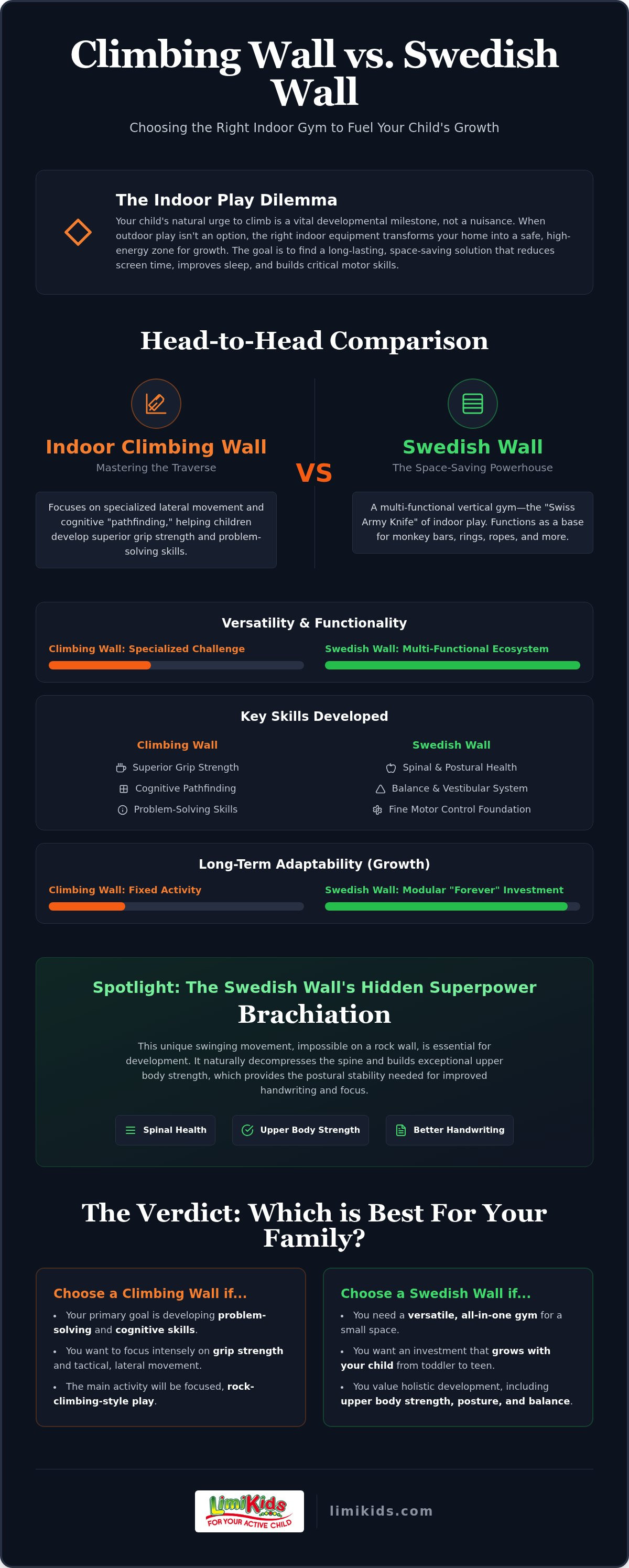
Choosing between a climbing wall vs swedish wall isn't just about picking a favorite activity. It's about maximizing your home's potential. If you're living in a modern Canadian apartment or a home with narrow hallways, every inch counts. You need equipment that delivers massive developmental benefits without swallowing your entire floor plan. Swedish walls offer a higher "Play Value per Square Foot" because they aren't just for climbing; they're a foundation for a dozen different activities. While a rock wall is a specialized trainer, a Swedish system is a complete fitness ecosystem.
| Feature | Indoor Climbing Wall | Swedish Wall Gym |
|---|---|---|
| Footprint | Large (Requires 6ft fall zone) | Compact (Vertical focus) |
| Brachiation | No (Lateral only) | Yes (Hanging/Swinging) |
| Grip Type | Pinch and Crimp | Power and Cylindrical |
| Modularity | Low (Static panels) | High (Add rings, ropes, bars) |
Installation complexity is another major differentiator. A DIY rock wall requires sourcing plywood, T-nuts, and holds. It's a weekend project with a high margin for error. LIMIKIDS kits are professional-grade. They come with everything you need for a secure, reliable install that you can trust. We focus on structural integrity so you don't have to worry about the "wobble factor" during intense play sessions.
Space Efficiency: The Vertical Advantage
Swedish walls excel in tight quarters. They typically protrude only 6 to 12 inches from the wall, making them ideal for narrow bedrooms or even play-zones in a living room. Rock walls require a flat surface but also a massive, dedicated floor area for crash mats. If you have multiple children, the Swedish system allows for more simultaneous users. One child can climb the bars while another uses the gymnastic rings or the rope ladder. It's about keeping everyone active at once.
Developmental ROI: Motor Skills vs. Strength
Think about the long-term return on your investment. Rock walls are fantastic for specific athletic training and agility. However, Swedish walls are the gold standard for sensory motor equipment for home. They provide the proprioceptive input kids need to feel grounded and focused. The boredom factor is also much lower. You can swap attachments every few months to keep the challenge fresh. Ready to build a gym that lasts? Explore our range of indoor home gyms and find the perfect fit for your growing athletes.
Why LIMIKIDS Swedish Walls are the Ultimate Home Investment
Since 2008, we've helped Canadian families reclaim their living spaces from the chaos of furniture climbing. While the debate of climbing wall vs swedish wall often focuses on aesthetics, the real winner is the system that supports your child's complex sensory needs. LIMIKIDS designs for durability and structural reliability. We don't settle for mass-market materials that flex or wobble. Our systems are anchors of safety that encourage bold movement. When you choose a Swedish wall, you aren't just buying a ladder. You're installing a professional-grade developmental hub that exceeds standard home safety requirements.
One critical advantage often ignored is sensory integration. Children need proprioceptive and vestibular input to regulate their emotions and focus. A Swedish wall provides the intense "heavy work" of pulling, hanging, and climbing that a flat rock wall simply can't match. This makes our equipment a vital tool for children with specific sensory processing needs. It aligns perfectly with Montessori play equipment principles, fostering independent discovery and self-correction. Your child leads the way; the equipment provides the safe foundation.
Crafted for Canadian Families
We know the reality of Canadian winters. When it's freezing outside, the living room is the only playground you've got. Our systems are specifically engineered for modern homes with low ceilings and tight floor plans. We've spent nearly two decades refining our modular designs to ensure they fit where other gyms fail. You get peace of mind knowing every component has been expert-tested for structural integrity. Whether you're in a high-rise or a suburban basement, our gear transforms unused walls into high-energy outlets. Plus, we offer fast, reliable shipping across Canada to get your home gym up and running without the wait.
Take the Next Step Toward an Active Home
Ready to transform your home into a zone of growth? Start by measuring your available wall height and floor clearance. Our modular systems are designed for flexibility, but a few quick measurements ensure a perfect fit. Explore our extensive range of monkey bars, gymnastic rings, and sensory play attachments to customize the experience for your child's current milestones. Don't let another winter pass with kids bouncing off the sofa. Join the thousands of Canadian parents who've traded screen time for active play. It's time to invest in your child's physical future with a gym that grows as fast as they do.
Build a Foundation for Lifelong Fitness
Choosing between a climbing wall vs swedish wall is about more than just filling a room. It's about choosing the right developmental anchor for your family. While rock walls offer tactical precision, the Swedish wall stands out as the ultimate multi-tool for sensory integration and strength. It provides the vital hanging and swinging movements that build spinal health and grip strength in a compact, vertical footprint. You don't need a massive playroom to give your kids a high-energy outlet. You just need the right equipment.
Since 2008, LIMIKIDS has been the trusted choice for Canadian parents looking for space-saving designs that don't compromise on quality. Our expert-approved systems are built for structural reliability and long-term wellness. Stop watching your kids climb the furniture and start watching them master new skills in a safe, dedicated "yes" space. It's time to invest in a home gym that grows with them. Shop Premium Indoor Swedish Walls and Kids Gyms at LIMIKIDS and transform your home today. Your kids have the energy. We have the tools to help them use it!
Frequently Asked Questions
Is a Swedish wall better than a rock climbing wall for a small bedroom?
A Swedish wall is generally superior for small bedrooms because it utilizes vertical height without requiring a massive footprint. While a rock wall needs a wide clear zone for lateral movement, the Swedish system protrudes only 6 to 12 inches from the wall. This makes it a perfect fit for narrow hallways or compact play areas. When comparing a climbing wall vs swedish wall, the ladder system provides more play options per square foot.
What age is appropriate for a Swedish wall gym?
These gyms are incredibly versatile and appropriate for children as young as 18 months under close supervision. The beauty of a modular system is that it grows with your family. Toddlers enjoy low-level climbing and sensory swings; while teenagers use the same bars for pull-ups and core conditioning. It's a long-term investment that provides physical challenges for every stage of your child's development.
Do I need a professional to install an indoor climbing wall?
You don't necessarily need a professional, but you must follow the installation guide with precision. Most Canadian families successfully install our kits using basic tools. It's vital to anchor the system into wall studs to ensure structural reliability. Unlike a DIY rock wall that requires sourcing your own plywood and T-nuts, our systems come as complete kits designed for straightforward home assembly and permanent stability.
Can a Swedish wall help with my child's sensory processing needs?
Absolutely. Swedish walls are exceptional tools for sensory integration. They provide the "heavy work" children need to regulate their vestibular and proprioceptive systems. Activities like hanging from rings or climbing the rungs offer deep pressure input that helps kids feel grounded and focused. It's a proactive way to support children with sensory processing challenges right in the comfort of your own home.
What is the weight limit for LIMIKIDS indoor gyms?
LIMIKIDS equipment is engineered for high-capacity use, supporting the dynamic weight of growing children and teenagers. While specific limits vary by model, our premium materials are chosen for their structural integrity and long-term durability. We've focused on reliability since 2008 to ensure every gym remains a safe hub for active play. Always check your specific model's manual for the exact weight ratings before use.
Which is safer for a toddler: a climbing wall or wall bars?
Wall bars are often considered safer for toddlers because they provide consistent, easy-to-grip rungs. Tiny hands can easily wrap around a cylindrical bar, whereas rock holds require more advanced grip strength. In the climbing wall vs swedish wall debate for early learners, the Swedish ladder offers more points of contact, which builds confidence and reduces the risk of slips for those just starting to explore.
How do I prevent my child from falling off an indoor gym?
The most effective way to prevent injuries is by maintaining a clear fall zone with high-quality safety mats. These crash mats provide a cushioned landing for those inevitable slips during active play. You should also ensure the equipment is used at age-appropriate heights. Supervision is key for younger children, and adding sensory attachments like ropes or rings should be done according to the manufacturer's safety guidelines.
Will a Swedish wall damage my floors or ceiling?
Our systems are designed to respect your home's surfaces. We offer both wall-mounted and pressure-mounted options that distribute weight safely. Floor pads and specialized mounting hardware help prevent scratches or indentations on your floors and ceilings. When installed correctly according to our instructions, these gyms provide a permanent, high-energy outlet without compromising the structural or aesthetic integrity of your living space.