






Space Saving Kids Gym: Complete Indoor Play Guide 2026
Your living room floor doesn't need another bulky plastic toy to keep energetic kids moving. When freezing Canadian winters keep your family indoors, cabin fever strikes fast, and floor clutter quickly takes over your home. Finding a dependable space saving kids gym often feels daunting when you worry about damaging drywall, compromising structural safety, or watching your child outgrow tiny gear in six months. You shouldn't have to surrender your everyday living space just to give your children an active, healthy physical outlet.
Vertical architecture solves this challenge instantly. Discover how vertical indoor play systems unlock full-body physical development without cluttering your living space. By shifting active play up the wall, modular climbing frames and Swedish ladders occupy under five square feet of floor footprint while handling high-capacity dynamic energy. In this guide, we break down certified home safety standards, safe stud-anchoring techniques, and versatile modular accessories that adapt seamlessly from toddlerhood right through the elementary school years.
Key Takeaways
- Maximize usable living area with a vertical space saving kids gym that mounts securely to walls, requiring under five square feet of floor space.
- Drive upper-body strength, bilateral coordination, and sensory regulation through compact climbing rungs and dynamic movement accessories.
- Protect your walls and ensure reliable safety by anchoring directly into structural studs while planning essential drop-zone impact clearances.
- Future-proof your play setup with modular frames and high-capacity weight limits that adapt from toddler milestones to elementary school fitness.
What Is a Space Saving Kids Gym and Why Do Families Need One?
A space saving kids gym rethinks active indoor play by shifting movement off your floor and directly onto your walls and ceiling. Conventional play setups expand outward, monopolizing precious square footage in family living areas. Vertical climbing equipment flips that layout completely. It harnesses unused vertical height, turning blank walls into dynamic indoor jungle gyms that challenge growing bodies.
For Canadian families, this shift is transformative. Harsh winter weather and freezing temperatures keep children cooped up inside for months at a time. Kids require regular, intense gross motor release to stay physically healthy and emotionally regulated. While public parks rely on traditional jungle gyms and climbing frames spread across wide open grass, homes need space-conscious efficiency. Modern vertical systems deliver continuous physical conditioning without turning your family room into a permanent obstacle course.
The Problem with Bulky Freestanding Play Equipment
Bulky plastic play centers consume massive footprints and create constant visual clutter. Parents spend evenings stepping around hollow molded steps and oversized toddler slides. Beyond the mess, children outgrow consumer plastic play sets within eighteen to twenty-four months once their basic coordination matures. Furthermore, their low weight limits eliminate multi-child cooperative play and prevent energetic, dynamic climbing. Families end up with expensive, disposable gear taking up floor space while failing to satisfy an older child's movement needs.
The Vertical Solution: Leveraging Wall and Ceiling Height
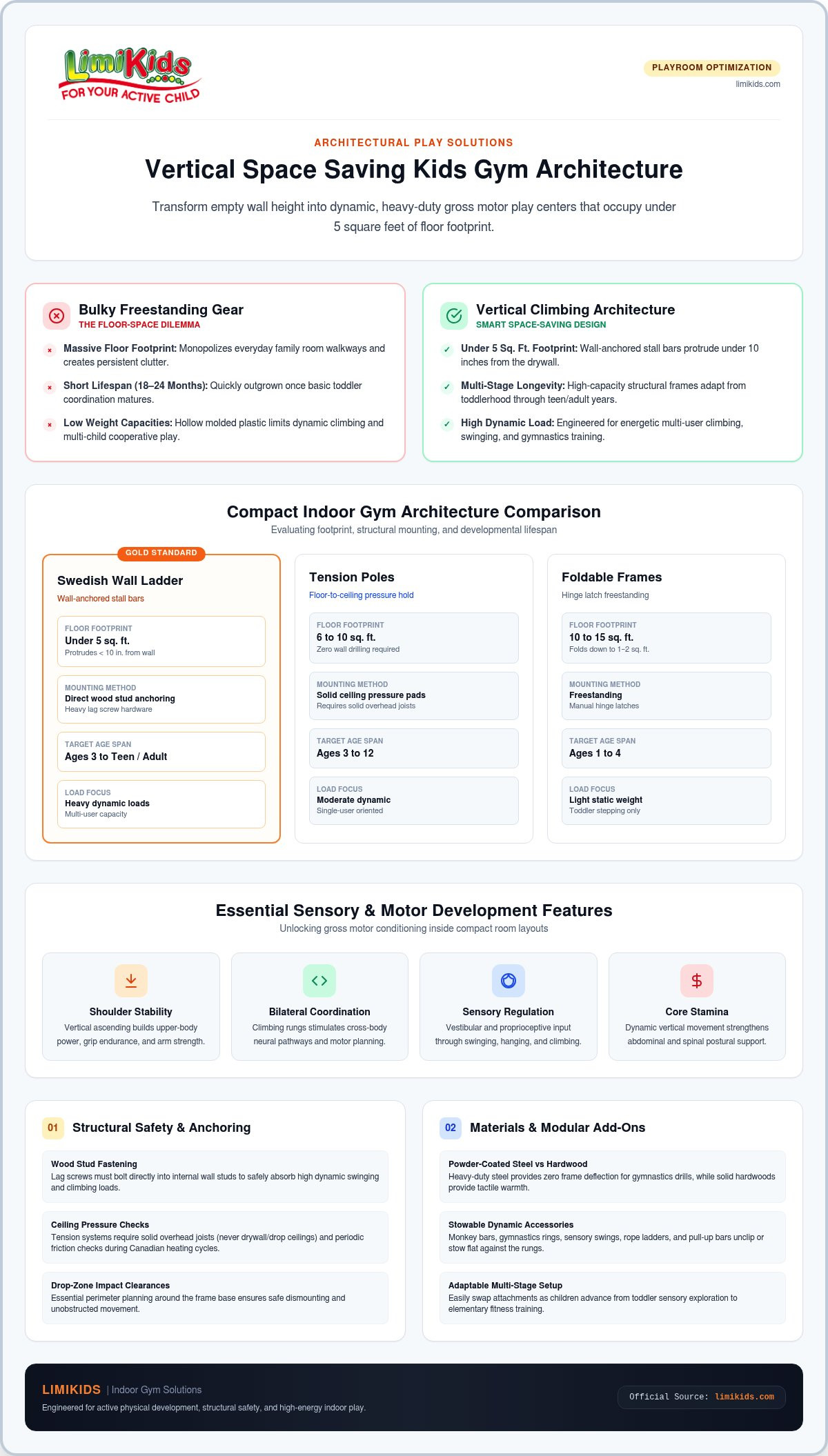
A vertical space saving kids gym solves room constraints through smart engineering. Solid Swedish wall ladders occupy under five square feet of dedicated room floor space while supporting high-capacity loads. Ascending vertical rungs challenges gross motor pathways, builds shoulder stability, and activates core stamina without choking off your walkways. Multi-functional accessories like monkey bars, gymnastics rings, and sensory swings unclip or stow away cleanly against the rungs when active play ends. You keep your floor clear for daily living while giving your children unlimited indoor adventure.
Comparing Compact Indoor Gym Types for Low-Footprint Playrooms
Choosing the right space saving kids gym means balancing room architecture against long-term developmental durability. Many parents get trapped purchasing disposable, single-stage climbing sets that satisfy early toddler steps but fail as kids grow bigger and faster. A true space-conscious setup handles intense physical impact while taking up minimal square footage. Understanding how framing styles and materials interact helps you invest in an indoor setup that endures.
| Gym Type | Floor Footprint | Mounting Requirement | Best Age Span | Load Capacity Focus |
|---|---|---|---|---|
| Swedish Wall Ladder | Under 5 sq. ft. | Direct wood stud anchoring | Ages 3 to Teen / Adult | Heavy dynamic loads, multi-user |
| Tension-Mounted Poles | 6 to 10 sq. ft. | Solid ceiling pressure pads | Ages 3 to 12 | Moderate dynamic, single user |
| Foldable Wooden Frames | 10 to 15 sq. ft. (stowed: 1-2 sq. ft.) | Freestanding / hinge latches | Ages 1 to 4 | Light static weight, toddler step |
Material selection defines structural rigidity and room styling. Heavy-duty powder-coated steel handles energetic gymnastics drills with zero frame deflection, while solid hardwoods offer tactile warmth. You can explore our deep dive comparing wooden vs metal indoor jungle gym builds to evaluate durability in humid or dry home conditions.
Swedish Wall Ladders and Stall Bars
Wall-anchored stall bars represent the gold standard of vertical play efficiency. Protruding under ten inches from the wall, they transform empty drywall spans into heavy-duty physical hubs. Bolting lag screws directly into wood studs provides exceptional stability for swinging rope ladders, pull-up bars, and gymnastic rings.
Floor-to-Ceiling Pressure-Mounted Climbing Systems
Tension setups avoid wall drilling by clamping vertical poles between the floor and solid overhead joists. While ideal for rental properties, they cannot install against suspended or drywall drop ceilings. Seasonal Canadian heating cycles cause natural material expansion, demanding routine pressure checks to ensure safe friction holds.
Foldable Wooden Climbing Structures and Pickler Variations
Hinged triangular climbers offer portable motor exploration for little explorers. They fold down easily to slide under low beds or stow inside closets when quiet floor time returns. If you are supporting early toddler balance, exploring certified Montessori play equipment provides excellent low-height climbing milestones.
When selecting your layout, verify all clearance perimeters against established CPSC safety and clearance guidelines to keep dynamic arcs protected. If you want to transform your small playroom into an enduring movement zone, explore the versatile modular setups from LIMIKIDS to find a model tailored to your family's space.
Essential Sensory and Motor Development Features in Compact Footprints
You don't need a sprawling basement playroom to unlock transformative pediatric movement therapy. A well-engineered space saving kids gym brings clinic-grade sensory feedback right into everyday residential bedrooms. By focusing on multi-planar movement, compact setups target the nervous system with precision. Children crave dynamic sensory inputs to feel centered, calm, and focused. When cold weather traps everyone indoors, vertical play channels high energy into purposeful physical development.
Integrating targeted play elements addresses three fundamental sensory-motor systems:
- Proprioceptive feedback: Deep muscle loading and heavy joint compression.
- Vestibular regulation: Fluid head positioning and equilibrium balancing.
- Brachiation mastery: Overhead hand-over-hand travel across horizontal rungs.
To dive deeper into setting up clinical-style movement pathways at home, read our complete guide on sensory motor equipment for home.
Proprioception and Heavy Work Through Vertical Climbing
Ascending vertical ladder rungs delivers vital "heavy work" for children. Pulling bodyweight against gravity compresses joint receptors in the elbows, wrists, and knees. This intense proprioceptive stimulation grounds sensory-seeking kids, regulating nervous system activity and melting away restless tension. At the same time, gripping round rungs refines fine finger strength and establishes strong postural shoulder stability.
Vestibular Integration with Detachable Swings and Rings
Fluid motion trains the inner ear to master spatial equilibrium. Detachable gymnastic rings let children spin, invert, and swing through controlled arcs, fine-tuning their balance and spatial orientation. Trapeze bars challenge spatial timing as kids shift between grip holds. Using secure quick-clip carabiners, parents can swap dynamic accessories in seconds, stowing them away when quiet room time begins.
Brachiation Mechanics on Compact Overhead Monkey Bars
True upper-body development requires hanging and traversing. Cantilevered monkey bar attachments extend out over a room's upper perimeter, giving kids authentic brachiation opportunities without stealing floor clearance. Swinging hand-over-hand builds bilateral hand-eye coordination, stretches spinal alignment, and expands natural ribcage lung capacity. A compact vertical space saving kids gym delivers this vital pediatric cross-body patterning right within your existing room boundary.
Planning Room Layouts, Stud Placement, and Drop-Zone Clearances
Installing an active climbing setup in a compact bedroom or family area requires exact spatial planning. To guarantee rock-solid safety, follow our proven four-step blueprint: measure overhead clearance, map internal wall studs, anchor structural framing, and lay down certified impact padding. Safe drop zones protect your peace of mind. Always calculate a clear five-foot perimeter in every direction around dynamic play zones, ensuring children swing and jump well away from radiators, open doorways, and sharp furniture corners.
- Measure clearances: Verify ceiling height and lateral swing clearance.
- Map wall studs: Find exact stud centers with a deep-scan electronic sensor.
- Secure hardware: Drive structural lag bolts directly into solid wood framing.
- Position safety mats: Place certified, high-density folding crash mats beneath the entire climbing area.
Step 1 & 2: Space Measurement and Structural Stud Mapping
Start by measuring floor-to-ceiling clearance to ensure ample headroom for overhead monkey bars and hanging accessories. Next, scan the target wall with an electronic multi-sensor to pinpoint structural stud centers. Standard North American residential framing places solid wood studs sixteen inches or twenty-four inches on-center. Mark both outer edges of each stud to identify the exact structural core. Never drive mounting screws into hollow drywall anchors alone; dynamic climbing forces will rip drywall apart instantly.
Step 3 & 4: Hardware Anchoring and Dynamic Fall Mat Sizing
Align heavy-duty steel brackets over your marked stud centers and drill pilot holes into the wood framing. Drive manufacturer-specified structural lag screws deep into the studs until the mounting plate sits flush without movement. Before letting your children play, test the installed anchor points with your full adult bodyweight to confirm complete rigidity. Finish your installation by placing a high-density expanded polyethylene (EPE) folding tumbling mat underneath the climbing path. These mats absorb significant drop impacts, then fold cleanly against the wall rungs when play winds down.
A properly installed space saving kids gym gives your children an exhilarating, confidence-building physical outlet while keeping your walls and room fully protected. Ready to turn your open wall into a safe, heavy-duty play zone? Explore safe, stud-mounted gym equipment at LIMIKIDS to find the perfect fit for your home.
Choosing an Adaptable Indoor Gym System That Grows with Your Child
Smart play equipment grows alongside your child instead of heading to a landfill after toddlerhood. Investing in a true space saving kids gym means prioritizing modular architecture that accommodates shifting developmental stages over many years. Modular framing lets you swap rungs, incline ramps, and suspension attachments as your child's confidence, height, and coordination surge. High-capacity structural limits ensure your investment withstands intense, dynamic adolescent play rather than buckling under growing weight. For a deeper breakdown of frame construction and modular options, explore the ultimate guide to choosing an indoor home gym for kids in 2026.
When evaluating multi-stage systems, keep three core benchmarks in mind:
- Interchangeable mounting points: Quick transitions between static climbing rungs and dynamic hanging gear.
- Adolescent-rated load thresholds: Heavy weight tolerances built for vigorous swinging and teen bodyweight fitness.
- Non-toxic structural materials: Smooth hardwood rungs and powder-coated steel engineered for lifetime indoor durability.
Progressive Milestones: From Toddler Rungs to Adolescent Strength
Physical development accelerates quickly across childhood. Early toddlers build bilateral confidence on low bottom rungs paired with soft, angled climbing ramps. As spatial awareness sharpens, elementary kids advance to gymnastic rings, hanging climbing ropes, and suspended monkey bar runs. Because quality stall bars feature heavy-duty weight limits, adolescents and adults can use the exact same vertical ladder for pull-ups, spinal decompression, and daily core conditioning.
The LIMIKIDS Standard: Canadian Reliability and Engineered Safety
Active indoor gear must withstand continuous, vigorous play through long, cold winters. Proudly serving Canadian families with active indoor play solutions since 2008, LIMIKIDS builds indoor home gyms engineered to meet strict home safety standards. Premium-grade materials and reinforced hybrid engineering eliminate structural flex, anchoring directly into wall studs while occupying under five square feet of floor footprint. Browse the LIMIKIDS indoor playground collection to build an adaptable movement space tailored to your family's home.
Unlock Limitless Indoor Adventure in Any Room
Vertical play redefines how your family conquers long, freezing winters and indoor restlessness. Shifting movement upward onto structural wall framing protects valuable floor space while providing vital sensory regulation and full-body physical conditioning. A modern space saving kids gym transforms under five square feet of floor footprint into an active arena, proving you don't need a sprawling playroom to build remarkable coordination, balance, and lifelong confidence.
Proudly serving Canadian families with active indoor play solutions since 2008, LIMIKIDS designs modular systems engineered to withstand dynamic loads, safely supporting growing kids and active parents alike. Your home setup adapts year after year, swapping dynamic attachments as developmental milestones evolve. Take the leap, protect your living area, and bring adventurous physical discovery right to your walls. Explore our space-saving indoor kids gyms at LIMIKIDS to find your family's perfect fit today!
Frequently Asked Questions
How much floor space is truly required for a space saving kids gym?
A dedicated Swedish ladder system requires under five square feet of actual floor footprint, projecting less than ten inches outward from the wall. During active climbing and swinging sessions, you need a dynamic drop zone extending roughly five to six feet forward. Because accessories unclip or fold flush in seconds, that surrounding floor area remains completely open for daily family living when playtime wraps up.
Can an indoor climbing gym be safely mounted to standard drywall walls?
No climbing gym should ever rely solely on hollow drywall anchors. Dynamic climbing forces easily tear sheetrock apart, creating severe fall hazards. Wall-mounted gyms must fasten directly into internal solid wood framing studs using heavy-duty structural lag screws. If your wall studs don't match the gym's bracket width, mount a solid wood stringer board horizontally across multiple studs first, then secure your climbing frame into that reinforced backing.
Are space saving kids gyms suitable for small apartment living?
Yes, an apartment is often the best setting for a space saving kids gym. Because vertical equipment utilizes overhead ceiling height rather than broad floor area, compact condos can easily host climbing rungs and sensory swings. Renters who want to avoid drilling wall studs can choose floor-to-ceiling tension-mounted systems that lock into solid joists via pressure pads. Just ensure your building allows overhead tension installations.
What is the safe age range for indoor Swedish wall climbing gyms?
Most modular Swedish climbing frames accommodate children from age three through adolescence and even adulthood. Toddlers can safely explore the lowest rungs and angled ramps under close supervision. As grip strength develops around preschool age, kids graduate to higher rungs, rope ladders, and gymnastic rings. Thanks to heavy-duty engineering and high weight thresholds, older kids and adults can use the exact same ladder for bodyweight fitness.
How thick should the safety crash mat be under a kids indoor gym?
Standard residential carpet and regular padding don't provide adequate shock attenuation for falls above twelve inches. For proper protection, place a dedicated tumbling crash mat measuring two to four inches thick directly beneath the play zone. High-density expanded polyethylene (EPE) or multi-layer EVA folding mats provide certified impact absorption. They absorb heavy landings, protect developing joints, and fold upright against the wall when play finishes.
Can tension-mounted kids gyms damage plaster or finished drywall ceilings?
Tension poles can crack finished drywall or historic plaster if they aren't positioned directly beneath a structural solid wood ceiling joist. Never install tension systems beneath suspended drop-tile ceilings or unsupported drywall spans. Tightening pressure pads against hollow drywall pushes straight through the sheet. Always locate solid framing joists with a deep-scan sensor, or place a wide hardwood distributor plate across the ceiling to spread tension loads safely.
How do indoor climbing gyms support children with sensory processing needs?
Indoor gyms offer vital sensory diet tools right at home. Pulling bodyweight against vertical rungs provides deep proprioceptive feedback, which calms restless nervous systems through therapeutic heavy work. Detachable sensory swings and gymnastic rings deliver controlled vestibular stimulation, helping children master spatial orientation and balance. Well-designed space saving kids gyms turn room corners into soothing regulation zones where neurodivergent kids can decompress, reset, and build physical confidence safely.