






Kids Indoor Jungle Gym Safety Standards in Canada: The Parent’s 2026 Guide
Your child's indoor jungle gym is more than a toy. It's a precision-engineered tool for physical growth. It must meet the highest kids indoor jungle gym safety standards Canada to handle the intense energy of daily play. We know the anxiety that comes with watching your toddler reach for the highest rung. You worry about structural integrity. You wonder if your flooring is thick enough to break a fall. It is natural to feel protective when your child is exploring their physical limits.
It's frustrating to stare at technical codes like CSA Z614:20 or ASTM F1148-22 and wonder what they actually mean for your living room. You deserve total peace of mind while your kids build strength and coordination. This 2026 guide helps you master the technical requirements to ensure every climb is secure. We’ll explain the latest Canadian regulations, simplify the differences between public and residential standards, and give you a clear checklist for evaluating equipment durability. Let's transform your home into a safe, high-energy zone for active development.
Key Takeaways
- Decode the 2026 kids indoor jungle gym safety standards Canada to identify equipment that truly protects your child during high-energy play.
- Compare the structural benefits of wood versus metal and learn why non-toxic, lead-free finishes are essential for a healthy home environment.
- Master the 1.8-metre clearance rule and discover why standard household carpets don't provide enough impact protection for climbing heights.
- Identify critical engineering features that prevent head and neck entrapment, ensuring your child's physical discovery remains worry-free.
- Get a practical checklist for evaluating long-term durability and structural integrity so your gym safely grows with your family's needs.
Understanding Indoor Jungle Gym Safety Standards in Canada
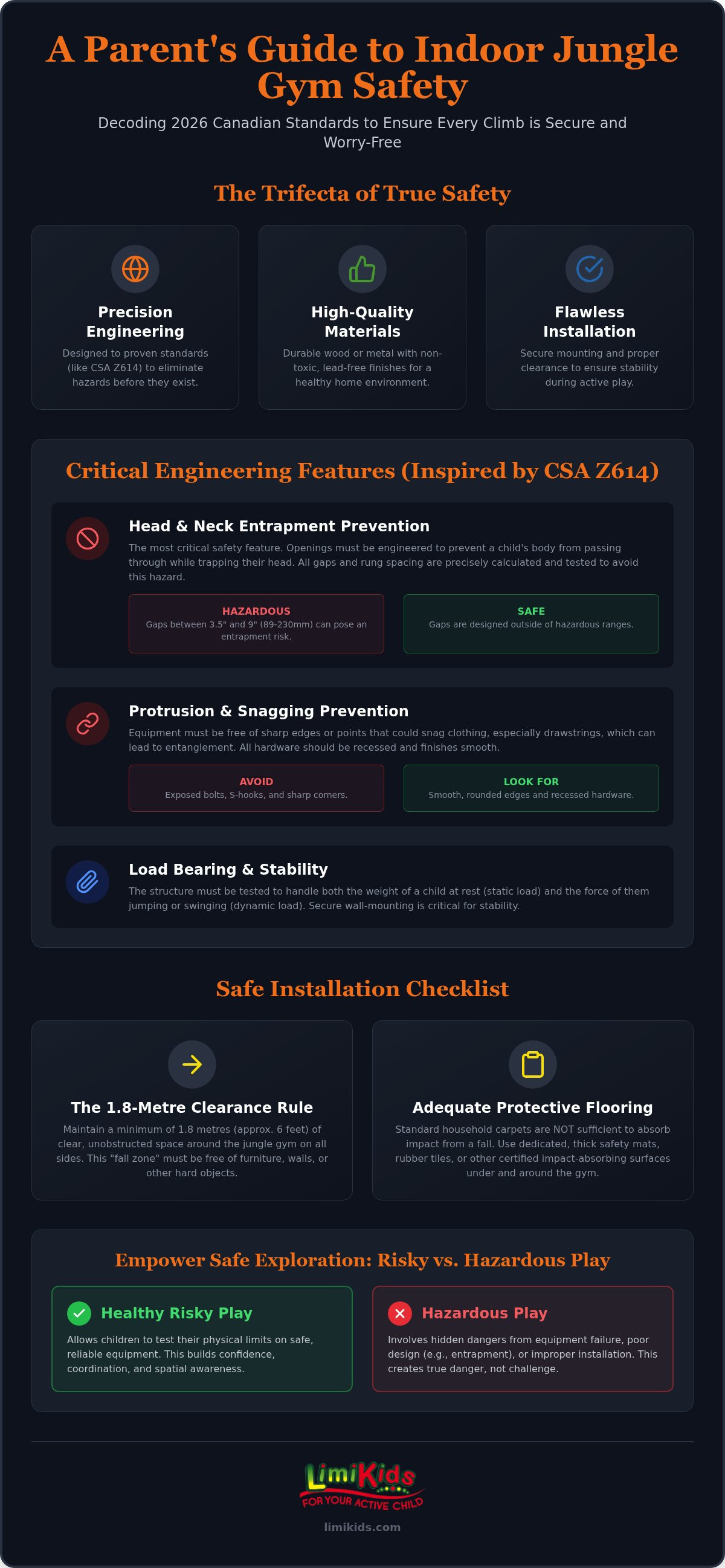
Canadian winters are legendary for their length and intensity. For parents, this means months of pent-up energy trapped inside the home. The rise of active indoor play isn't just a trend. It's a survival strategy for active families. However, transforming your living room into a movement hub requires more than just bolting bars to a wall. True safety is a trifecta of precision engineering, high-quality materials, and flawless installation. When you evaluate kids indoor jungle gym safety standards Canada, you're looking for equipment that manages the force of a growing child's jumps and climbs without compromise.
Many parents confuse residential-grade equipment with the bulky commercial sets found in public parks. While both must be durable, residential systems are optimized for the specific footprint of a home. They prioritize space-saving designs and aesthetic finishes while maintaining the structural integrity required by law. Since 2008, LIMIKIDS has focused on this balance, ensuring that home equipment meets the rigorous demands of Canadian domestic life. Safety standards aren't just red tape. They are the engineering blueprint that prevents structural failure and ensures your child's development is as secure as it is active.
The Psychology of Safe Play
Safe play doesn't mean zero risk. It means the absence of hazards. There is a vital distinction between "risky play" and "hazardous play." Risky play allows children to test their physical boundaries, which is essential for building confidence and spatial awareness. Hazardous play involves equipment failure or hidden dangers like poor bar spacing. Certified equipment empowers your child to take healthy risks. It builds a deep foundation of trust between the parent and the equipment. When a child knows the bar won't budge, they focus entirely on their grip, their reach, and their burgeoning strength.
Regulatory Bodies in Canada
Health Canada oversees the safety of children's products through the Canada Consumer Product Safety Act (CCPSA). This act is a powerful shield for families. It prohibits the sale of any product that poses a danger to human health or safety. While many international brands follow basic guidelines, Canadian standards are often more stringent to address specific residential risks. The CSA Group develops the technical benchmarks that manufacturers use to prove their equipment can withstand the rigors of daily play. These standards ensure that every bolt, finish, and rung meets a national expectation for reliability. By choosing equipment that aligns with these benchmarks, you're investing in a permanent tool for your child's pediatric wellness.
The CSA Z614 Standard: What it Means for Your Home Gym
While CSA Z614:20 is technically the national standard for public-use playgrounds, it serves as the ultimate engineering benchmark for residential equipment. It dictates how manufacturers design every joint, rung, and fastener to prevent serious injury. For parents, understanding these kids indoor jungle gym safety standards Canada is about moving beyond "it looks sturdy" to "it is scientifically proven." According to Parachute's Playground Safety Standards, proper equipment design is the first line of defense against falls and entrapment. By aligning home gyms with these rigorous public standards, you ensure your child's play space is built to the same level of accountability as a city park.
Entrapment and Protrusion Zones
The most critical technical requirement involves preventing head and neck entrapment. Engineers use a "probe test" to simulate a child's head or body entering a space. If a gap is large enough for a child's torso but small enough to catch their head, it's a hazard. This is why the spacing between rungs on a Swedish wall gym must be precise. It's not just about aesthetics; it's about life-saving geometry. Protrusion hazards are equally dangerous. Standards prohibit "S-hooks" or sharp edges that can snag clothing drawstrings or jewelry. A safe gym has smooth, rounded finishes and recessed hardware to keep your child moving freely without the risk of entanglement. These details separate high-quality equipment from cheap imitations that compromise on safety for lower costs.
Load Bearing and Stability
Structural integrity depends on how a gym handles weight. Manufacturers calculate two types of limits: static and dynamic. Static weight is the load the equipment holds while still. Dynamic weight is the force applied during active swinging or jumping. Premium gyms often utilize wall-mounting systems to anchor the frame directly into the home's structure. This provides superior stability compared to simple tension systems. In the context of engineering safety, load capacity is defined as the ability of a component to withstand three times the rated weight without structural failure. This safety factor provides a massive buffer for high-energy play. If you want to ensure your setup meets these elite benchmarks, you can learn more about choosing high-safety indoor gyms that grow with your family.
Material Integrity: Comparing Wood, Metal, and Finishes
Material choice is the foundation of structural safety. Every surface your child touches must be non-toxic and resilient. When you compare wooden and metal indoor jungle gyms, you're looking at two different paths to the same goal: durability. Metal gyms excel in high-humidity areas like basements because they resist corrosion. High-quality wooden frames use multi-layered plywood or solid hardwoods to prevent splinters. These materials must meet kids indoor jungle gym safety standards Canada to handle the dynamic loads of active climbing. Your choice defines the gym's lifespan and its safety profile.
Non-Toxic Coatings and VOCs
Safety extends to the air your child breathes. Low-quality equipment often uses solvent-based paints that release volatile organic compounds (VOCs). This off-gassing can affect indoor air quality for weeks. Premium Canadian equipment uses water-based lacquers. These finishes are lead-free and saliva-resistant. To verify this, look for REACH or Greenguard certifications. These standards ensure the finishes meet strict chemical emission limits. It's a proactive way to protect your child's health while they explore their physical limits. Don't settle for mystery coatings when certified non-toxic options are available.
Grip and Surface Texture
Grip is the difference between a successful swing and a slip. The diameter of the rungs is a critical technical detail. For effective brachiation, rungs should be between 25mm and 32mm. This size allows small hands to wrap completely around the bar for a secure hold. Powder-coated metal provides a consistent, slightly textured grip that resists sweat. Natural wood offers a warm, high-friction surface that many find more comfortable. Both must pass slip-resistance tests under kids indoor jungle gym safety standards Canada. Whether you choose the industrial strength of metal or the organic feel of wood, the surface must empower your child to move with total confidence.
Safe Installation: Flooring, Clearance, and Maintenance
A successful setup begins with the right foundation. While many homeowners choose durable, low-maintenance surfaces like those from DIY Floorboards as a base for their playrooms, remember that safety standards require additional impact attenuation in the fall zone.
Installation is the final bridge between a premium product and a secure home. You've invested in high-quality equipment. Now you must ground it properly. The "Fall Zone" is your non-negotiable buffer. To align with kids indoor jungle gym safety standards Canada, maintain a 1.8-metre clearance around all active play areas. This space must be free of furniture, sharp corners, or hard walls. If your child swings or jumps, they need a clear landing path. Don't eyeball it. Use a tape measure. Precision here prevents the most common indoor impact injuries.
Impact attenuation is where many parents falter. A standard residential carpet provides almost zero protection against a fall from a height of one metre. You need specialized mats designed to absorb energy. This is about physics, not just softness. High-quality indoor climbing equipment requires flooring that manages G-Max and HIC levels effectively. Professional-grade surfacing ensures that a stumble doesn't become a trip to the emergency room.
Selecting Safety Mats
G-Max measures the maximum acceleration of an impact. HIC, or Head Injury Criterion, measures the duration of that impact. You want a low G-Max and a safe HIC score. For home use, high-density EPE foam mats are ideal. They offer firm support for joints while providing critical shock absorption. Folding mats are a smart choice for Canadian homes. They provide professional-grade protection during play and tuck away when you need your floor space back. You can secure your play zone with engineered safety mats that meet these rigorous benchmarks.
The Installation Checklist
- Step 1: Identify your studs. Never anchor a gym to drywall alone. Canadian homes typically use 16-inch or 24-inch wood stud spacing. Use a high-quality stud finder to ensure a direct hit.
- Step 2: Measure clearance zones. Verify the 1.8-metre rule in every direction. Account for the full arc of a swing or the extension of a slide.
- Step 3: Level the structure. An unlevel gym places uneven stress on fasteners and joints. This leads to premature wear and structural instability.
- Step 4: Final stress test. Apply your own weight to the bars before your child starts their first session. This confirms the kids indoor jungle gym safety standards Canada are met in your specific environment.
Commit to a monthly "tighten and check" routine. Active play creates vibration that can loosen bolts over time. A five-minute inspection keeps the equipment permanent and your peace of mind intact.
Why LIMIKIDS Standards Set the Bar for Canadian Families
Choosing the right equipment is a major decision for your family's home environment. Since 2008, LIMIKIDS has been at the forefront of the industry, helping Canadian parents navigate the complexities of kids indoor jungle gym safety standards Canada. We don't just sell equipment. We provide a foundation for your child's physical and sensory development. Our systems are engineered specifically for the Canadian home. We acknowledge that space is often at a premium, yet the need for activity remains high during our long winters. We've taken the technical requirements of CSA Z614 and integrated them into designs that fit seamlessly into your living space without compromising on strength.
Structural integrity is our baseline, not our ceiling. While many brands offer "disposable" plastic toys that degrade or crack over time, we focus on permanence. We use high-strength materials that withstand the dynamic forces of growing, high-energy children. This commitment to quality means our gyms don't just sit in a room. They become a reliable part of your child's daily routine. Our dedicated Canadian support team is always available to answer specific installation or safety questions. We ensure your setup is as secure as the day it was built. You get expert guidance tailored to the specific needs of Canadian residential construction.
Designed to Grow with Your Child
True value lies in longevity. Our Montessori play equipment is designed to adapt as your child ages. A toddler using a low rung for stability eventually becomes a school-aged child mastering complex climbing sequences. This progression is essential for gross motor development and coordination. By providing a secure environment, you encourage independent discovery. Your child learns to trust their body because they can trust the equipment. This is the heart of the Montessori philosophy. You provide the right tools so the child can do it themselves. You aren't just buying a gym. You're investing in a decade of active, healthy milestones.
The LIMIKIDS Quality Assurance
We believe that safety and sustainability go hand in hand. Our commitment starts with sourcing high-strength, sustainably harvested materials that meet strict environmental criteria. Every component undergoes a rigorous quality control process before it ships across Canada. We inspect every weld, every finish, and every fastener to ensure it meets our elite benchmarks for reliability. We've vetted these standards so you don't have to. You can focus on the joy of watching your child reach new heights, knowing the engineering beneath them is rock solid. Ready to transform your home into a space of growth? Explore our collection of safety-certified indoor gyms and start your family's active journey today.
Elevate Your Child's Play with Certified Safety
Mastering the technical side of indoor play ensures your child's physical development remains both active and secure. You now understand why CSA Z614 engineering is vital for residential equipment and how specialized impact flooring prevents common injuries. Choosing equipment that meets kids indoor jungle gym safety standards Canada isn't just about regulatory compliance; it's about building a deep foundation of trust within your home environment. You deserve a space where your children can test their limits without compromise.
Since 2008, LIMIKIDS has delivered premium Canadian quality through Montessori-inspired safety designs that grow alongside your family. We've vetted the materials, the load-bearing math, and the non-toxic finishes so you can focus entirely on the milestones. Transform your living space into a high-energy zone for strength and coordination today. It's time to provide the professional tools your kids need for independent discovery. Shop Certified Indoor Jungle Gyms for Your Home and start your active journey with a partner who prioritizes your peace of mind. Let's build a future where every climb is as safe as it is exciting!
Frequently Asked Questions
Do indoor jungle gyms need to be CSA certified in Canada?
While no federal law mandates that residential equipment must be CSA certified, following kids indoor jungle gym safety standards Canada is the best way to ensure quality. Manufacturers often use the CSA Z614 standard as a voluntary engineering benchmark to prove structural integrity. Choosing equipment that aligns with these national standards ensures your home setup matches the safety profile of a public playground, providing peace of mind for every climb.
What is the safest flooring for a home indoor climbing frame?
High-density EPE foam mats are the safest choice for home climbing frames. Standard carpets or rugs don't provide the impact attenuation needed to absorb energy from a fall. Look for mats designed with safe G-Max and HIC ratings, which measure maximum acceleration and impact duration. Professional safety mats protect your child’s joints and head by dispersing force effectively, turning a potential stumble into a soft landing.
How much clearance space do I need around an indoor gym?
You need a minimum of 1.8 metres of unobstructed clearance in every direction around your active play equipment. This "Fall Zone" ensures that if a child swings or jumps, they won't collide with furniture, hard walls, or sharp corners. Measuring this zone with a tape measure is a non-negotiable step in your installation process. It creates a dedicated safety buffer that allows for high-energy movement without the risk of secondary impact.
Can I install a Swedish wall gym on drywall?
No, you should never install a Swedish wall gym directly onto drywall alone. Drywall lacks the structural strength to support the dynamic weight of a climbing child. You must anchor the equipment directly into wood studs, which are typically spaced 16 or 24 inches apart in Canadian homes. Using a stud finder ensures a secure connection to the home’s frame, preventing the equipment from pulling away from the wall during use.
What are the most common safety hazards in cheap indoor gyms?
Cheap indoor gyms often present hazards like head and neck entrapment zones where rungs are spaced incorrectly. Other common issues include poor-quality materials that splinter, "S-hook" hazards that catch clothing, and finishes that off-gas harmful VOCs. High-quality equipment follows kids indoor jungle gym safety standards Canada to eliminate these engineering flaws. Investing in premium gear ensures that every joint and surface is smooth, non-toxic, and built to withstand years of intense play.
Is a wooden or metal jungle gym safer for toddlers?
Both materials are equally safe if they meet professional engineering standards. Wooden gyms offer a natural, warm texture that provides excellent grip for small hands and fits beautifully in living spaces. Metal gyms are incredibly durable and resist corrosion, making them ideal for basement setups. The key is ensuring the equipment features non-toxic finishes and rounded edges, regardless of whether you choose the organic feel of wood or the industrial strength of metal.
How often should I inspect my kids indoor gym for safety?
You should perform a "tighten and check" inspection at least once a month. Active play creates vibrations that can naturally loosen bolts and fasteners over time. Check for any signs of wear on ropes, ensure all wall anchors remain flush, and verify that the structure is still level. A quick five-minute routine keeps the equipment permanent and secure, ensuring your child’s play environment stays as safe as the day you installed it.
Are there specific weight limits for indoor monkey bars?
Yes, every set of indoor monkey bars has specific weight limits divided into static and dynamic loads. Static limits refer to stationary weight, while dynamic limits account for the force applied during active swinging. Premium equipment is often engineered to withstand three times the rated weight as a safety buffer. Always check the manufacturer’s specifications to ensure the equipment can support your child’s current weight and their expected growth over the next several years.