






Best Low Ceiling Indoor Monkey Bars: 2026 Parent's Guide
What if that cramped 7-foot basement ceiling wasn't an obstacle, but actually the launchpad for your child's next big physical milestone? You've likely spent hours measuring and worrying that your home just isn't built for high-energy play. It's frustrating to watch your kids climb the furniture because you're terrified a bulky gym set won't fit or will lead to a head injury against a low joist. We understand the struggle of finding the best indoor monkey bars for low ceilings that don't turn your playroom into a cluttered, dangerous mess.
You deserve a home that fosters growth without sacrificing safety or floor space. This guide reveals how to transform even the tightest spaces into high-energy climbing zones using modular, low-profile Swedish wall systems. We'll explore equipment that fits perfectly under 8-foot ceilings, builds incredible upper body strength, and meets the latest 2026 safety standards. From choosing the right metal frames to understanding critical fall zones, you're about to discover how to turn that "wasted" basement space into a professional-grade kids' gym.
Key Takeaways
- Master vertical space by choosing wall-mounted Swedish gyms that provide maximum climbing potential without cluttering your floor.
- Discover how to select the best indoor monkey bars for low ceilings by calculating the essential "buffer zone" to keep your child's head safe from overhead obstructions.
- Boost your child's upper body strength and grip endurance through brachiation, even in rooms with limited vertical clearance.
- Ensure a rock-solid installation by securing equipment to wall studs and accounting for the thickness of high-density safety mats.
- Invest in modular equipment that adapts to your home's unique layout and grows alongside your child's developmental milestones.
Understanding the Low-Ceiling Challenge for Indoor Play
Don't let a 7-foot ceiling crush your child's climbing dreams. In the world of indoor play, we define a "low ceiling" as anything under 8 feet. This is a common reality for families with finished basements or attic playrooms. While standard equipment often demands massive vertical clearance, the best indoor monkey bars for low ceilings are engineered specifically to work within these tight boundaries. The goal isn't just to fit the bars in the room; it's to ensure your child has the range of motion to actually use them safely. If the equipment is too cramped, the play becomes restrictive and loses its developmental value.
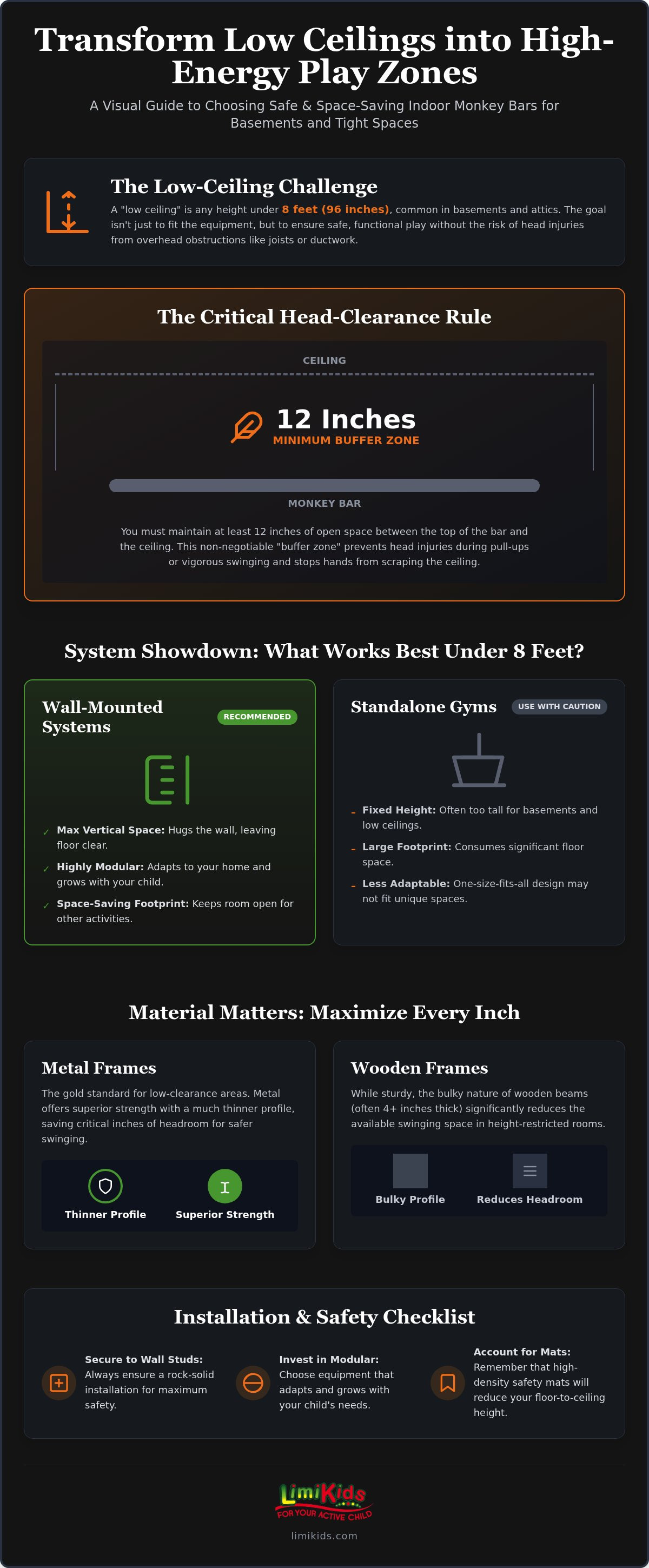
Safety centers on the "buffer zone." This is the space between the top of the bar and the ceiling itself. Many parents focus solely on how high the bars are from the floor, but head clearance is actually the more critical metric. If a child performs a pull-up or a vigorous swing, they need enough clearance to avoid overhead injuries. Understanding The Science of Brachiation shows us that arm-swinging requires a fluid, rhythmic motion. If the ceiling is too close, that rhythm is broken. We're here to debunk the myth that small spaces can't support high-level physical activity. With the right configuration, your basement can become a powerhouse for gross motor development without feeling like a cluttered storage unit.
The Minimum Height Requirement for Safe Swinging
Calculating your clearance starts with the 12-inch rule. You must maintain at least 12 inches of open space between the monkey bar rungs and your ceiling. This gap provides enough room for small hands to grip the bars securely without scraping knuckles against the drywall. It also protects your child's head during active play. When you're looking for the best indoor monkey bars for low ceilings, prioritize adjustable height systems. These modular designs allow you to drop the bar height as your child grows, ensuring they always have the perfect balance of swinging room and safety clearance. In a basement with 7-foot ceilings, every inch is a precious resource you can't afford to waste.
Space-Saving vs. Low-Clearance: Knowing the Difference
It's easy to confuse a small floor footprint with low-clearance design. A piece of equipment might take up very little floor space but still be too tall for your room. Conversely, some wide sets are actually quite short. In a standard Canadian home, the basement is often the primary zone for an indoor jungle gym. These rooms frequently feature low-hanging ductwork or support beams that complicate installation. Modular Swedish wall systems excel here because they focus on vertical efficiency. If you can't go higher, you can expand horizontally along the wall. This layout keeps the center of the room open for other activities while providing a dedicated, safe climbing zone that respects your home's architectural limits.
Choosing the Right Monkey Bar System for Your Space
Stop settling for bulky, one-size-fits-all frames that eat up your entire basement. Finding the best indoor monkey bars for low ceilings means looking beyond the local big-box toy store. You need a system that respects your vertical limits while maximizing your child's movement. While standalone jungle gyms are popular, they often feature fixed heights that are too tall for finished basements. Wall-mounted frames and Swedish walls offer a streamlined alternative. These systems hug the wall, keeping the center of your room clear for other activities. They provide the structural integrity your kids need without the massive footprint of traditional equipment.
Material choice is your next big decision. Metal frames are the gold standard for low-clearance environments. They offer a much thinner profile than bulky wooden sets. In a room with only 84 inches of height, a 4-inch thick wooden beam significantly reduces swinging space. High-quality metal tubing provides superior strength with a much smaller diameter. This allows you to squeeze every possible inch of play out of your room. Always check weight capacities before you buy. You want equipment that supports multi-child play and remains stable as your children grow into their teenage years. Following home playground safety guidelines ensures your installation remains a secure sanctuary for years to come.
Swedish Wall Gyms: The Low-Ceiling Hero
Swedish wall gyms are the ultimate vertical solution for tight spaces. These systems are incredibly efficient. They use a ladder-style base that can be either wall-anchored or pressure-mounted between the floor and ceiling. You can learn more about the Swedish wall gyms for kids and how they promote healthy growth. Pressure mounting is a game-changer for many Canadian basements. It allows for a rock-solid fit without drilling into your joists. Because the monkey bar components are often adjustable, you can set the height exactly where your child needs it. This flexibility is perfect for toddlers who need a lower start and older kids who crave a challenge.
Modular Attachments for Custom Heights
Growth is inevitable, but your equipment should keep up. Modular systems allow you to add or remove components as your child's skills evolve. You can start with a basic wall ladder and add monkey bar extensions later. This "build-as-you-go" approach is budget-friendly and space-efficient. When deciding on materials, consider reading our guide on wooden vs metal indoor jungle gyms to see which fits your home's aesthetic and durability needs. Metal remains the favorite for longevity and low-profile installation. If you're ready to upgrade your playroom, explore our collection of premium indoor playground equipment designed for modern homes.
The Science of Brachiation: Why Every Inch Counts
Brachiation sounds complex, but it's the simple, joyful act of swinging from bar to bar. This movement is a developmental powerhouse. It's not just about burning energy; it's about wiring the brain for success. When you install the best indoor monkey bars for low ceilings, you aren't just buying a toy. You're providing a tool for cognitive and physical growth. This rhythmic locomotion stretches the spine, improves posture, and builds the foundational strength needed for complex movements later in life. Even in a basement with limited headroom, the benefits of suspension play are massive.
Upper body strength and grip endurance are the most immediate rewards. Even in a room where full swinging range is limited, the act of hanging is transformative. It builds the small muscles in the hands and wrists that are essential for fine motor tasks like writing and drawing. Research into the role of play in physical development confirms that these active challenges are vital for coordination and balance. Every second your child spends suspended from a bar, they're mastering their own body weight and building grit. They learn to trust their own hands.
The psychological impact is just as profound. Mastering a difficult climbing route in the comfort of home provides a massive confidence boost. It teaches children that they can overcome physical obstacles through persistence. This "can-do" attitude doesn't stay in the playroom. It follows them into the classroom and onto the sports field. By optimizing your space with equipment designed for low clearance, you ensure these developmental benefits aren't lost just because your ceiling height is standard. You're turning a structural limitation into a personal victory for your child.
Gross Motor Skills and Low-Profile Play
Core stability is the secret benefit of climbing. Even when vertical space is tight, your child's midsection works overtime to stabilize their body during a swing or pull-up. This deep core strength is the foundation for all other gross motor skills. Understanding how monkey bars for kids indoor build confidence helps parents see beyond the physical rungs. This active play also improves classroom focus. When children get the intense physical input they crave at home, they're better able to sit still and concentrate during school hours. They've already "worked out" their restless energy.
Sensory Benefits for Active Kids
Indoor gyms provide essential proprioceptive and vestibular input. Proprioception is the brain's ability to know where the body is in space. Pulling, hanging, and climbing provide the deep pressure input that many high-energy children need to feel calm and regulated. Vestibular stimulation comes from the movement of the head during a swing or climb. This helps develop a strong sense of balance and spatial awareness. For kids who struggle with sensory processing, having a dedicated climbing zone at home is a life-changer. It offers a safe, controlled environment to explore movement and find their center without the overwhelming noise of a public park.
Step-by-Step: Installing Monkey Bars in Low-Profile Rooms
Ready to build the ultimate play zone? Success starts with a solid plan. Before you even open the box, grab your stud finder. You must anchor your equipment into solid wood, not just drywall. In many basements, you'll also need to navigate around low-hanging pipes, electrical conduits, or HVAC ducts. When searching for the best indoor monkey bars for low ceilings, look for systems that offer modular footprints. This allows you to shift the placement slightly to avoid these permanent household fixtures. Mark your intended "swing path" on the floor with painter's tape to visualize the movement before you commit to the first bolt.
Precision is your best friend when vertical space is tight. Measure your ceiling height in three different spots to account for uneven basement floors. Most importantly, subtract the thickness of your safety mat from your total height. If you have an 84-inch ceiling and a 4-inch mat, your "active" vertical play space is actually 80 inches. Pressure-mounted systems are fantastic for finished rooms because they don't require drilling into your flooring or joists. However, if you choose a bolt-down model, ensure you have the right hardware for your specific floor type, whether it's concrete or wood subflooring. Once assembly is complete, perform the "Parent Pull" check. Grab the bars yourself and apply firm, downward pressure. If the frame doesn't budge under your weight, it's officially ready for theirs.
Safety Mats: The Non-Negotiable Foundation
Never skip the mat. In a low-ceiling environment, falls happen from lower heights, but the impact is no less significant. A 4-inch high-density foam mat provides the necessary cushioning for active play. Ensure the mat extends at least 4 feet beyond the "exit" point of the monkey bars. This covers the area where kids naturally land after a successful cross. To keep your equipment in top shape, wipe down the rungs weekly and check for any loosening bolts or shifted mats every month. Consistency keeps the fun going safely.
Dealing with Basement Obstacles
Basements are notorious for bulkheads and vents that eat into your headspace. If you're installing near a bulkhead, ensure there's enough lateral clearance for a full arm swing. Lighting is another critical factor. Avoid installing bars directly under low-hanging light fixtures or hot halogen bulbs. Recessed LED lighting is the safest bet for high-energy play zones. Finally, check your airflow. Basements can get stuffy during intense climbing sessions. Positioning your gym near a vent or using a small floor fan will keep your little athletes cool and comfortable. Ready to start your transformation? Explore our durable indoor home gym for kids collection to find the perfect fit for your space.
Why LIMIKIDS Modular Systems Excel in Small Spaces
Canadian basements are unique, and your play equipment should be too. Since 2008, LIMIKIDS has specialized in transforming standard family homes into high-energy developmental hubs. We understand that a finished basement in Toronto or a playroom in Vancouver often comes with strict height limits. You don't need a generic, one-size-fits-all solution that leaves you worried about head clearance. You need engineering that respects your architecture. Our metal-framed Swedish wall gyms are designed to provide maximum strength with a minimal vertical profile. This ensures your child can swing, climb, and grow without the equipment feeling like an intrusion.
Structural integrity is our obsession. While flimsy wooden imports might look okay in a photo, they often lack the rigidity needed for active, multi-child play. Metal doesn't warp, crack, or wiggle. It provides a rock-solid foundation that builds trust between the child and the equipment. This stability is vital for developing gross motor skills and sensory processing. We provide dedicated assembly guidance and fast national shipping to ensure your home gym is up and running safely. You aren't just buying a product; you're gaining a partner who understands the logistical challenges of modern Canadian parenting.
Customisable Heights for Every Room
Adaptability is the secret to a successful indoor gym. Our Swedish wall systems feature adjustable components that allow you to set the perfect bar height for your specific room. This flexibility makes LIMIKIDS the source for the best indoor monkey bars for low ceilings. Whether you have a 7-foot basement or a standard 8-foot bedroom, the modular rungs can be positioned to ensure a safe "buffer zone" overhead. Check out our latest 2026 range of best kids gym equipment in Canada to see how our designs grow with your child. From toddlerhood through the teenage years, this equipment remains a permanent fixture of your child's fitness journey.
Join the LIMIKIDS Community
We're on a mission to make physical play a year-round priority for every family. Don't let the weather or a low ceiling stop your child's progress. By choosing a modular system, you're empowering your kids to master their own body weight and build lifelong confidence. Thousands of parents across the country have already turned their cramped spaces into active hubs of discovery. It's time to reclaim your home for growth and movement. Stop dreaming about the perfect playroom and start building it today. Explore our low-ceiling friendly indoor gyms and find the configuration that unlocks your home's full potential.
Transform Your Home Into an Active Powerhouse Today
You've discovered that a 7-foot ceiling doesn't have to mean low energy for your kids. By prioritizing modular Swedish wall systems and calculating your safety buffer zone, you've unlocked a massive world of physical development right in your basement. Remember that high-grade steel construction and professional-grade safety mats are the non-negotiable foundations of every successful home gym. Finding the best indoor monkey bars for low ceilings is about more than just fitting a frame into a room; it's about investing in equipment that adapts to your home's unique layout and your child's growing skills.
As a Canadian specialist in indoor play since 2008, we've engineered our modular designs specifically for home environments to ensure maximum safety and durability. You now have the blueprints to deal with basement obstacles and prioritize the science of brachiation without sacrificing floor space. Your home is ready for a revolution. Empower your kids to climb, swing, and succeed every single day of the year. Find Your Perfect Low-Ceiling Indoor Gym at LIMIKIDS and start your transformation now.
Frequently Asked Questions
What is the absolute minimum ceiling height for indoor monkey bars?
You can safely install specific modular systems in rooms with ceilings as low as 7 feet (84 inches). When searching for the best indoor monkey bars for low ceilings, always ensure you have at least 12 inches of clearance between the top of the bar and the ceiling. This "buffer zone" protects your child's head and knuckles during active swinging and pull-ups.
Can I install monkey bars in a finished basement with a drop ceiling?
No, you should never use a pressure-mounted system against a drop ceiling because the tiles lack structural integrity. If your basement has a drop ceiling, you must choose a wall-mounted Swedish wall gym instead. These frames anchor directly into the wall studs, providing a rock-solid climbing experience without relying on the ceiling for support.
Are metal monkey bars safer than wooden ones for low ceilings?
Metal frames are the superior choice for low-clearance areas because they offer a much thinner profile than bulky wood. High-grade steel provides incredible structural integrity without eating up precious vertical inches. This low-profile design ensures your child has the maximum possible range of motion, which is critical for safe brachiation in tight spaces.
How much weight can a pressure-mounted Swedish wall gym actually hold?
Premium metal Swedish wall gyms are engineered to support 220 lbs (100 kg) or more, depending on the specific model. This high weight capacity makes them perfect for multi-child play and ensures the equipment remains stable as your children grow. Always verify the manufacturer's specs to ensure the frame can handle the dynamic force of active swinging.
Do I need a professional to install indoor monkey bars?
Not necessarily, as many modular systems are designed for straightforward DIY assembly. You just need to be comfortable using a stud finder and a level to ensure the frame is perfectly vertical and securely anchored. Pressure-mounted sets are particularly easy to set up because they don't require drilling into your home's permanent structure.
How do I prevent my child from hitting the ceiling while swinging?
The best indoor monkey bars for low ceilings feature adjustable rungs that let you customize the bar height. Set the bars lower to maintain that essential 12-inch head clearance. As your child grows taller, you can continue to adjust the rungs to keep their feet off the floor while keeping their head a safe distance from the ceiling.
What kind of safety mat is best for a low-clearance climbing area?
A 4-inch high-density foam mat is the gold standard for indoor climbing safety. Even if your ceiling is low, the impact of a fall can be significant on a hard basement floor. Choose a mat that offers firm support and doesn't bottom out, ensuring it extends at least 4 feet past the monkey bar exit zone for maximum protection.
Can monkey bars be moved if we renovate or change rooms?
Yes, modular and pressure-mounted systems are highly portable and perfect for families who plan to renovate or move. You can easily disassemble the frame and re-install it in a new room with similar ceiling heights. This flexibility makes them a smart long-term investment for active Canadian families who want their play equipment to move with them.