






Keep Kids Active Indoors: Parent’s Guide for 2026
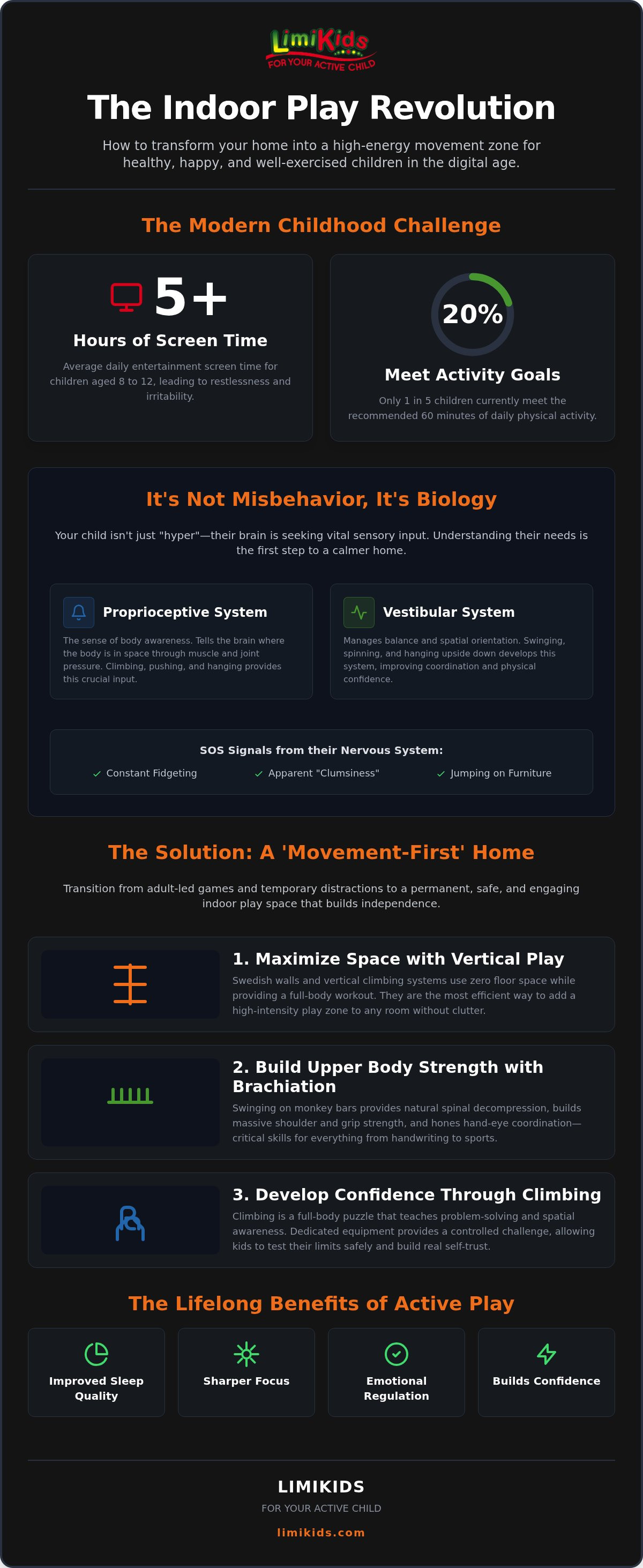
Did you know that children aged 8 to 12 now average over five hours of entertainment screen time every single day? It is a staggering figure, especially since only about 20 percent of kids currently meet the recommended 60 minutes of daily physical activity. If you're tired of the constant battle against tablets or the fear of your furniture being destroyed by climbing, you're not alone. Learning how to keep kids active indoors is no longer just a rainy day backup plan; it's a vital strategy for healthy development in 2026.
We know you want a calm, well-exercised child without turning your home into a chaotic construction site. You need a space that encourages growth and discovery while respecting your limited floor space. This guide promises to show you how to transform your home into a high-energy movement zone using expert-backed strategies and professional-grade setups. We'll dive into the benefits of Swedish walls, explore sensory play equipment, and provide a roadmap to improve your child's motor skills and confidence right in your living room. Let's turn that cabin fever into a breakthrough for your child's physical potential.
Key Takeaways
- Understand the science of proprioception and why your child's need to climb is a vital developmental milestone rather than just misbehavior.
- Discover how to keep kids active indoors by engineering a high-intensity movement zone that effectively bridges the Canadian "Winter Energy Gap."
- Learn why vertical climbing systems are the most efficient way to maximize limited floor space; they provide a full-body workout without cluttering the room.
- Transition from adult-led games to independent active play that builds your child's confidence and motor skills without constant supervision.
- Explore how to select durable indoor playground equipment that provides a permanent, safe alternative to climbing on furniture.
The Challenge of Indoor Physical Play: Why Movement Matters
Active play isn't just a game of tag. It is high-intensity movement that raises the heart rate and builds real physical strength. For Canadian parents, the "Winter Energy Gap" is a grueling reality. When temperatures plummet, outdoor playgrounds become inaccessible for months. This creates a pressure cooker environment where pent-up energy transforms into behavioral restlessness. If your child is bouncing off the walls, they aren't being difficult; they are seeking the movement their bodies crave. We need to shift from temporary distractions to a "Movement-First" home mindset. Figuring out how to keep kids active indoors is about engineering your space for success. It means transforming a corner of your living room into a zone of achievement.
The Science of Gross Motor Development Indoors
Vertical movement is a game changer for growing bodies. When kids climb and hang, they develop critical core strength and upper body stability that sitting at a desk simply cannot provide. The importance of physical education extends far beyond the school gym; it belongs in the home. This level of exertion directly correlates with improved sleep quality and sharper focus during school hours. Don't rely on "incidental movement" like walking to the kitchen. Growing bodies need deliberate, challenging physical outlets to hit their developmental milestones. High-impact sensory input helps children regulate their emotions and understand their physical limits.
Screen Time vs. Active Time: Finding the Balance
Sedentary lifestyles are the silent enemy of childhood wellness in 2026. With children aged 8 to 12 averaging five hours and 33 minutes of screen time daily, the psychological impact is clear. Restlessness and irritability often stem from a lack of physical release. By providing a permanent indoor climbing equipment solution, you naturally reduce the screen-time battle. When a child has a fun, physical alternative, the tablet loses its grip. Aim for a healthy "Active Play Ratio" of at least one hour of vigorous movement for every hour of sedentary entertainment. This balance ensures your child remains calm, confident, and physically capable. It turns your home into a sanctuary of health rather than a cage of inactivity.
Understanding Your Child’s Sensory and Motor Needs
Your child isn't just "hyper." They are likely a sensory seeker. Their brain is screaming for specific input that only heavy work and high-intensity movement can provide. This involves two critical systems: the proprioceptive and vestibular systems. Proprioception tells the brain where the body is in space through muscle and joint pressure. The vestibular system manages balance and spatial orientation. When kids don't get enough of this, they crash into walls or climb bookshelves. Understanding how to keep kids active indoors starts with meeting these biological needs. It turns your home from a source of frustration into a laboratory for growth.
According to the physical activity guidelines for children, kids need at least 60 minutes of moderate-to-vigorous activity daily. Without it, they become irritable, struggle with sleep, and lose focus. Watch for signs like constant fidgeting, "clumsiness," or a sudden obsession with jumping on the bed. These are SOS signals from their nervous system. Learning how to keep kids active indoors is the secret to a peaceful, productive household.
The Power of Brachiation and Monkey Bars
Swinging isn't just for the jungle. Brachiation, or the act of swinging from bar to bar, offers incredible technical benefits. It provides natural spinal decompression and builds massive shoulder girdle strength. It also hones hand-eye coordination as they reach for the next rung. By installing monkey bars for kids, you provide a year-round solution for these critical milestones. This isn't just play; it's high-level physical training. Your child develops a powerful grip and upper body stability that helps with everything from handwriting to competitive sports. It is an investment in their structural integrity.
Climbing as a Developmental Tool
Climbing is a full-body puzzle. It forces children to use problem-solving skills and spatial awareness to navigate heights and angles. Many parents fear "risky play," but there is a vital difference between a dangerous situation and a controlled challenge. Using dedicated sensory motor equipment for home allows your child to test their limits safely. They learn to trust their bodies. They build confidence. Most importantly, they burn that high-octane energy in a zone designed for impact and durability. If you're ready to stop the couch-climbing, consider browsing our collection of indoor climbing equipment to find the perfect fit for your space.
Effective Strategies to Keep Kids Moving Indoors
Stop searching for ways to just "keep them busy." True success in learning how to keep kids active indoors comes from categorizing activities by intensity. Think of your home as a tiered movement zone. High-intensity movement, like climbing, should be the foundation of their day. Medium-intensity options like obstacle courses keep the momentum going. Low-intensity activities like yoga or stretching help with the evening wind-down. By using a "15-Minute Movement Burst" strategy, you can shatter sedentary afternoons. These short, explosive sessions of activity reset the brain and burn off the restless energy that often leads to behavioral issues. It is about efficiency and impact.
Independent play is your secret weapon for a sane household. While adult-led games are fun, they aren't sustainable for busy parents. You need a setup that allows your child to move safely without you acting as a constant referee. Empower them to explore their physical limits on their own terms. To maintain interest over long Canadian winters, rotate your activities every few weeks. Change the configuration of your play zone or introduce a new accessory to keep the environment fresh and challenging. This proactive approach ensures the "Winter Energy Gap" never slows down your child's growth.
DIY Obstacle Courses and Active Games
Grab some pillows, painters' tape, and chairs to build a temporary adventure. Use the tape to create "balance beams" on the floor or "laser grids" to crawl under. Incorporating "The Floor is Lava" into a structured movement routine turns your living room into a high-stakes arena. However, recognize the limitations of DIY. While tape on the floor is a great distraction, it doesn't build the upper body strength or grip power that a permanent climbing frame provides. Use DIY for variety, but rely on structural equipment for the heavy-duty physical results your child needs.
Structured Indoor Activities for Every Age
Movement must evolve as your child matures. For toddlers, focus on balance beams and soft climbing blocks to build early confidence and spatial awareness. As they reach school age, transition them to Swedish wall gyms and rope ladders. These vertical systems challenge their coordination and strength in ways a flat floor simply cannot. Even teens can find value in an active home. Use indoor gyms for pull-ups and functional strength training to keep them physically sharp during their sports off-season. Provide a gym that grows with them to ensure a lifetime of health.
How to Design a Permanent Indoor Play Space
Stop settling for paper plate games that lose their charm in ten minutes. If you want to master how to keep kids active indoors, you need to think like an engineer. Designing a permanent play space is about creating a reliable destination for movement. Start by measuring your ceiling height. Most professional systems use a pressure-fit design that requires no drilling. Next, map out your "impact zone." This is the floor area around the equipment where a child might land. Clear this space of sharp corners or fragile decor. By dedicating a specific area to high-energy play, you create a mental boundary that tells your child exactly where it's safe to push their limits.
Vertical systems, often called Swedish walls, are the ultimate solution for modern homes. They provide a massive range of movement while occupying less than a few square feet of floor space. This "upward" approach is why vertical climbing frames are the gold standard for small spaces. To maintain a peaceful home, use "zoning." Keep your Active Zone physically separate from the Quiet or Study Zone. This separation helps children regulate their energy levels based on which part of the room they're in. It turns a simple room into a functional environment for both growth and rest.
Maximizing Small Spaces and Apartments
You don't need a dedicated playroom to build an indoor gym. A bedroom corner or a wide hallway can easily house a full climbing system. If you're working with a multi-use room, look into foldable kids gym equipment. These innovative designs allow you to provide a high-energy outlet that can be tucked away when the day is done. Select equipment that offers a small footprint but high play value, such as units with integrated rings, ropes, and ladders. This ensures your child never runs out of ways to challenge their coordination.
Safety Standards and Installation Tips
Durability is non-negotiable. When comparing materials, metal often provides superior structural integrity and a higher weight capacity than wood. This ensures the equipment grows with your child into their teen years. Always check the weight limits for every attachment, from swings to trapeze bars. To keep your home gym in peak condition, perform a monthly safety inspection:
- Check all bolts and pressure-fit joints for tightness.
- Inspect ropes and nets for signs of fraying.
- Ensure high-impact mats are positioned correctly under all climbing areas.
- Verify that all moving parts have clear clearance from walls.
Ready to build your home movement zone? Explore our range of indoor home gyms to find a safe, space-saving solution that fits your family's needs perfectly.
Investing in Long-Term Active Play with LIMIKIDS
LIMIKIDS has been at the forefront of childhood development in Canada since 2008. We understand the unique challenges of our climate and the importance of physical literacy. Our mission is to empower parents with the tools they need to master how to keep kids active indoors without sacrificing floor space or safety. We don't just sell toys; we provide high-performance developmental equipment. Our "Grow-With-Me" philosophy ensures that your investment adapts as your child matures. From the first tentative climbs of a toddler to the functional strength training of a teenager, our systems remain a relevant, challenging part of your home environment. We prioritize structural integrity by using premium metal and high-quality wood, ensuring every piece of equipment offers total reliability and permanence.
Ordering is simple and efficient. We provide fast shipping across Canada, bringing professional-grade gym equipment directly to your door. Most of our systems feature a pressure-fit installation that requires no drilling, making it easy to transform your home into a high-energy movement zone in a single afternoon. You are choosing a legacy of quality and a commitment to your child's physical potential. It is time to stop worrying about weather-related inactivity and start building a foundation for lifelong health.
Why a Home Gym is a 10-Year Investment
Think about the long-term value of your space. When you conduct a cost-per-use analysis, an indoor home gym far outperforms seasonal sports fees or repeated trips to commercial indoor playgrounds. It is available 24/7, 365 days a year. Beyond the financial savings, there is a profound psychological benefit. A dedicated movement zone provides a safe "escape" for children to regulate their emotions and burn off steam during stressful days. It becomes a sanctuary of achievement. If you're still on the fence, check out these 7 reasons your child needs an indoor play gym to see how it transforms daily life. This is a decade-long investment in your child's confidence and motor skills.
Selecting Your First LIMIKIDS System
Start with the foundation. The Swedish Wall Gym is the ultimate anchor for any home movement zone. Its vertical design maximizes small spaces while offering endless opportunities for climbing and hanging. As your child's skills evolve, you can customize the experience. Add accessories like rings, climbing ropes, and trapeze bars to keep the challenge fresh and exciting. This modular approach allows you to build a comprehensive fitness center that perfectly matches your child's developmental milestones. You have the power to change how to keep kids active indoors from a daily struggle into a natural, joyful part of your family routine. Browse our collection of premium indoor gyms and start your active home journey today!
Take Charge of Your Child's Physical Potential
You now have the blueprint to transform your home into a powerhouse of development. Mastering how to keep kids active indoors is no longer a mystery; it is a strategic choice to prioritize high-intensity movement and sensory regulation. By choosing verticality over floor clutter, you provide your child with a permanent outlet for their energy. You're moving beyond temporary distractions and investing in a lifestyle that builds core strength, improves focus, and boosts confidence every single day. Your home can be much more than a living space; it can be a launchpad for your child's physical success.
Since 2008, LIMIKIDS has been the trusted guide for Canadian families seeking structural integrity and space-saving innovation. Our Swedish wall designs are crafted from premium, safety-tested materials that withstand the test of time and grow with your child. We believe that every home has the potential to be a playground for growth, regardless of square footage. Don't wait for the next "Winter Energy Gap" to strike. Transform your home with a LIMIKIDS Indoor Home Gym today! and watch your child thrive in a space designed for discovery. Your journey toward a more active, balanced household starts right now. Let's get moving!
Frequently Asked Questions
How do I keep my kids active indoors without a lot of space?
Focus on vertical movement rather than floor area to maximize your living space. Swedish wall gyms are the ultimate solution for small apartments because they utilize the height of your room rather than the width. You can fit a full climbing system into a narrow hallway or a bedroom corner. This strategy allows you to discover how to keep kids active indoors without sacrificing your home's functionality or flow.
Are indoor climbing gyms safe for toddlers?
Yes, indoor climbing gyms are exceptionally safe for toddlers when paired with high-impact mats and age-appropriate accessories. Start with low-level rungs or soft climbing blocks to build their early confidence and grip strength. These systems are designed to grow with your child. They provide a secure, controlled environment for them to test their motor skills under your supervision while preventing furniture-related accidents.
What is the best indoor gym equipment for high-energy kids?
A Swedish wall gym combined with monkey bars is the gold standard for high-energy children. These systems provide the high-intensity movement required to burn off excess energy and regulate the nervous system effectively. Adding dynamic accessories like climbing ropes, rings, or trapeze bars keeps the experience challenging. It prevents boredom during long Canadian winters by offering endless ways to move and achieve.
How can I encourage my child to play independently on an indoor gym?
Create a dedicated, safe zone that empowers your child to explore their physical limits without constant intervention. When children feel secure in their environment, they naturally gravitate toward independent play and discovery. Try rotating your accessories every few weeks to keep the space fresh and enticing. This builds their problem-solving skills and self-reliance while giving you a much-needed break from acting as a referee.
Do indoor monkey bars require professional installation?
No, most premium indoor monkey bars use a specialized pressure-fit design that requires no professional installation or drilling into your walls. You can securely mount the system between the floor and ceiling in a single afternoon using basic tools. This makes it a practical, DIY-friendly solution for any home. It is especially ideal for rentals where permanent modifications are often prohibited by landlords.
How does indoor climbing help with sensory processing issues?
Climbing provides intense proprioceptive and vestibular input, which is essential for children with sensory seeking behaviors. The deep pressure on muscles and joints during a climb helps the brain organize and process sensory information more efficiently. This "heavy work" naturally calms the nervous system. It improves a child's ability to focus, regulate their emotions, and feel more grounded in their own body.
What are some low-noise indoor activities for apartment living?
Climbing is a fantastic low-noise activity compared to high-impact jumping or running on hardwood floors. It focuses on controlled, deliberate movements that don't create loud vibrations for neighbors below. You can also integrate slow-motion obstacle courses or balance beam challenges into your routine. These strategies help you master how to keep kids active indoors while maintaining a peaceful environment for everyone in the building.
How do I choose between a wooden or metal indoor gym?
Choose metal for maximum durability and a higher weight capacity that supports your child as they grow into their teenage years. Metal systems often offer more versatility for high-intensity attachments like heavy-duty swings or pull-up bars. Wooden gyms provide a warmer aesthetic and a natural grip feel that many parents prefer for younger children. Both materials offer excellent structural integrity when sourced from a reputable manufacturer.