






Gross Motor Skills Indoor Equipment: A Parent’s Guide to Active Play
What if the best indoor play choice isn’t the biggest structure, but the one that invites your child to move in ways they enjoy? Choosing gross motor skills indoor equipment can feel tricky when you’re weighing your child’s age, interests, abilities, and the space available at home. Safety matters just as much as keeping play engaging.
Start by considering the movements your child might practise: climbing, reaching, balancing, crawling, and swinging. Indoor climbing equipment, wall gyms, monkey bars, and sensory play equipment can each invite different kinds of active play. The right fit depends on your child, your home, and the product’s intended use. There’s no need to turn every day into a workout. A well-chosen play opportunity can make movement feel like fun.
This guide will help you match equipment to movement, choose options that suit your child and available space, and set up varied play with safety in mind. You’ll also learn what to check, including age guidance, dimensions, load limits, and installation instructions, so your child has room to explore as their abilities grow.
Key Takeaways
- Recognize gross motor practice in big-body movements such as climbing and balancing, and distinguish it from small, precise actions.
- Choose gross motor skills indoor equipment by the movements it invites, then consider whether those activities appeal to your child.
- Compare your child’s interests and abilities with your available space and each product’s specific guidance.
- Make indoor active play more manageable by following equipment instructions and preparing a clear play area.
- Consider residential climbing, wall-gym, monkey-bar, and sensory equipment as possible starting points for movement-rich play.
What Gross Motor Skills Mean in Indoor Play
Gross motor skills are movements that use the body’s large muscles, including those in the arms, legs, and torso. They help children with everyday activities such as walking, jumping, reaching, and balancing. This plain-language definition reflects the overview of gross motor skills, which describes abilities involving large muscle groups.
Fine motor skills, by contrast, rely on smaller, more precise movements. A child climbing onto a low platform uses gross motor movement; picking up a small block or turning a page calls for fine motor control. Play can involve both, but this guide focuses on big-body actions.
Indoor equipment can invite children to explore these movements. It creates an opportunity to move, not a promise of a particular developmental result. No structure can guarantee that a child will gain a specific skill or progress at a set pace. Think of gross motor skills indoor equipment as a way to make active play available, with your child’s interests and the product’s instructions shaping how it’s used.
Which movements count as gross motor skills?
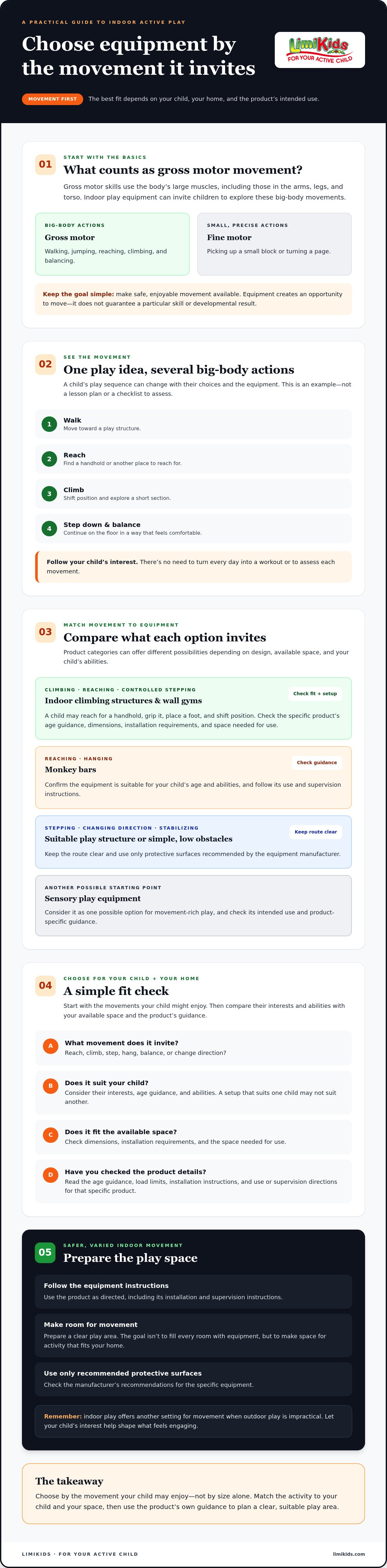
Walking, reaching, climbing, jumping, and balancing are all examples of large-muscle actions. A single play idea may bring several together: a child might walk to a climbing frame, reach for a handhold, climb a short section, then step down and balance on the floor. The sequence can change according to the child’s choices and the equipment. You don’t need to turn it into a lesson or assess each movement. Notice what your child enjoys trying.
Why include indoor active play?
Rain, cold weather, limited outdoor access, or a busy day can make outdoor play impractical. An indoor play space offers another setting for movement, whether that means crawling across a clear area or exploring a home climbing structure. The goal isn’t to fill every room with equipment. It’s to make room for safe, enjoyable activity that fits your home.
Interest matters. A child who chooses to revisit an activity has more chances to explore it, while choice lets them decide what feels engaging. These are practical reasons to notice what draws your child in, not evidence that a particular toy will accelerate development or treat a condition. If you have concerns about your child’s movement or development, speak with a qualified health professional rather than relying on equipment to address them.
Match Indoor Equipment to the Gross Motor Skills It Invites
Start with the movement, not the product label. Ask what your child might do: reach, climb, step, hang, or change direction? The same equipment category can offer different movement opportunities depending on its design, the available space, and whether it suits your child’s abilities. Use these examples to compare options, then check the specific product’s age guidance and instructions before choosing.
Movement opportunity: Climbing, reaching, and controlled stepping
Example equipment: Indoor climbing structures and wall gyms
Setup consideration: Check product-specific age guidance, dimensions, installation requirements, and the space needed for use.
Movement opportunity: Reaching and hanging
Example equipment: Monkey bars
Setup consideration: Confirm that the equipment is suitable for your child’s age and abilities, and follow its use and supervision instructions.
Movement opportunity: Stepping, changing direction, and stabilizing
Example equipment: A suitable play structure or simple, low obstacles
Setup consideration: Keep the route clear and use only protective surfaces recommended by the equipment manufacturer.
Climbing, reaching, and upper-body movement
A climbing structure can invite a child to reach for a handhold, grip it, place a foot, and shift position. Wall gyms may offer opportunities to reach and step between holds, while monkey bars invite reaching and hanging. These are movement possibilities, not guaranteed strength gains. Equipment design affects the challenge, and a setup that suits one child may not suit another. Check the manufacturer’s guidance rather than assuming a structure fits every age or ability.
Balance, coordination, and whole-body movement
Balance-focused play doesn’t have to be complicated. A child might step around a low obstacle, pause, turn, and continue along a clear route. Coordination means bringing movements together smoothly, such as reaching while stepping or changing direction without stopping. A suitable play structure can also invite a child to shift position and steady themselves. These activities create chances to move; they aren’t a measurement of development or proof of a particular outcome.
The World Health Organization’s motor development milestones provide a developmental reference, not a product-selection checklist. When choosing gross motor skills indoor equipment, consider the movements your child enjoys and the product’s verified guidance. You can explore LIMIKIDS’ indoor climbing and wall-gym equipment as residential play options, then assess each item’s suitability for your home and child.
How to Choose Gross Motor Skills Indoor Equipment for Your Home
The best fit depends on your child and your home, not on a one-size-fits-all age chart. Use this decision path to narrow down gross motor skills indoor equipment by interest, movement, available space, and verified product guidance.
Start with the child and the space
- Observe interests. Does your child gravitate toward climbing, reaching, balancing, or sensory exploration? Notice the play themes they return to, too, such as pretending to cross a bridge or navigate a path.
- Identify movement opportunities. Decide which actions you want play to invite. A climbing frame may offer chances to climb and change position, while sensory play equipment can support hands-on exploration alongside movement.
- Measure the intended area. Check the room’s usable floor space and ceiling height, then compare them with the product’s dimensions and any specified clearance requirements. Leave enough room for the equipment to be used as directed.
- Check product guidance. Review age guidance, load limits, materials, assembly and installation instructions, and supervision recommendations for the exact item. Don’t assume these details are the same across products in one category.
Also consider daily routines. Will the play area be shared with siblings or used for other activities? Can an adult supervise as instructed? A setup that fits the room but disrupts household movement may be harder to use comfortably.
Compare equipment by use, fit, and adaptability
Different formats invite different kinds of play. Fixed climbing frames can offer routes for climbing, reaching, and controlled stepping. Swedish wall gyms use a wall-mounted format that may suit families looking to make use of wall space, but you’ll still need to check the specific dimensions and installation requirements. Monkey bars invite reaching and hanging, so confirm age guidance and suitability for your child before choosing. Sensory play equipment offers another avenue for exploration; check the product details to understand its intended use.
No format is automatically best. Compare how each option fits your room, your child’s current abilities, and the movements that interest them. A child’s abilities vary, so don’t rely on age alone to predict whether a particular challenge is appropriate. The product’s verified guidance should help you assess suitability.
For another perspective on comparing options, look for LIMIKIDS’ Ultimate Guide to Choosing an Indoor Home Gym for Kids in 2026. Use it alongside the exact product information, especially for dimensions, load limits, and installation details. Choose a setup that fits your home and invites the kind of play your child wants to return to.
Create Safer, Varied Indoor Movement Opportunities
A thoughtful setup helps active play fit your home and your child. Before play begins, follow the instructions for the specific equipment. Mounting, anchoring, clearance, protective surfaces, and supervision guidance can differ, so don’t rely on assumptions or instructions for a similar-looking product. If a detail isn’t clear, check with the manufacturer before use.
Set up an appropriate play area
Use the manufacturer’s guidance to prepare the space. Confirm how the equipment should be assembled or mounted, what surface is suitable, how much clearance is needed, and whether or how the product should be inspected. Don’t add mats or other protective surfaces unless the manufacturer recommends them for that equipment.
Clear the play zone of furniture, loose objects, and anything that could create an avoidable trip or collision hazard. Keep the route to and around the equipment unobstructed. Then supervise in a way that matches the child, the equipment, and the manufacturer’s instructions. A setup that works for one child or room may not be appropriate for another.
Vary play without forcing a progression
Offer simple choices that suit the equipment and your child’s current abilities. They might approach a suitable structure from a different direction, choose which part to explore, or pause and return to play later. Keep variations within the manufacturer’s intended use. Don’t encourage a child to reach, climb, hang, or jump in ways the product instructions don’t allow.
Let your child lead the pace. A short turn, a change of activity, or a break can keep play responsive rather than turning it into a test. Gross motor skills indoor equipment provides opportunities to move, but using it doesn’t prove that a child has reached a particular developmental milestone. Likewise, avoiding an activity or finding it challenging isn’t a diagnosis. If you have concerns about your child’s development, speak with a qualified health professional.
Before each play session, take a moment to check that the area is clear and the equipment appears ready for use, following any inspection guidance provided by its manufacturer. For residential options, explore LIMIKIDS indoor play equipment and review the product-specific instructions to help determine what fits your space and supervision routine.
Choose Home Equipment That Keeps Active Play Inviting
You now have a practical framework: decide which movements you want to invite, consider what interests your child, then check whether the equipment fits your home and its verified product guidance. The right setup isn’t the one with the most features. It’s an option your family can use safely and comfortably, without expecting equipment to guarantee a developmental outcome.
When an indoor climbing or wall-gym setup may fit
If your child enjoys reaching, climbing, or stepping between holds, an indoor climbing structure or wall gym may offer ways to explore those movements at home. Monkey bars and sensory play equipment invite different kinds of play, so compare each category by its intended use rather than assuming every option meets the same need.
Before deciding, check the exact product’s dimensions, installation details, age guidance, and other suitability information. A wall-mounted option may use space differently from a freestanding structure, but the product’s requirements and your room layout determine whether it’s a practical fit. If sensory exploration is part of what interests your child, LIMIKIDS’ Sensory Motor Equipment for Home: Parent’s Guide may offer another perspective on choosing home play options.
Explore equipment at your family’s pace
A useful play space can start with one clear purpose. Perhaps you want to invite climbing and reaching, or make room for sensory play. Compare residential equipment categories with your child’s interests, your usable space, and the supervision and installation instructions for each specific item. You don’t need to create a complicated course or push your child through a set progression. Keep play inviting, and let their choices help shape how they use the space.
LIMIKIDS is a Canadian retailer of residential indoor climbing structures, Swedish wall gyms, monkey bars, and sensory play equipment. The company has supported families since 2008 and provides dedicated customer support and fast shipping across Canada. These are options to explore, not promises of particular results. Take time to review product details and decide what makes sense for your home.
Make Room for Play That Fits Your Family
Choosing gross motor skills indoor equipment starts with the movement your child enjoys, then moves to practical checks: available space, product suitability, and instructions for safe use. The right choice doesn’t need to be the biggest or most complex. It should feel manageable at home and invite play without promising a particular developmental outcome.
LIMIKIDS’ residential options include indoor climbing equipment, Swedish wall gyms, monkey bars, and sensory play equipment, with dedicated customer support and fast shipping across Canada. Review each item’s product-specific details to see what may work for your child and space.
Ready to compare options? Explore LIMIKIDS indoor play equipment and take the next step at your family’s pace. A thoughtful setup can make everyday indoor play more inviting, one joyful movement at a time.
Frequently Asked Questions
What are gross motor skills, and which movements do they include?
Gross motor skills are large-muscle movements that help children move their bodies. Examples include walking across a room, reaching overhead, climbing suitable equipment, jumping, and balancing while changing direction. These differ from fine motor actions, such as turning a page or picking up a small object. Children use and develop movement abilities in individual ways, so these examples describe activities, not a method for diagnosing a child.
What indoor equipment encourages gross motor skills?
Indoor climbing structures can invite climbing, reaching, and stepping; wall gyms offer opportunities to move between holds; and monkey bars invite reaching and hanging when suitable for the child. A clear movement pathway, with room to walk around safe obstacles, can encourage stepping and changing direction. Each option creates an opportunity for active play, not a guarantee that a child will gain a particular skill or reach a specific outcome.
Can indoor play equipment help children practise balance and coordination?
Yes, suitable equipment and play setups can invite children to practise balance and coordination. A child might step between parts of an appropriate structure, pause to steady themselves, or turn and continue along a clear route. Coordination means bringing movements together smoothly. What a child chooses to try, and how their abilities develop, varies. Treat equipment as one way to invite movement, not as a test or a promise of measured progress.
How do I choose gross motor skills equipment for my child?
Start by noticing which activities your child enjoys, such as climbing, reaching, or exploring sensory play. Consider their current abilities, but don’t assume age alone determines what’s suitable. Measure the intended space, including any clearance specified in the product guidance. Then review the exact item’s age recommendations, dimensions, load limits, materials, installation instructions, and supervision guidance. The right gross motor skills indoor equipment should fit both your home and your child’s play interests.
Is indoor climbing equipment suitable for toddlers?
It depends on the specific equipment and the child. Before considering indoor climbing equipment for a toddler, check the manufacturer’s age guidance, installation instructions, intended use, and supervision recommendations for that exact product. Don’t assume all climbing structures are suitable for toddlers just because they’re designed for home play. If product information doesn’t clearly address your child’s age or use, ask the manufacturer for clarification before making a decision.
How can I encourage active play indoors without a large playroom?
Start by measuring the space you can actually use, then compare it with product dimensions and any manufacturer-specified clearance. A wall-mounted gym may use floor space differently from a freestanding climbing structure, while a clear route for walking around suitable obstacles may not require a large play area. Check installation, use, and supervision instructions before choosing. No equipment format is guaranteed to fit every room, so assess your home and product details first.
Does gross motor equipment replace occupational or physical therapy?
No. Home play equipment can offer opportunities for movement, but it doesn’t replace individualized advice or therapy from a qualified occupational or physical therapist. A professional can consider a child’s specific needs and recommend appropriate support. If you have concerns about your child’s movement, development, or participation in everyday activities, speak with a qualified health professional. Don’t rely on equipment alone to assess, diagnose, or address a developmental or health concern.