






Educational Benefits of Play Equipment: How Active Play Helps Kids Learn
What if a climb, crawl, or balancing challenge were also a chance to practise thinking? The educational benefits of play equipment can be easy to miss when active play looks like pure fun. And it should be fun: children learn through movement, experimentation, and choices, not only through formal lessons.
If you’re wondering what kids can actually learn as they play, the answer goes beyond physical skills. Climbing and balancing invite children to practise coordination and body awareness. Finding a way through a challenge can encourage problem-solving, while playing with others gives children chances to practise communication and taking turns. These are opportunities to practise skills, not guaranteed outcomes.
In this article, you’ll see how different types of play equipment can support physical, cognitive, social, and emotional learning. You’ll also find ways to match activities to a child’s age, interests, and abilities, including indoor climbing and sensory play options. The goal isn’t to turn play into a lesson. It’s to make room for safe, engaging exploration at a child’s own pace.
Key Takeaways
- The educational benefits of play equipment come from the skills children can practise while moving, exploring, and making choices.
- Connect play actions, such as climbing, hanging, or exploring textures, with different areas of learning.
- Compare climbing structures, monkey bars, wall gyms, and sensory equipment by the kinds of play they invite, not by a one-size-fits-all ranking.
- Make play more engaging with a simple routine: notice your child’s interests, offer an invitation, then let them explore in their own way.
- Use a practical checklist to choose equipment that fits your child, your space, and your supervision plans, while leaving room for free play and connection.
What Are the Educational Benefits of Play Equipment?
Play can be joyful and meaningful without becoming another lesson on the family schedule. Parents don’t need to quiz children or set a learning target every time they move. The educational benefits of play equipment come from the opportunities it offers: children can practise skills as they move, make choices, and explore at their own pace. Equipment creates possibilities, not guaranteed outcomes, and it can’t replace responsive interaction with a caregiver.
Active play is learning through movement and choice; passive entertainment is primarily something a child watches or listens to. That doesn’t make quiet or screen-based activities inherently unhelpful. It highlights what active play adds: a child can act, notice what happens, and decide what to try next. A general overview of the Playground also describes play spaces as places for recreation and opportunities to develop physical and social skills. The same idea can apply to indoor equipment at home.
How play equipment turns movement into learning
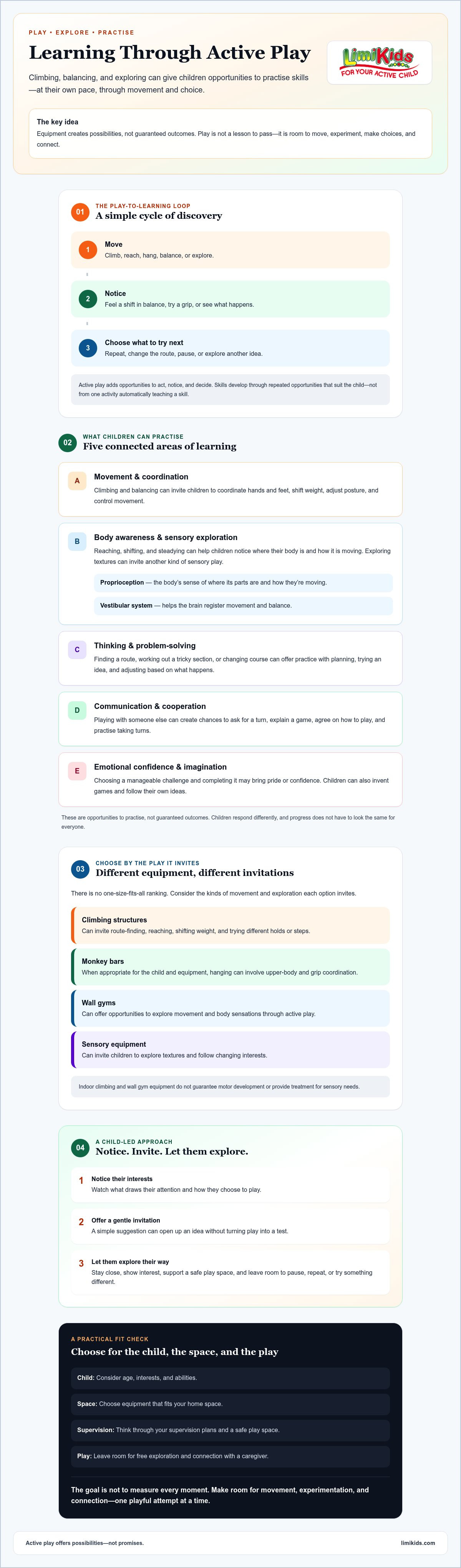
Movement gives children something to experiment with. When a child climbs, reaches for a new hold, or balances across a surface, they can adjust their grip, footing, or body position and notice what changes. Repeating an action gives them another chance to test an idea: “What if I step here?” or “Can I reach that spot?”
Getting across an obstacle may involve planning a route and changing course. These experiences can offer practice with coordination, body awareness, and problem-solving, but no single activity automatically teaches a skill. Learning develops through repeated opportunities that suit the child, with room to pause or try a different approach.
Why child-led play matters for learning
Children bring their own ideas to play. One might move slowly across a climbing frame; another might repeat a familiar route or invent a new game around it. Child-led play lets them choose their pace, decide which challenge feels manageable, and return to an activity when they’re ready.
Stay close, show interest, and help maintain a safe play space, but resist directing every move. A gentle invitation can open up an idea; a stream of instructions can make exploration feel like a test. Open-ended indoor climbing or sensory equipment may invite different kinds of play as a child’s interests change. Follow their attention and let curiosity lead.
The goal isn’t to measure every moment or expect equipment to do the teaching. It’s to make space for movement, experimentation, and connection. Notice what captures your child’s interest, offer encouragement when they want it, and allow them to discover what they can do, one playful attempt at a time.
How Play Equipment Supports Physical, Cognitive, and Sensory Learning
One play session can invite children to move, think, and notice how their bodies respond. The educational benefits of play equipment come from these chances to practise, not from a promise that a particular structure will produce a specific result. Watch what a child does: the movement itself can show what they’re exploring.
Movement, coordination, and body awareness
Climbing asks a child to coordinate hands and feet, shift weight, and choose where to move next. Balancing or stepping between surfaces invites them to adjust posture and control their movements. Hanging from monkey bars, when appropriate for the child and equipment, also involves coordinating the upper body and grip.
These actions engage proprioception, the body’s sense of where its parts are and how they’re moving, and the vestibular system, which helps the brain register movement and balance. A child might reach for a hold, feel their body shift, then steady themselves. Indoor climbing equipment and wall gyms can offer opportunities to explore these sensations through active movement. They don’t guarantee motor development or provide treatment for sensory needs.
Thinking, communication, and emotional confidence
Play can also involve a series of small decisions. A child might look for a route across a climbing structure, pause at a tricky section, then try a different handhold or step. That’s an observable chance to practise planning and problem-solving: they form an idea, act, and adjust based on what happens.
With another person nearby, a child may ask for a turn, explain a made-up game, or agree on how to use a piece of equipment. These moments can create opportunities for communication, cooperation, and imaginative play. A child who chooses a manageable challenge and completes it may feel proud or more confident. Each child responds differently, and progress doesn’t have to look the same from one play session to another.
Active play gives children room to practise movement, sensory awareness, thinking, and communication through choices they make themselves. Adults can support that practice by staying attentive, following the child’s lead, and offering help when needed rather than turning every action into a lesson. Families exploring options can browse indoor climbing equipment from LIMIKIDS for active play at home.
Which Play Equipment Benefits Different Learning Goals?
There’s no single “best” equipment for learning. Different designs invite different actions, and the educational benefits of play equipment depend partly on what a child chooses to explore. Use this comparison as a starting point, not a checklist of outcomes.
| Play activity | Possible practice area | Example equipment category |
|---|---|---|
| Climbing a route or moving around obstacles | Coordination, movement planning, trying alternatives | Indoor climbing structures or climbing frames |
| Reaching and hanging from rungs | Grip, upper-body movement, judging reach | Monkey bars |
| Moving between rungs, holds, or stations | Sequencing movements and exploring different routes | Wall gyms, including Swedish wall gyms |
| Touching, moving, and exploring features | Sensory discovery, curiosity, independent exploration | Sensory or Montessori-inspired play equipment |
What climbing and hanging activities can invite
A climbing route gives a child choices: which hold to reach for, where to place a foot, or whether to pause and try another way. Monkey-bar play can invite reaching, gripping, and hanging movements. These are opportunities to practise coordination and upper-body movement, not promises of increased strength. To compare home options, see this indoor home gym guide.
What sensory and Montessori-inspired equipment can invite
Sensory equipment can encourage children to notice textures, explore movement, and discover how different features respond to touch or action. Montessori-inspired equipment can offer opportunities for independent exploration, but it isn’t a clinical method or a guarantee of a particular developmental result. If this approach interests your family, explore Montessori play equipment.
Match equipment to more than a learning goal. Consider what your child is drawn to, how much room you have, what supervision the activity calls for, and whether the challenge suits your child’s abilities. Read the product guidance and think about how the equipment will fit into your home and everyday play. The right choice is one that invites your child to explore comfortably, not the one with the longest list of possible benefits.
How Can Parents Make Play Equipment More Educational?
You don’t need a lesson plan to make play meaningful. A little attention and one thoughtful invitation can help children explore while keeping the fun theirs. Try this simple routine:
- Observe interests. Notice what your child returns to, whether that’s climbing, reaching, moving between features, or exploring textures.
- Offer a manageable invitation. Ask, “Which route would you like to try?” or suggest exploring one feature together.
- Allow exploration. Give your child time to repeat an action, change the game, pause, or move on.
- Reflect together. Share a simple observation, such as, “You tried a different way,” and let your child decide whether they want to talk about it.
This approach keeps learning connected to curiosity rather than performance. The educational benefits of play equipment are easier to support when children can make choices and adults stay responsive without directing every move.
Offer invitations, then let children lead
Keep prompts open-ended. “What would you like to try next?” leaves room for the child’s own idea, while “Can you do it this way?” may turn play into a test. Notice effort and experimentation rather than comparing one child’s abilities with another’s. Children can repeat a familiar activity, find a new approach, or stop when their interest shifts. All are valid ways to play.
Your presence still matters. Stay attentive and available, offer encouragement when it’s welcome, and step in when support is needed. You don’t have to fill every pause with instructions. Sometimes watching quietly gives a child the space to decide what comes next.
Adapt play to age, interest, and ability
Choose invitations that feel approachable for your child, then adjust based on their interest and comfort. For example, they might explore one part of an activity before trying a different route, or return to a familiar movement rather than take on a new one. There’s no need to prescribe milestones or push a child toward a challenge they aren’t ready to attempt.
Follow the manufacturer’s age guidance and supervision instructions for the equipment. Check the product guidance for specific use and safety details, and supervise as directed. Offer varied play experiences, too, so equipment is one option among movement, conversation, imagination, and everyday discovery. For ideas focused on touch and movement, explore this guide to sensory motor equipment for home.
Encourage learning by staying close, offering a gentle invitation, and letting your child decide what to explore. To see indoor options for active play at home, browse LIMIKIDS play equipment.
Choosing Play Equipment That Supports Learning at Home
Choosing equipment starts with your child and your home, not a promise of faster learning. Think about the kinds of play your child enjoys, the space available, and how the equipment could fit into everyday family routines. A thoughtful choice can invite active exploration while leaving plenty of room for other kinds of play.
A parent checklist for a useful play environment
- Follow your child’s interests. Do they seek out climbing, hanging, balancing, or hands-on sensory exploration? An activity they’re curious about is more likely to invite play.
- Decide what opportunities you want to offer. Consider whether you’re looking for more ways to move, explore, or play independently. Treat these as possibilities, not guaranteed developmental outcomes.
- Check the fit at home. Consider available space, the equipment’s intended use, and how it will work in the room and your family’s routine.
- Plan for supervision. Think about where you’ll be and how you can supervise play as directed by the manufacturer.
- Read the product guidance. Check age guidance, instructions, and any other information provided for the specific equipment before deciding whether it suits your child and home.
- Consider changing interests. Look for play opportunities your child may explore in different ways as their interests and abilities change, while following the equipment’s guidance.
Keep expectations realistic and play joyful
The educational benefits of play equipment aren’t a reason to buy something solely for a promised skill or developmental result. Equipment can offer an engaging setting for movement and discovery, but children also need unstructured play, relationships with caring adults, and varied experiences. Sometimes the value is in a child repeating a favourite activity, inventing a new game, or sharing a playful moment with you.
LIMIKIDS is a Canadian retailer offering indoor climbing equipment, wall gyms, and sensory play equipment for families. These categories can help parents explore different ways to invite active play at home. Equipment creates opportunities; children’s interests, interactions, and wider play environment matter too.
Use the checklist to guide your choice, keep play flexible, and follow the product instructions. When you’re ready to explore options, take a look at LIMIKIDS indoor play equipment.
Make Room for Learning Through Play
The educational benefits of play equipment come from the chances children get to move, explore, make choices, and try again. Climbing, hanging, and sensory play can invite practice across physical, cognitive, social, and emotional skills, but every child’s experience is different. Equipment creates possibilities, not guaranteed outcomes.
Choose with your child’s interests, abilities, home space, supervision needs, and product guidance in mind. Then let play stay playful. A thoughtful invitation and your supportive presence can help, but children also need room to lead, enjoy, and discover in their own way.
LIMIKIDS is a Canadian company that has supported families since 2008. Its indoor play equipment categories include indoor climbing structures, Swedish wall gyms, Montessori-inspired play systems, and sensory play equipment. Explore options that could invite movement and discovery at home.
Start with curiosity, keep expectations realistic, and celebrate the small moments of exploration. Explore indoor play equipment from LIMIKIDS for active play at home.
Frequently Asked Questions
Can play equipment help with cognitive development?
Play equipment can invite children to make choices, plan movements, test ideas, and adjust their approach. A child might decide how to cross a climbing structure, pause, then try another route. These moments offer opportunities to practise thinking skills through play. They don’t prove that one piece of equipment will produce a particular result. Keep the challenge suitable for the child, and let curiosity guide what they try next.
How does climbing equipment support learning?
Climbing invites children to coordinate movements, decide where to place their hands and feet, and work out how to approach a route. They might repeat a familiar path or change their approach when they reach a tricky spot. These experiences can offer practice with planning and persistence. Each child’s experience is different, so climbing is best viewed as an opportunity to practise, not a guaranteed way to build strength, coordination, or confidence.
Is sensory play equipment educational?
Sensory play equipment can invite children to explore movement, touch, and other sensory experiences as they play. A child may investigate how a feature feels or moves, then choose what to explore next. Sensory equipment isn’t a diagnostic tool or treatment. If you have concerns about your child’s sensory needs or development, talk with an appropriately qualified professional. Follow the equipment’s product guidance and supervise play as directed.
What play equipment is best for learning?
There isn’t one best choice for every child. Start with the activities your child enjoys, then consider the play opportunities different equipment offers. Climbing structures, monkey bars, wall gyms, and sensory equipment each invite different kinds of exploration. Check the available space and the manufacturer’s age and use guidance before choosing. Focus on a good fit for your child and home, rather than equipment marketed with a promised learning outcome.
How can parents make play more educational without making it feel like school?
Follow your child’s interest, offer a simple invitation, and let them decide what to do next. You might ask, “Which route would you like to try?” or simply watch as they explore. Notice experimentation without correcting every movement or comparing abilities. Repeating, changing, or stopping an activity can all be part of child-led play. With room for movement, imagination, and shared interaction, play can stay joyful while children practise skills.
Does play equipment replace outdoor play or adult interaction?
No. Indoor equipment can add opportunities for active exploration at home, but it doesn’t replace outdoor experiences, varied kinds of play, or relationships with caregivers and other children. Different settings can offer different ways to move, explore, and connect. Treat equipment as one part of a balanced play environment. Choose and use it according to the manufacturer’s instructions, and provide supervision as directed so children can explore with appropriate support.