






Developmental Benefits of Monkey Bars: What Kids Learn Through Play
What if the developmental benefits of monkey bars go beyond stronger arms? Each reach, pause, and decision gives a child a chance to practise movement at their own pace. The challenge isn’t only crossing from one side to the other. It’s learning how to grip, shift body weight, and decide what to try next.
It’s understandable to wonder whether monkey bars are too difficult or risky for your child. Readiness varies, and play equipment doesn’t guarantee developmental outcomes. The skills children practise depend on an appropriate setup, attentive supervision, and room to explore without pressure.
This article explains how monkey bars can offer opportunities to practise strength, coordination, balance, confidence, and problem-solving through repeated, child-led play. You’ll also learn how to encourage age-appropriate practice, recognize when your child may need support, and make thoughtful choices about supervision and equipment setup. The goal isn’t a perfect crossing. It’s helping your child discover what they can do, one grip at a time.
Key Takeaways
- Explore the developmental benefits of monkey bars, from movement skills to confidence, without expecting every child to progress in the same way.
- Notice how hanging, reaching, and alternating hands create different movement challenges for children to practise.
- Compare monkey bars with climbing, swinging, and balancing to find activities that suit your child’s interests.
- Use a simple safety routine: check the setup, supervise, offer a reachable challenge, and follow your child’s cues.
- Consider whether indoor monkey-bar play fits your space and routine, then leave room for open-ended exploration.
What developmental benefits can children get from monkey bars?
Monkey-bar play involves moving along overhead rungs by gripping with the hands and coordinating the rest of the body. A child might hang in place, reach for the next rung, or travel across several rungs. Each movement creates a different physical challenge. For a general overview of the equipment and its history, see Jungle gym.
Monkey bars give children opportunities to practise grip, upper-body strength, coordination, and body awareness while exploring a challenge at their own pace. These are opportunities for practice, not guaranteed developmental outcomes or clinical treatment. What a child takes from play depends on their experience, abilities, interest, and the equipment available.
Which skills are involved when a child moves across monkey bars?
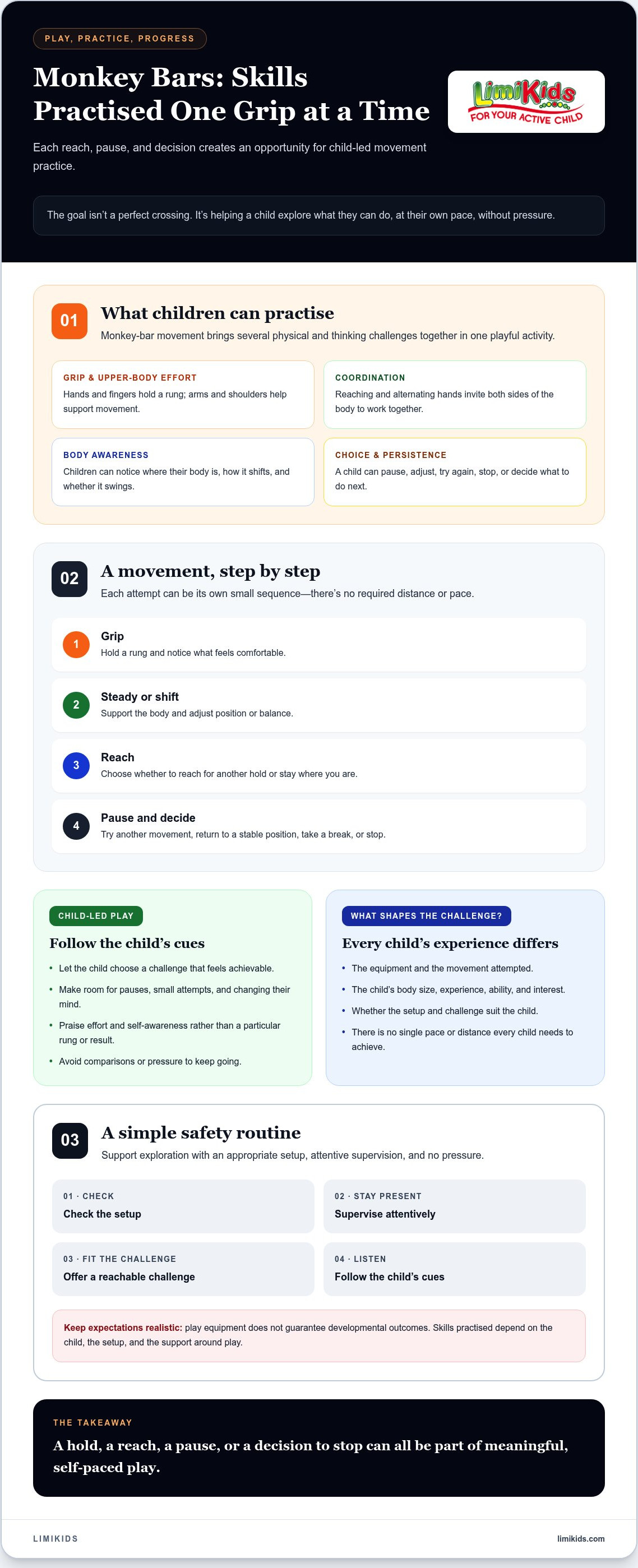
Hanging and reaching engage the hands and fingers, arms, shoulders, and trunk as a child works to hold a position and move. Grip is part of the challenge, but so is noticing where the body is and adjusting its position. Moving one hand and then the other invites bilateral coordination, or using both sides of the body together in an organized way. The exact challenge varies with the equipment, the child’s body size and experience, and their individual ability.
Some children may start by holding a rung or reaching for the next one; others may be ready to move farther. Both approaches can offer useful practice. There’s no single pace or distance every child needs to achieve.
How can play support confidence and independence?
Confidence can grow as a child chooses a challenge that feels achievable, tries it, and decides what to do next. A child might pause, adjust their grip, or choose to stop. Those choices offer practice in noticing their own comfort and ability. Repeated attempts may also give children a chance to practise persistence, but persistence isn’t an automatic result of using monkey bars.
Encourage without turning play into a test. Praise effort and self-awareness: “You found a grip that felt comfortable,” or “You noticed you wanted a break.” Avoid comparing children or pushing them to reach a particular rung. Play can be valuable even when a child chooses a small challenge, changes their mind, or explores one movement at a time.
How monkey-bar movements build strength, coordination, and body awareness
Each reach asks a child to do several things at once: hold on, steady the body, and choose where the next hand will go. Monkey bars offer a chance to practise physical skills through play rather than through a formal workout. The developmental milestones for 5-year-olds page from the Centers for Disease Control and Prevention also points caregivers to monkey-bar play as one activity for supporting a child’s development. It’s a prompt to play, not a promise of a particular result.
Reaching and moving across monkey bars brings grip, upper-body effort, timing, coordination, and body awareness into one playful activity. These connected actions help explain the developmental benefits of monkey bars, while each child’s abilities and experience shape the challenge.
How does monkey-bar play involve grip and upper-body strength?
A child grips a rung with their hands, supports some or all of their body weight, then reaches toward another hold. The hands and fingers work to maintain contact while the arms and shoulders help support movement. The trunk also plays a part as the child steadies or shifts their body. How demanding this feels varies with the equipment, body size, movement attempted, and individual ability.
This is strength practice woven into play, not a prescribed strength-training programme. One child may hang briefly; another may reach from one rung to the next. Neither needs to meet a particular fitness goal or timeline. Keep the focus on comfortable, self-paced exploration rather than asking a child to continue after they want to stop.
Why do timing, coordination, and body awareness matter?
To reach for a rung, a child plans the movement while keeping the other hand in place and managing the rest of their body. Alternating hands invites bilateral coordination, which means coordinating both sides of the body. A child also practises proprioception: the sense of where their body is and how it’s moving, even without looking directly at every arm, leg, or shift.
For example, a child might pause, tighten their grip, then reach with one hand while the other supports them. They can notice whether their body swings, adjust their timing, and decide whether to try the next reach or return to a stable position. Repeating movements at their own pace offers opportunities to practise rhythm and coordination, though every child’s experience will differ.
If you’re considering ways to make active movement available at home, explore indoor monkey bars for kids as one possible option. When comparing equipment, consider the available space, your child’s abilities, and the manufacturer’s setup and use guidance.
Monkey bars and other play: what developmental benefits are different?
Different kinds of active play invite different movements, though the skills children practise can overlap. Monkey bars emphasize repeated overhead reaches and hand-to-hand movement. Climbing asks children to find routes across or upward, while swinging and balancing bring their own movement patterns. The risky play discussion from Dartmouth College considers monkey bars as one way children encounter manageable physical challenges. What feels manageable, appealing, or appropriate varies from child to child.
| Activity | Movement it invites | Possible practice area |
|---|---|---|
| Monkey bars | Reaching overhead and moving hand to hand | Grip, timing, and coordinating both sides |
| Climbing | Moving up or across, using varied holds and positions | Route planning, body positioning, and adapting movement |
| Swinging | Moving rhythmically as body orientation changes | Timing, rhythm, and noticing movement |
| Balance play | Shifting weight while controlling posture | Stability and body awareness |
What does monkey-bar play practise compared with climbing?
Monkey bars often offer a repeating sequence: reach for a rung, transfer weight, then reach again. Climbing can involve varied handholds and changing body positions, such as stepping up, shifting sideways, or choosing a route around an obstacle. Both activities can invite children to adjust their movement and consider what they can reach. Neither is universally better. The right challenge depends on a child’s interest, confidence, ability, and available space.
How are swinging and balance play different?
Swinging centres on rhythm and movement through space. A child may notice how their body changes orientation as they move back and forth. Balance play is less about travelling overhead and more about controlled shifts in posture and weight, such as stepping carefully along a low, stable surface. These activities can still overlap with monkey bars in the coordination and body awareness they invite.
If a child enjoys exploring, offer variety without turning play into a skills checklist. They might choose to reach across rungs one day and explore a balance challenge another. The developmental benefits of monkey bars are one part of a broader mix of movement experiences, shaped by what the child wants to try and what’s suitable for them.
How to encourage monkey-bar play safely and at a child’s pace
A thoughtful setup and attentive supervision help make room for children to explore without pressure. Readiness isn’t determined by one universal age or milestone. A child’s comfort, ability, and experience all matter, as does the equipment. Safe monkey-bar play starts with suitable equipment, active supervision, and a challenge that fits the individual child.
Use this simple sequence before and during play:
- Check the setup. Follow the manufacturer’s installation, maintenance, age, and use instructions. Make sure the surrounding area is clear and has an appropriate protective surface for the equipment and setting.
- Stay close and supervise. Keep your attention on the child so you can respond if they need help or decide to stop.
- Invite a reachable challenge. Let the child choose a movement they’re comfortable attempting, rather than setting a distance or achievement target.
- Follow their cues. Pause or finish when they show hesitation, fatigue, discomfort, or a desire to stop.
What should caregivers check before play begins?
Check that the equipment is installed and maintained according to the manufacturer’s instructions, and confirm that the child’s age and intended use align with the supplied guidance. Look over the play area and move objects that could get in the way. Use a protective surface appropriate to the equipment and setting. Stay close enough to observe the child and respond, rather than relying on a quick check from across the room.
How can children progress without pressure?
Let children start with movements they can manage, even if that means holding a rung or reaching only as far as feels comfortable. Offer encouragement, but don’t lift or push them into a movement. A child who wants to pause or stop is giving you useful information about how the challenge feels. The developmental benefits of monkey bars come from opportunities to explore, not from completing a particular route.
Keep encouragement specific and calm: “You chose a grip that felt comfortable,” or “You listened to your body and took a break.” Avoid comparing siblings or peers. If you have individual concerns about your child’s physical development, ability, or readiness, ask a qualified health professional for guidance before deciding what kind of activity is suitable.
Looking for an option to support active play at home? Explore monkey bars for kids, and review the product’s setup and age guidance to help assess whether it suits your child and space.
Making monkey-bar play part of an active home environment
Indoor monkey bars can make movement available at home, but they’re a good fit only if they suit your child, your space, and your family’s routine. Consider whether your child is interested in overhead movement, whether the equipment can be installed according to the manufacturer’s instructions, and whether you can supervise play as needed. The developmental benefits of monkey bars are possibilities to explore, not outcomes a piece of equipment can guarantee.
How can parents encourage purposeful play without over-directing?
Leave room for freely chosen movement. Your child might reach, hang, explore another way to move, or decide they’re done. A gentle question such as “Which movement feels comfortable to try next?” can invite them to think without telling them what to do. Notice enjoyment, effort, and self-directed choices rather than counting crossings or tracking progress. Some days, a few minutes of exploration may be enough.
Open-ended play gives children space to repeat a movement because they want to, not because an adult has turned it into a lesson. Stay attentive, follow the equipment’s guidance, and let your child set the pace. Your role is to support a suitable play environment, not to coach every reach.
When might indoor monkey bars suit a family?
Consider the available space, installation requirements, ongoing supervision, and whether your child enjoys this kind of movement. Check the manufacturer’s instructions for fit, setup, age guidance, and intended use before deciding. If overhead movement isn’t appealing or suitable, other indoor climbing and movement options may offer different ways to play. There’s no single setup that works for every home or child.
LIMIKIDS offers indoor monkey bars, indoor climbing equipment, and indoor home gyms for kids. These are options for bringing active play into a home, not developmental solutions in themselves. Families comparing types of indoor play can also look for an indoor home gym guide or sensory motor equipment guide. No guide or piece of equipment replaces choosing a setup that fits your child and space.
Keep play light and responsive. Let your child explore, repeat what they enjoy, and stop when they choose. If you’re considering a way to make active movement part of your home, explore LIMIKIDS’ indoor play equipment and review the details to see what may suit your family.
Make room for movement, curiosity, and small wins
The developmental benefits of monkey bars come from the movements children get to explore: reaching, gripping, coordinating their bodies, and choosing challenges that feel manageable. These are opportunities to practise, not guaranteed outcomes. A suitable setup, attentive supervision, and a child-led pace help keep play grounded and encouraging.
Monkey bars are one option among many. Consider your child’s interests, available space, and the kinds of movement that fit your family’s routine. LIMIKIDS, a Canadian retailer serving families nationally, has supported families since 2008 and offers indoor monkey bars and climbing equipment.
Explore indoor monkey bars and active play equipment, then choose what feels right for your home and child. Every curious reach and self-chosen pause can be part of an active, joyful play experience.
Frequently Asked Questions
What are the developmental benefits of monkey bars?
The developmental benefits of monkey bars include opportunities to practise gripping, reaching, hanging, and coordinating movement. These actions may involve upper-body strength, bilateral coordination, timing, and awareness of body position. Children may also experience confidence or persistence as they explore manageable challenges. What they practise varies by child and experience. Monkey bars don’t guarantee particular outcomes or replace individualized support from a qualified professional when a child has specific needs.
Do monkey bars help children build upper-body strength?
Monkey-bar play can give children opportunities to use and practise their hands, arms, shoulders, and trunk. Holding a rung involves gripping, while reaching for another hold adds a movement challenge. How demanding it feels depends on the child, equipment, and action they choose. Treat it as active play, not a prescribed strength-training programme. Supervise appropriately, encourage manageable movements, and let children stop if they feel tired or uncomfortable.
Can monkey bars improve coordination?
Monkey bars offer opportunities to practise coordination, but they don’t guarantee improvement or follow a fixed timeline. A child might plan a reach, move one hand while keeping the other in place, then adjust their body to stay steady. This involves timing and coordinating movements. Choose a suitable setup, supervise, and let your child move at their own pace. If you have concerns about their development, ask a qualified professional for guidance.
At what age can a child use monkey bars?
There isn’t one age that means every child is ready to use monkey bars. Readiness depends on the child’s ability and confidence, as well as the equipment’s design and manufacturer guidance. Check the age and use instructions for the specific equipment, supervise closely, and let your child start only with movements they can manage. Don’t pressure a child to hang or cross the bars before they feel ready.
Are monkey bars safe for young children?
No equipment removes all risk, so safety depends on the setup, supervision, and whether the activity suits the child. Follow the manufacturer’s installation, maintenance, age, and use instructions. Keep the play area clear and use an appropriate protective surface. Stay nearby and watch how your child responds, ready to help if needed. Avoid describing any monkey-bar setup as completely safe, and stop play if the child seems uncomfortable.
Do monkey bars help with sensory development?
Monkey-bar movement offers sensory experiences, such as gripping, changing body position, and noticing where the body is in space. Children may respond differently to these sensations, so follow your child’s comfort and cues. Play can provide movement experiences, but it shouldn’t be presented as treatment for a sensory or developmental condition. If you have questions about your child’s sensory needs, consult a qualified professional for individualized guidance.
How can I encourage my child to try monkey bars?
Make the equipment available in a supervised setting and invite your child to explore without pressure. Check the setup and manufacturer instructions first. You can demonstrate a movement if it helps, then let your child choose what feels manageable or decide to stop. Encourage effort without lifting, pushing, or comparing them with other children. If you have concerns about your child’s physical abilities, ask a qualified professional for advice.