






Creating a Yes Space for Toddlers: A Parent's Guide
What if your toddler could explore more freely without you having to say “no” every few seconds? Creating a yes space for toddlers starts with a simple idea: set aside a clearly bounded area where safer, suitable choices are within reach. It won’t make a room completely risk-free or replace supervision, but it can make it easier to manage everyday exploration without trying to control every corner of your home.
It’s understandable to feel unsure how much independence is appropriate when household hazards, fragile belongings, and a toddler’s curiosity all compete for attention. You don’t need a renovation or a room full of toys. This guide explains how to choose and prepare an area, offer play options that suit your child, and keep supervision part of the plan. You’ll also learn how to adjust the setup as your toddler’s skills and interests change.
Key Takeaways
- Start with a manageable part of a room, inspect it, and set clear boundaries before adding play choices.
- Creating a yes space for toddlers supports exploration, but it doesn’t replace active supervision or sensible limits.
- Offer a small, visible mix of age-appropriate activities that suits your child and the space.
- Observe how your toddler uses the area, then adjust it as their interests and abilities change.
- Build a routine that works for your family: start small, supervise, observe, and make changes when needed.
What Is a Yes Space for Toddlers, and What Is It Not?
Encouraging a toddler’s curiosity can be challenging when household hazards and treasured belongings are within reach. A yes space gives your child a defined area to explore, but no corner can account for every risk or replace your attention.
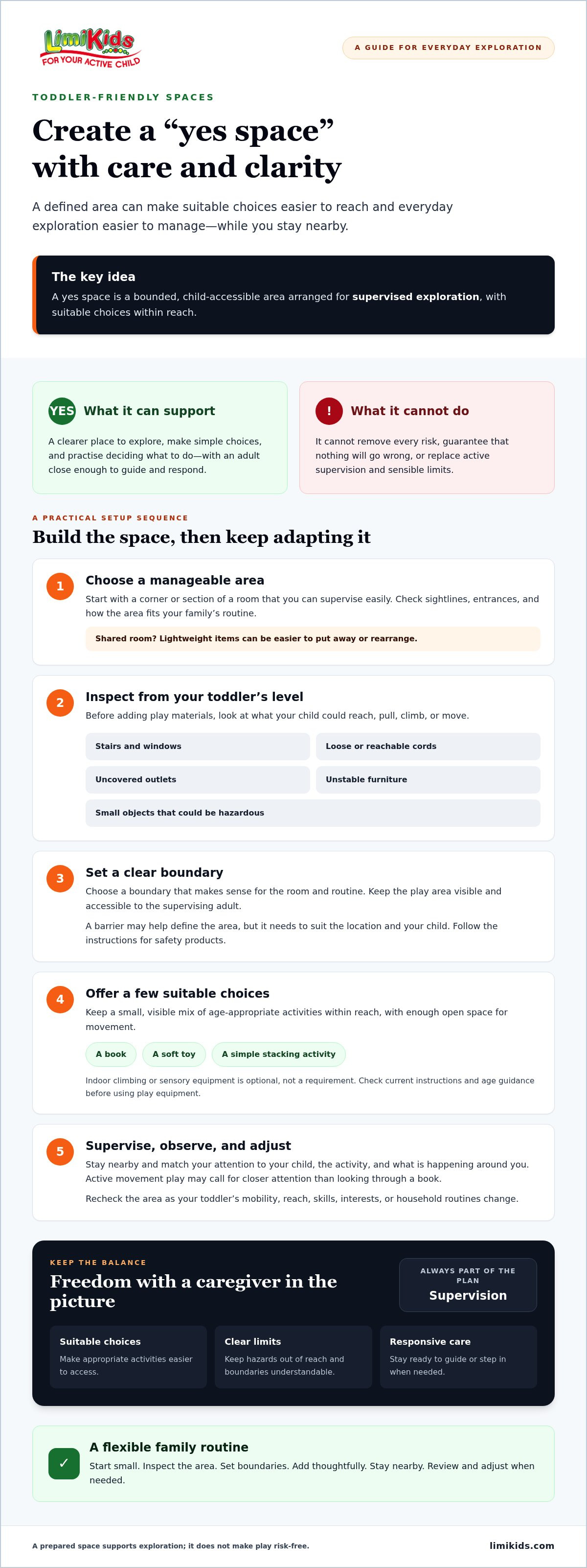
A yes space is a bounded, child-accessible area arranged for supervised exploration, where suitable choices are within reach. It can reduce access to some hazards and make it easier for your toddler to choose what to explore. It cannot remove every risk or guarantee that nothing will go wrong.
How a Yes Space Supports Toddler-Led Exploration
Keep a few appropriate options where your child can see and reach them. Your toddler might choose a book, pick up a soft toy, or try a simple stacking activity. These everyday choices let your child practise deciding what to do while you stay nearby and ready to respond. A yes space reflects the Montessori idea of a prepared environment, shaped to support a child’s access and autonomy.
Independence develops gradually. It doesn’t mean expecting a toddler to manage every moment alone or stepping away when they’re absorbed in play. Your presence and guidance still matter.
A Yes Space Is Not a Childproofed Guarantee
No room, gate, or piece of equipment makes play completely safe. Toddlers may find new ways to use familiar objects, and their abilities can change quickly. Check the area and its contents regularly, and keep hazards outside your child’s reach.
Match your supervision to your child, the activity, and what’s happening around you. Looking through a book is different from active movement play, and a change in the room or your child’s mood may call for closer attention. A prepared area can make supervision easier, but it is not a reason to leave a toddler unattended.
Think of creating a yes space for toddlers as setting up conditions for exploration, not handing over responsibility. Make appropriate choices easier to access while keeping clear limits and responsive care in place. That balance gives your child room to practise choosing, reaching, and playing, with you close enough to step in when needed.
How to Choose and Prepare a Toddler-Friendly Yes Space
You don’t need to redesign your home. Begin with a manageable corner or section of a room, then plan around how your family uses it. Choose an area, inspect it, set boundaries, add a few activities, and reassess. Start with a space you can supervise easily, rather than one that simply looks appealing.
Select an Area That Fits Your Home and Routine
A shared-room corner may work if you can keep your toddler in view while preparing a meal or folding laundry. A playroom may provide more room, as long as a caregiver can reach it easily. Check sightlines and entrances, and consider how the area is used at different times of day. If it needs to serve another purpose, choose lightweight items that are easy to put away or rearrange.
Inspect the Space Before Adding Toys
Get down to your toddler’s level and scan the area from their perspective. Check access to stairs and windows, loose or reachable cords, uncovered outlets, unstable furniture, and small objects that could be hazardous. Consider what your child can reach, pull, climb, or move, not just what’s on the floor. If you’re unsure about a hazard, pause and seek qualified advice.
Before adding play materials, check sightlines, stairs, windows, cords, outlets, furniture stability, small objects, and the boundary you’ll use. Choose barriers and protective measures that suit your home, and follow the instructions for any safety products. A barrier can help define the area, but it needs to suit the location and your child’s needs.
Set a clear boundary that makes sense for the room and your routine. Keep the area visible and accessible to the supervising adult. Then add a few suitable play choices, leaving enough open space for your toddler to move. Aim for a practical play zone, not a miniature playroom crowded with equipment.
Before using play equipment, read its current instructions and age guidance, and check that it suits your child and the available space. Indoor climbing or sensory equipment is optional, not a requirement. You can explore indoor climbing and sensory play equipment when considering options for a home play area.
Reassess the area as your toddler’s mobility, reach, and interests change, and whenever furniture or household routines shift. A setup that works today may need an adjustment later. Keep the process flexible: choose, inspect, set boundaries, add thoughtfully, and review.
How to Balance Toddler Freedom With Boundaries and Supervision
A yes space doesn’t mean your toddler can touch everything or do whatever they want. It makes suitable choices easier to access while keeping adult guidance in the picture. The boundary might be physical, such as a gate, or involve keeping a household item out of reach. Freedom works best when your child knows what they can explore and you stay attentive.
Some activities give a toddler room to make choices with less hands-on direction. They might decide which book to look at or how to arrange suitable blocks. Climbing, energetic movement, or unfamiliar activities call for closer attention. The supervision needed can change with the activity, your child, or the surroundings.
Match Supervision to the Activity and Child
Stay close during climbing and movement play, and whenever your toddler is trying something unfamiliar. Consider their current skills and behaviour, along with what’s nearby. A busy household, a change in the room, or a new challenge may call for more direct attention. Before using equipment, check its current instructions and age guidance, and make sure the setup suits your child and space.
Think of play as a chance to practise choosing, exploring, and moving within clear limits, not as a guarantee of a particular developmental result. You might join in, watch nearby, or offer hands-on support when your toddler needs it. Follow your child’s cues and step in when the activity or situation calls for you.
Set Clear Limits Without Making the Whole Room Off-Limits
Keep restricted areas and household items consistently out of bounds. Use short phrases your toddler can understand, such as “That stays on the shelf” or “The stairs are not for playing.” Calm repetition makes a boundary clear without turning every moment into a long explanation. You can keep a limit firm while speaking warmly.
When your toddler reaches for something off-limits, redirect them toward a suitable choice: “That isn’t for playing. You can choose a book or blocks.” You’re not saying yes to the restricted object. You’re showing your child where they can direct their curiosity instead.
Creating a yes space for toddlers means balancing choice with your active presence. Keep boundaries predictable, adjust how closely you supervise to the play, and offer alternatives when you need to set a limit. The aim isn’t unrestricted play. It’s a clearer framework for exploration that can flex with your child and your family’s routines.
How to Add Play Choices and Adjust the Space Over Time
A small, well-chosen selection can invite more exploration than a crowded shelf. Keep options visible and reachable, with enough room to use them comfortably. A mix of quiet, sensory, and movement play offers variety when each activity suits your toddler and the space.
Choose Activities for Different Kinds of Play
Consider a sturdy board book for quiet time, blocks for stacking, or a simple puzzle suited to your child. For sensory play, choose materials appropriate for your toddler’s age and behaviour, and supervise their use. If your child mouths objects, keep small parts and anything else they could choke on completely out of reach.
Movement activities can be as simple as making room to crawl, dance, or move with you. Climbing or sensory equipment is optional, not a requirement for a useful yes space. Before adding equipment, check its current instructions and age guidance, and confirm that it fits your home and the supervision you can provide.
Use Observation to Refresh the Setup
Notice what your toddler chooses, how they use it, and whether they return to it. A book they revisit or a stacking activity they try in new ways may be worth keeping close. If an activity repeatedly causes frustration, consider whether it’s unsuitable right now, needs your help, or should be put away for a while.
Rotate a few materials when your child’s interest shifts rather than replacing everything at once. Familiar favourites can stay available while other choices take a turn. Watch how your toddler moves through the area, too. If play now involves reaching higher, moving faster, or exploring new corners, recheck the boundaries and each activity’s suitability.
The best yes space changes with your child and household, keeping play choices suitable as abilities, interests, and routines evolve. You might swap a quiet activity for a movement option, clear more floor space, or put away materials that no longer fit. Creating a yes space for toddlers is an ongoing process of observing and making small adjustments, not a one-time decorating project.
If you’re considering optional movement or sensory additions, explore indoor play equipment and check the product details carefully to see what may suit your child and space.
Make Your Toddler’s Yes Space Work for Your Family
A useful yes space doesn’t need to take over your home or look like a picture-perfect playroom. It needs to suit your available space, daily routines, and the way your toddler likes to play. Start with one prepared area and a few accessible activities. Then supervise, observe, and adjust one detail at a time.
Start Small, Then Improve One Detail at a Time
Try the setup during a part of the day when you can stay nearby. Notice whether you can see and reach your toddler easily, whether the area interrupts household routines, and which activities your child chooses. If it feels cramped or gets in the way, make a small change rather than abandoning the idea. A few thoughtful adjustments can help the space work better for your family.
Keep activities that invite comfortable, repeated play, and reconsider anything that causes frustration or no longer suits your child. As your toddler’s interests and abilities change, revisit the area instead of expecting one arrangement to work indefinitely. If you’re considering active-play equipment as an optional addition, this indoor home gym buying guide can help you think through what to consider.
Add Equipment Only When It Suits the Child and Space
An indoor climbing option may offer another way to explore movement at home, but it isn’t needed to create a yes space. Before choosing equipment, compare its dimensions with the space you have, review the installation requirements and current age guidance, and consider how closely you’ll need to supervise its use. Make sure it suits your child’s abilities and your family’s routine, not just the available floor area.
Sensory equipment can also be an optional choice if it suits your child and the play area. Keep supervision and the product’s instructions in mind. For ideas about active discovery, explore this Montessori play equipment guide.
Keep the next step manageable: start small, stay close, notice what works, and adjust as needed. Creating a yes space for toddlers is a practical way to make room for exploration while respecting your home, your routines, and your child’s changing interests. Let the space grow with your family, one considered choice at a time.
Make Room for More Curious, Confident Play
A yes space doesn’t need to be elaborate. Start with a clearly bounded area, a few suitable play choices, and supervision that matches your toddler and the activity. Watch how your child uses the space, then adjust it as their interests, abilities, and family routines change. Creating a yes space for toddlers is an ongoing process, not a one-time project.
Indoor climbing or sensory equipment can add play possibilities, but neither is required. If you’re exploring options for active discovery at home, explore indoor play equipment for active discovery at home. LIMIKIDS offers indoor climbing and sensory play equipment designed for home use, including space-saving options designed to grow with children through different stages.
Start small, stay close, and let your setup evolve. Explore LIMIKIDS indoor play equipment to find options to consider for your family’s home play space.
Frequently Asked Questions
What is a yes space for a toddler?
A yes space is a prepared, bounded area where a toddler can explore accessible activities while a caregiver remains responsible for supervision. Its purpose is to make suitable choices easier and reduce access to common household hazards. It doesn’t guarantee safety or replace attentive care. You don’t need to redesign your entire home: a practical corner or section of a room can be a helpful place to begin.
How do I create a yes space for my toddler?
Choose an area that fits your home and routine, inspect it for hazards, set clear boundaries, and add a few age-appropriate activities. Consider whether you can see and reach your toddler while supervising. Start simply, then observe how your child uses the space. Adjust it as their abilities and interests change, or when household routines shift. Creating a yes space for toddlers is an ongoing process, not a one-time project.
Is a yes space safe for toddlers?
A thoughtfully prepared yes space can reduce access to some household hazards, but no play area is completely risk-free. Safety depends on your toddler, the activity, the surroundings, and ongoing supervision. Check furniture stability, cords, outlets, small objects, and access to restricted areas. Recheck the setup as your child’s reach and abilities change. Follow the instructions for any products or equipment you use, and adjust your supervision to the activity.
Can I leave my toddler alone in a yes space?
No, a yes space isn’t a reason to leave a toddler unattended. Caregivers remain responsible for supervision, and how closely you stay should reflect your child, the activity, and the surroundings. Climbing, movement, or unfamiliar play may call for closer attention than a quiet activity. Preparing the area can make exploration easier, but keep checking in and respond to your toddler’s needs as they play.
What should I put in a toddler yes space?
Choose a small selection of age-appropriate activities that suit your child and home. Board books, blocks, and simple puzzles can offer different kinds of play; movement activities may also fit if there’s room and you can supervise. Keep small parts and unsuitable objects out of reach, especially if your toddler mouths items. Special equipment isn’t required. If you add climbing or sensory equipment, check its instructions, fit, and supervision requirements.
How much space do I need for a toddler yes space?
There’s no single room size required. Start with a clearly bounded area that fits your home, routines, and toddler’s activities. Prioritize a practical layout, clear sightlines for the supervising caregiver, and boundaries that suit the space rather than aiming for a particular amount of square footage. Before adding equipment, check its dimensions, installation requirements, and the space needed for its intended use.
How often should I change a toddler yes space?
Review the setup whenever your toddler’s abilities, interests, or household routines change. You can also make a small adjustment if an activity is ignored, causes frustration, or no longer suits your child. Try rotating a few accessible choices instead of changing everything at once. As the space evolves, recheck its boundaries and any equipment instructions so the setup continues to suit your toddler and home.