






Indoor Climbing for Kids Development: 5 Common Myths Debunked
What if your living room held the secret to unlocking your child's cognitive potential? It is a bold idea, but the latest research shows that indoor climbing for kids development is about much more than just physical exercise. You have likely felt the stress of a long Canadian winter, watching your little ones bounce off the furniture while you worry about safety. You want them active; you want them growing; but the fear of injury or bulky gear often stops you in your tracks.
It is completely normal to feel hesitant about bringing climbing equipment into your home. You are a safety-conscious parent who wants the best for your child's milestones without the risk. This guide will show you exactly how vertical play transforms physical coordination and brain power while separating scary fiction from reality. We are debunking five common myths to give you total confidence in choosing safe, high-impact equipment. You will discover how to turn restless energy into measurable growth and create a home environment where your child can truly thrive.
Key Takeaways
- Stop viewing active play as just a distraction. Learn how vertical movement builds essential motor planning and cognitive skills through structured discovery.
- Explore the science of the mind-body connection. Discover how indoor climbing for kids development uses cross-lateral movement to bridge brain hemispheres and improve coordination.
- Turn your living room into a year-round developmental lab. See why frequent home play offers more growth opportunities than occasional trips to the outdoor park.
- Build with confidence. We'll show you how to spot the difference between flimsy toys and premium, structurally sound indoor playground equipment designed for home safety.
- Future-proof your playroom. Learn how to select modular systems that grow with your child's physical milestones to keep them challenged as they age.
Is Indoor Climbing Just for Fun? Busting the "Empty Play" Myth
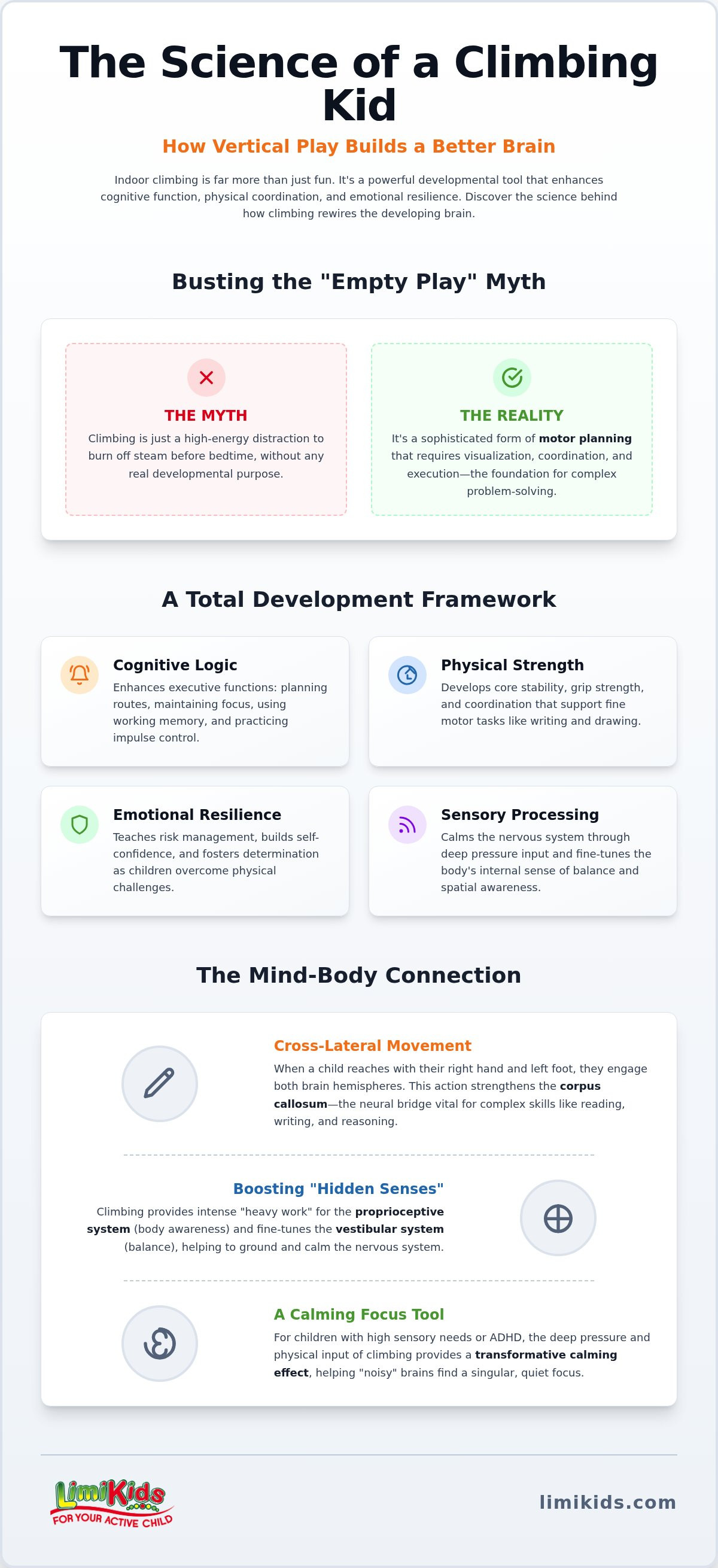
Stop viewing your child's climbing habit as a mere nuisance or a simple way to tire them out before bedtime. Many parents fall for the "Empty Play" myth. This is the mistaken idea that climbing is just a high-energy distraction without a real purpose. In reality, indoor climbing for kids development is a sophisticated form of motor planning. It requires children to visualize a path, coordinate their limbs, and execute precise movements under pressure. It is a structured yet free-play activity that builds the foundation for complex problem-solving. This isn't just play; it is preparation for life.
The Biological Drive: Why Kids Need to Go Vertical
Children are hardwired to seek heights. This is not just mischief; it is a biological necessity for mastering child development stages related to spatial awareness. Evolutionarily, exploring vertical space helped humans understand their environment. While running on a flat surface is excellent for cardiovascular health, vertical movement activates the brain in a completely different way. It forces the mind to process three-dimensional space and gravity simultaneously. When you suppress this natural urge to go vertical, you might notice "clumsy" behavior or intense sensory seeking. Kids don't just want to climb; they need to climb to understand where their bodies end and the world begins.
More Than Muscles: The Total Development Framework
Think of climbing as a total-body classroom. It addresses four critical pillars of growth: physical strength, cognitive logic, emotional resilience, and sensory processing. Developmental climbing is a multi-planar physical challenge that prepares the nervous system for everything from organized sports to sitting still in a classroom. It builds the core stability and grip strength needed for fine motor tasks like writing and drawing. By engaging in this functional play, children learn to manage risk and build confidence in their own physical abilities.
To support this growth at home, choosing the right indoor home gym for kids provides a safe, dedicated space for this essential work. You transform "burning off steam" into "building a better brain" when you provide the right tools. Indoor climbing for kids development is an investment in their total potential. It gives your child the tools to tackle physical obstacles and academic challenges with the same grit and determination. Don't let the "Empty Play" myth hold your child back from reaching new heights.
The Mind-Body Connection: How Climbing Rewires the Developing Brain
Climbing acts like a high-speed data transfer between brain hemispheres. Every time your child reaches with their right hand while stepping with their left foot, they engage in cross-lateral movement. This action bridges the left and right sides of the brain by strengthening the corpus callosum. A strong neural bridge is vital for future skills like reading, writing, and complex reasoning. Indoor climbing for kids development isn't just about building physical power; it is about creating a faster, more efficient neural network through movement.
Your child's "hidden senses" also get a massive boost on the wall. The proprioceptive system tells the brain exactly where the body is in space without needing to look. Climbing provides intense "heavy work" through the joints and muscles, which helps ground and calm a child's nervous system. Simultaneously, the vestibular system in the inner ear manages balance and stability. As children tilt, reach, and pull against gravity, they fine-tune their internal GPS. This leads to the significant cognitive and physical benefits of climbing that experts observe in active play.
Executive function thrives in a vertical environment. A child cannot simply move randomly; they must plan their route, maintain focus on the next hold, and use their working memory to remember where their feet are. It is a high-stakes strategy game played with the entire body. These sessions require intense concentration and impulse control, which are the same skills needed for academic success later in life.
Sensory Integration and Focus
For children with high sensory needs or ADHD, climbing is a transformative tool. The deep pressure and physical input of pulling against gravity provides a calming effect that few other activities can match. It helps "noisy" brains find a singular, quiet focus. Integrating specialized kids balance and coordination equipment into your home allows for consistent, daily sensory regulation. It turns a restless afternoon into a productive growth session that settles the mind and body.
Problem Solving at Height
Every difficult ascent involves a "Stop-Think-Act" cycle. When a child hits a challenging section, they must pause and evaluate their options. These physical "micro-failures", such as reaching for a hold and missing, build incredible cognitive resilience. They learn that a mistake is just a piece of data for the next attempt. We define motor planning as the brain’s ability to execute a sequence of unfamiliar movements. It is the bridge between a child's intent and their physical achievement. To start building these essential brain connections today, browse our premium indoor climbing equipment designed for home use.
Indoor vs. Outdoor Climbing: Why Your Living Room is a Developmental Lab
Forget the idea that "real" climbing only happens at the local park. While outdoor playgrounds are fantastic, they are often high-intensity, low-frequency events. You might make it there once a week for a few hours. In contrast, indoor climbing for kids development thrives on the opposite: low-intensity, high-frequency engagement. Your living room is a year-round developmental lab where growth never stops, even when Canadian winters bury the local park in three feet of snow. By bringing the challenge inside, you ensure that gross motor milestones don't hibernate for six months of the year.
Consistency is the secret ingredient for neurological growth. Scientific data backs this up. According to University of North Florida research, proprioceptively dynamic activities like climbing can actually increase working memory by 50%. This massive boost isn't achieved through a single monthly visit to a commercial climbing gym; it happens through the daily, repetitive challenge of navigating a familiar home structure. A controlled home environment allows for "safe failure," where children can push their limits and master new skills without the distractions or pressures of a public space.
The Power of Consistent Access
Mastery requires repetition. A child who faces the same climbing frame every morning gains a level of confidence that a public park simply can't provide. They learn to navigate obstacles with precision, perfecting their grip and balance through hundreds of micro-interactions. When you integrate Montessori play equipment, you encourage this independent discovery. Your child becomes the master of their own vertical world, testing limits in a space they know and trust. Fifteen minutes of daily climbing beats a two-hour park visit once a week every single time.
Home Environment vs. Public Playgrounds
Public playgrounds often come with hidden stressors for both parents and children. You're frequently managing crowds, hygiene concerns, and equipment that might not be age-appropriate. At home, you create a "Yes Space." This is a dedicated environment where your child can explore without hearing a constant stream of "be careful" or "don't do that." You know the equipment is structurally sound and tailored to their specific size. Whether you choose a wooden vs metal indoor jungle gym, the outcome is a permanent, reliable outlet for energy. You monitor the progress, celebrate the small wins, and watch as daily play turns into lasting physical and cognitive gains.
Safety Myths: Can Indoor Climbing Really Be Safe for Home Use?
Safety is the primary concern for every parent considering a vertical upgrade to their home. You might worry about structural failure or a dangerous fall. These fears are natural, but they often stem from a lack of information about high-end home equipment. Indoor climbing for kids development is incredibly safe when you move past "toy-grade" options. Residential setups have evolved. They are no longer flimsy plastic structures; they are robust, engineered systems designed to handle the dynamic energy of growing children.
The secret to a safe home gym lies in the installation and the gear surrounding it. Never skip the safety mats. High-density foam mats are non-negotiable for absorbing impact and providing a clear "play zone." When it comes to mounting, stud-mounting is the gold standard for permanent reliability. While pressure-mounting offers flexibility, securing your equipment directly into the wall studs ensures it won't budge during even the most vigorous play. This structural permanence gives you peace of mind while your child explores their limits.
Structural Integrity: What to Look For
Don't settle for equipment that barely meets your child's current weight. A premium system, like a high-quality Swedish wall, often features weight capacities of 200lbs or more. You might wonder why a 40lb toddler needs a 200lb limit. It is about the dynamic load. When a child jumps or pulls suddenly, they exert force far beyond their static weight. Look for materials like high-grade steel or solid wood. These materials offer the reliability and permanence that plastic toys simply cannot match. Safety certifications aren't just labels; they are proof that the equipment has survived rigorous stress testing for home use.
The Risk vs. Reward Balance
We need to talk about "risky play." It sounds scary, but it is essential for preventing future injuries. By allowing your child to navigate heights in a controlled environment, you teach them how to fall safely and how to judge their own physical capabilities. This is "active supervision" rather than "hovering." You stay close enough to guide, but you allow them the space to make mistakes. Learning to manage a slip on a 4-foot climbing frame today prevents a major accident on a 10-foot park structure tomorrow. It builds the physical literacy required for a lifetime of safe movement.
Ready to transform your home with confidence? Explore our range of certified indoor playground equipment and see how structural integrity meets childhood joy.
Choosing the Right Climbing Gear for Every Developmental Stage
Selecting the right equipment is about more than just checking an age label on a box. To truly maximize indoor climbing for kids development, you must look at your child's current motor skill milestones. Are they just starting to pull themselves up, or are they ready to navigate complex vertical routes? Choosing gear that matches their physical readiness ensures they stay challenged without becoming overwhelmed. This is where the "Modular Advantage" becomes your best friend. Instead of replacing an entire setup every year, look for systems that allow you to add monkey bars, rings, or rope ladders as your child's abilities evolve.
In Canadian homes, space is often at a premium. Vertical Swedish walls are the ultimate solution for active play in tight quarters. They offer a massive range of movement options while taking up minimal floor space. By choosing a system that grows with your family, you transition your playroom from a simple "play area" into a high-functioning home developmental lab. You are building a permanent foundation for health and discovery that adapts to every new achievement. It is a proactive investment in your child's long-term physical literacy.
Toddlers (Ages 1-3): Foundation and Grip
For the youngest climbers, the focus is on stability and sensory exploration. Montessori-inspired low climbers are perfect for this stage. These structures encourage independent discovery in a safe, low-to-the-ground environment. At this age, children are developing their "pincer grip" and the basic pulling strength needed for later milestones. Look for equipment with varied sensory textures and low ladders that allow for small, successful climbs. Pair these with soft landing zones to create a space where your toddler feels bold enough to test their balance every single day. Start small, build trust, and watch their confidence soar.
Preschoolers to Big Kids (Ages 4+): Strength and Strategy
As children move past the toddler years, their need for complex physical challenges increases. This is the time to introduce monkey bars and rope ladders. These tools facilitate brachiation, which is the act of swinging from arm to arm. Brachiation is a powerhouse for building upper body strength and improving complex motor planning. Your child will start to visualize "routes" through the frame, turning their play into a strategic exercise. Indoor climbing for kids development at this stage focuses on core stability and the confidence to tackle multi-step physical problems. Explore LIMIKIDS premium indoor climbing frames to find the perfect modular fit for your home and watch your child reach their full potential.
Unlock Your Child's Vertical Potential Today
Stop letting the weather or safety fears limit your child's growth. Climbing is a neurological powerhouse, not just a way to burn energy. It builds the critical neural bridges and executive function skills your child needs for future success. By bringing this challenge into your living room, you guarantee consistent, daily progress that no occasional park visit can match.
True safety comes from choosing quality engineering over flimsy toys. Indoor climbing for kids development thrives in a space designed for mastery and resilience. LIMIKIDS has been serving Canadian families with premium, safety-tested gear since 2008. Our space-saving Swedish wall gyms are crafted to grow with your child, adapting perfectly as they conquer new developmental milestones. You don't have to choose between a tidy home and an active child.
Take the first step toward a more confident, capable child. Transform your environment into a hub of discovery and watch your little ones reach heights you never thought possible. They are ready for the challenge. Give them the tools to succeed today.
Transform your home into a developmental playground with LIMIKIDS
Frequently Asked Questions
Is indoor climbing safe for toddlers under 3 years old?
Yes, indoor climbing is incredibly safe for toddlers when you use age-appropriate equipment. Montessori-inspired low climbers and soft ladders are designed specifically for this developmental stage. These tools allow your little one to build grip strength and coordination just inches from the floor. Always provide active supervision and ensure a thick, soft landing zone is in place to support their earliest vertical discoveries.
How much space do I really need for an indoor climbing gym?
You don't need a dedicated playroom to start. Vertical Swedish walls are designed for Canadian homes where space is at a premium; they often require as little as two feet of wall width. While the equipment itself is compact, you should maintain a clear "fall zone" of approximately six feet around the structure. This ensures your child has plenty of room to move, jump, and explore safely without hitting furniture.
Does indoor climbing help with sensory processing disorders?
Climbing is one of the most effective activities for sensory regulation. It provides the "heavy work" your child's nervous system craves by putting productive pressure on joints and muscles. This deep sensory input helps calm a restless mind and improves proprioception, which is the brain's understanding of where the body is in space. Many parents find it transforms their home into a peaceful, regulated environment.
Can indoor climbing improve my child’s performance in school?
Indoor climbing for kids development directly impacts classroom success by strengthening executive function. When children plan a route up a climbing frame, they practice focus, working memory, and impulse control. These are the exact same cognitive skills required to follow multi-step instructions and stay seated during lessons. Physical mastery builds the mental grit needed to tackle tough academic subjects with confidence.
What is the best flooring or mat for a home climbing setup?
High-density foam mats are the absolute gold standard for home safety. Look for professional-grade mats that are at least four inches thick to ensure maximum shock absorption. Standard rugs or thin yoga mats don't provide the impact protection needed for vertical play. A high-quality mat creates a defined "Yes Space" where your child feels empowered to push their physical limits without fear of a hard landing.
How do I know if my walls can support a Swedish wall gym?
Most standard residential walls with wood or metal studs can easily support a premium home gym. You must use a stud finder to locate the vertical supports behind your drywall and secure the equipment directly into them. For those with concrete or brick walls, specialized masonry anchors provide a permanent, rock-solid connection. Always prioritize stud-mounting over simple drywall anchors to ensure the structure remains stable during high-energy play.
Will my child get bored of an indoor climbing frame quickly?
Boredom is rarely an issue with modular systems that adapt to your child's growth. By adding new attachments like monkey bars, rings, or rope ladders, you keep the physical challenge fresh and exciting. Unlike one-dimensional toys, climbing is an open-ended puzzle. Every time your child steps onto the frame, they find new ways to move, swing, and climb, keeping them engaged for years rather than weeks.
What are the most important safety features to look for in a home gym?
Focus on structural integrity and weight capacity above all else. Choose equipment made from premium materials like solid wood or high-grade steel with a weight limit of at least 200lbs. This ensures the frame can handle the dynamic force of a jumping child. Look for smooth, splinter-free finishes and certified mounting hardware. High-quality indoor climbing for kids development depends on gear that prioritizes permanence and reliability over "toy-grade" aesthetics.