






The Ultimate Checklist: Kids Balance and Coordination Equipment for Home
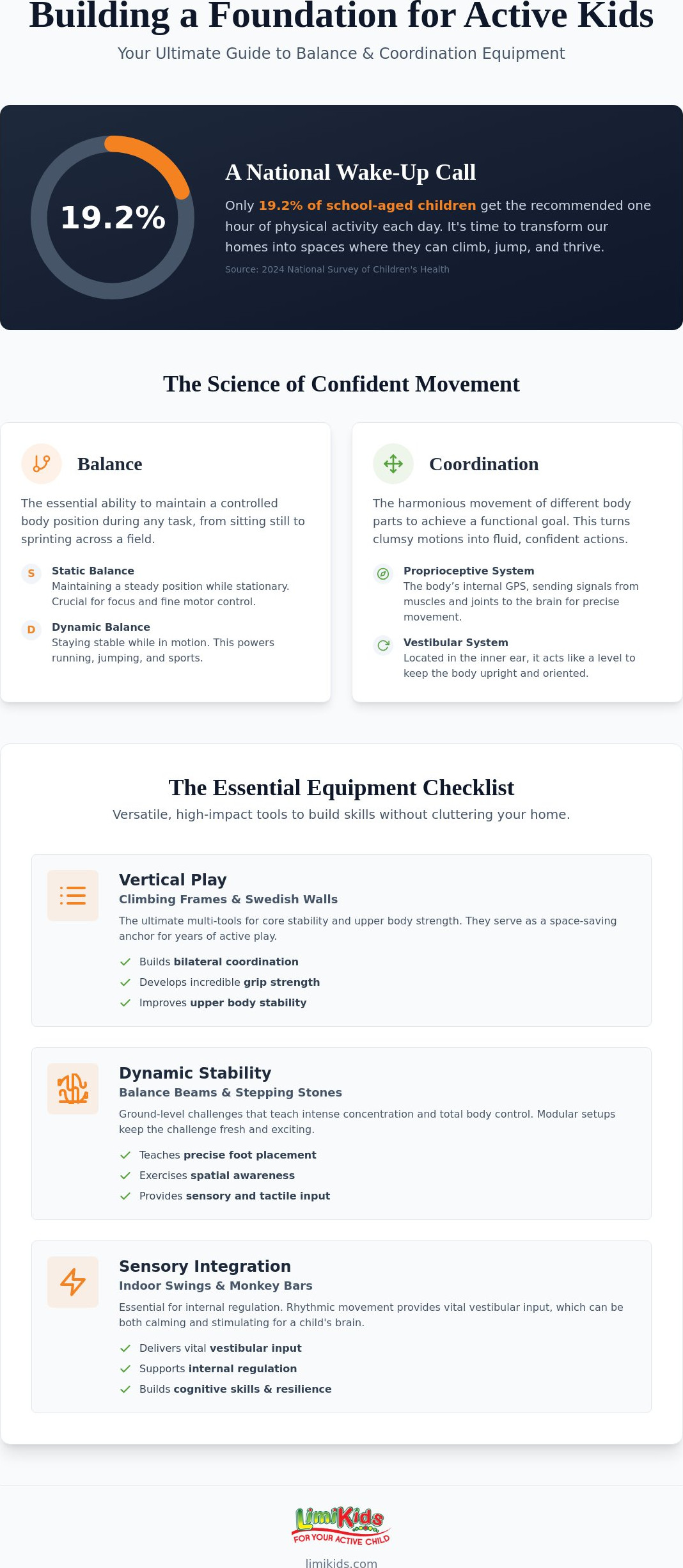
Only 19.2% of school-aged children get the recommended hour of physical activity each day, according to the 2024 National Survey of Children's Health. It's a wake-up call for every parent who worries about their child becoming sedentary indoors. You want your home to be a space where they can climb, jump, and thrive. We understand the frustration of trying to decode technical terms like proprioception or finding gear that doesn't swallow your entire living room. You deserve a clear path to supporting your child's milestones.
This article provides the ultimate checklist for kids balance and coordination equipment, giving you the tools to transform your home into a powerhouse for physical development. You'll discover the most effective indoor equipment and expert strategies to boost your child's confidence and motor skills. We've laid out exactly what you need to create a safe, high-energy play environment that grows with your family.
Key Takeaways
- Master the definitions of balance and coordination to better understand your child’s physical milestones and foundational confidence.
- Access a curated shopping list of kids balance and coordination equipment designed to maximize skill growth without cluttering your living space.
- Learn how to select versatile, "grow-with-me" gear that adapts as your child transitions through different developmental stages.
- Discover practical design strategies for installing high-energy play structures in compact Canadian homes or rooms with low ceilings.
- Understand the safety and durability benefits of choosing specialized indoor equipment like Swedish walls for long-term physical health.
Understanding the Core: Why Kids Balance and Coordination Equipment Matters
Balance is far more than a simple physical trick. It's the essential ability to maintain a controlled body position during any task; from sitting upright in a chair to sprinting across a playground. Coordination is the partner to balance. It’s the harmonious movement of different body parts to achieve a functional goal. When these two skills work together, they create the foundational "software" for a child’s confidence and social success.
Before diving into specific gear, it helps to understand the underlying science. What are motor skills? Simply put, they are the coordinated patterns of movement that allow us to navigate our world. By introducing kids balance and coordination equipment into your home, you give your child a dedicated space to refine these patterns daily. This consistent practice turns clumsy movements into fluid, confident actions.
This physical development relies on two critical sensory systems that often go unnoticed. The vestibular system, located in the inner ear, acts like a level to keep the body upright and oriented. The proprioceptive system serves as the body’s internal GPS for movement, sending constant signals from muscles and joints to the brain. Together, these systems allow a child to move with grace and precision without needing to look at their feet.
Static vs. Dynamic Balance: What Parents Need to Know
Static balance involves maintaining a steady position while the body is stationary. It's the foundation for classroom focus and fine motor control. Dynamic balance is the ability to stay stable while in motion. This is the skill that powers running, jumping, and team sports. Proprioception acts as the body’s internal GPS for movement, ensuring every limb knows its place during these activities. Both types of stability are essential for long-term physical achievement.
The Link Between Physical Movement and Cognitive Development
Physical challenges are actually brain exercises. Navigating a complex obstacle course or a climbing frame forces the brain to create new neural pathways for problem-solving. It isn't just about building muscle; it's about logic and resilience. Using indoor home gyms for kids provides a safe laboratory for this growth. In these spaces, children learn to take controlled risks, building the emotional grit they need to face challenges outside the home. They learn that a "fall" is just a data point on the way to success.
The Essential Kids Balance and Coordination Equipment Checklist
Transform your living room into a launchpad for growth. It’s time to move beyond passive screen time and sedentary afternoons. A truly effective home sensory gym requires a strategic mix of kids balance and coordination equipment that challenges the body from every angle. You don't need a massive warehouse to make an impact. You need versatile, high-impact tools that target developmental milestones for gross motor skills while keeping the energy high. Focus on equipment that serves multiple purposes. Your goal is a space that encourages discovery while meeting the latest safety standards for 2026. Investing in high-quality kids balance and coordination equipment ensures your child has the tools to master their environment safely.
Vertical Play: Climbing Frames and Swedish Walls
Vertical play is non-negotiable for core stability. Climbing frames and Swedish walls are the ultimate multi-tools for this. They demand bilateral coordination; the ability to use both sides of the body in a synchronized way. This vertical movement builds incredible grip strength and upper body stability. Because Swedish walls mount directly to the wall or floor-to-ceiling, they serve as a space-saving anchor. They provide a permanent, reliable structure for years of active play. This is the foundation your child needs to build physical confidence from the ground up.
Dynamic Stability: Balance Beams and Stepping Stones
Balance beams and stepping stones bring the challenge to the ground. Beams teach precise foot placement and intense concentration. They turn a simple walk into a high-stakes mission that requires total body control. Stepping stones allow for a modular setup. You can change the path daily to keep the challenge fresh and exciting. The classic "floor is lava" game is actually a sophisticated exercise in spatial awareness. Textured stones add a sensory layer, helping children process tactile information through their feet while they navigate their indoor environment.
Sensory Integration: Swings and Monkey Bars
Balance is also about internal regulation. Indoor swings offer vital vestibular input. This rhythmic movement can calm a child after a long day or alert their senses before a focused task. Monkey bars introduce the concept of brachiation. Swinging by the arms promotes healthy spinal alignment and builds functional shoulder strength. Safety is always the priority. High-quality landing mats are essential components of this setup. They provide the physical proof of durability and the peace of mind you need. Ready to build your own? You can browse our indoor playground equipment to find the perfect fit for your home.
Matching Equipment to Your Child’s Developmental Stage
Children grow at a lightning pace. Their physical needs at age two are worlds apart from their capabilities at age eight. To get the most out of your home setup, you need a "grow-with-me" strategy. Premium indoor gyms aren't static furniture. They are evolving tools that adapt to your child's height, strength, and curiosity. Choosing the right kids balance and coordination equipment means looking ahead to the next milestone while providing a safe challenge for today. This framework helps you upgrade your home gym logically. It ensures your investment pays off for years of active play.
The Early Years (Ages 1–3): Sensory Foundations
This stage is all about the transition from crawling to confident walking. Focus on low-to-the-ground climbing structures and soft, sensory textures that invite touch. Simple balance boards are perfect for toddlers learning to shift their weight. Small indoor slides offer a controlled way to experience speed and gravity. These tools build the foundational confidence needed for more complex tasks later. Keep it accessible. Encourage exploration. Every successful step builds a stronger neural connection for future movement patterns.
The Active Explorer (Ages 4–7): Building Strength
Preschool and early school-age children are high-energy explorers. This is the time to introduce monkey bars and rope ladders. These items require complex coordination and cross-lateral movement, where the brain must coordinate opposite sides of the body simultaneously. It’s a critical phase for developing total body control and grip strength. You might wonder which material is best for this intense level of play. Check out our guide on wooden vs metal indoor jungle gyms to see which fits your family’s style and energy levels. Metal often provides the high-impact durability needed for the most vigorous "jungle" sessions.
Advanced Skill Building (Ages 8+): Precision and Power
As children enter later childhood, their play shifts toward precision and power. They need equipment that supports sports-specific cross-training and more intense physical challenges. Vertical climbing walls and pull-up bars become essential for building functional strength. This age group is heavier and more powerful. Long-term durability is the top priority here. Your kids balance and coordination equipment must handle the weight of an older child without a hint of instability. High-quality Swedish walls truly shine in this phase. They provide a professional-grade anchor for everything from gymnastics practice to core workouts, transforming your home into a training center for the next generation. For parents who want to see these foundational skills applied in a structured discipline, Sin City Krav Maga & Fitness provides a great example of how martial arts can further develop a child's confidence and physical ability.
Designing Your Indoor Play Space for Maximum Skill Growth
Setting up a gym in a Canadian home often means working with basements, apartments, or compact urban rooms. Don't let limited square footage or low ceilings stop your child's progress. You can create a high-energy environment by focusing on layout and verticality. Arrange your kids balance and coordination equipment to encourage a "circuit" flow. This keeps the heart rate up and the mind engaged. A child should be able to move from a climbing wall to a balance beam without a break. This continuous movement mimics natural play and maximizes skill growth in a small area. It turns a living room into a functional training ground for life.
Structural integrity is the most important factor in a home environment. Unlike outdoor parks, indoor setups rely on your home's walls or ceilings for support. Ensure every piece of equipment is mounted to studs or uses a pressure-fit system designed for residential use. This stability allows your child to push their limits safely. When the environment feels secure, children are more likely to attempt the controlled risks that lead to major physical breakthroughs. You are building a space where "I can't" turns into "watch this" through smart design and reliable gear.
Small Space Solutions: The Vertical Advantage
When floor space is at a premium, look up. Wall-mounted Swedish walls are the gold standard for small-space solutions. They offer a massive range of activity within a tiny footprint. If you have standard 8-foot ceilings, you can still install monkey bars or climbing rungs. Focus on modular equipment that serves multiple purposes or can be folded away when not in use. This vertical advantage ensures your home remains functional while providing a powerhouse for physical development. You don't need a huge backyard to build incredible strength.
Safety and Maintenance: Creating a "No-Fear" Zone
Safety is the foundation of a "no-fear" zone. Every climbing area requires high-impact gym mats to provide a soft landing. These mats aren't just for falls; they build the confidence needed to jump and explore. Follow this simple maintenance checklist to keep the space safe:
- Inspect all hardware and bolts monthly for tightness.
- Check ropes and attachments for any signs of wear or fraying.
- Verify that floor-to-ceiling pressure fits remain secure.
- Clean high-touch surfaces regularly to maintain hygiene.
Ready to transform your space? Shop our full collection of indoor home gyms for kids to find the perfect fit for your square footage.
The LIMIKIDS Advantage: Quality Gear for Lasting Development
Choosing the right partner for your child’s physical journey is a major decision. Since 2008, LIMIKIDS has served as the premier provider of premium kids balance and coordination equipment for families across Canada. We don't just sell play structures; we build foundations for lifelong confidence. Our equipment is designed with a deep understanding of pediatric wellness and structural integrity. We utilize eco-friendly wood and high-grade metal to ensure every piece is a permanent, reliable fixture in your home. This isn't temporary gear that ends up in a landfill. It’s professional-grade equipment built to handle the boundless energy of growing children.
Innovation is at the heart of everything we do. Our systems are designed to evolve alongside your family. As your child masters one challenge, you can introduce a variety of add-ons to keep the environment fresh and demanding. From rope ladders to specialized rings, our gear remains relevant for years. We prioritize the "grow-with-me" philosophy because we know that physical development doesn't stop after the toddler years. By choosing high-quality kids balance and coordination equipment, you are providing your child with a consistent laboratory for movement and discovery.
Why Canadian Parents Choose LIMIKIDS
Canadian winters are long and demanding. When the local playground is buried under snow, your child still needs a way to burn energy and develop gross motor skills. We address this need directly by transforming indoor spaces into high-energy zones. Our space-saving Swedish wall gyms fit perfectly into urban apartments or suburban basements without sacrificing functionality. We understand the logistical challenges busy parents face. That’s why we offer fast national shipping across Canada and dedicated expert support. Our equipment is designed for easy assembly; allowing you to move from unboxing to active play in record time. Fast shipping. Reliable support. Lasting results.
Invest in Your Child’s Future Through Play
Physical health is the ultimate return on investment. Every hour spent climbing, swinging, and balancing builds the emotional grit and physical resilience your child needs for the future. You are giving them the tools to overcome challenges and master their own bodies. The confidence they gain on a climbing frame today translates to the confidence they’ll carry into the classroom and beyond. Don't wait for the next growth spurt to take action. Start your journey today with a foundational Swedish wall and watch your child thrive. Ready to transform your home? Browse our full collection of indoor gyms and discover the perfect fit for your family’s active lifestyle.
Build Your Child’s Indoor Powerhouse Today
Transforming your home into a space of discovery is one of the most rewarding steps you can take. You now have a complete strategy to select the best kids balance and coordination equipment for your child’s unique needs. By focusing on vertical play and modular designs, you can maximize every square inch of your home. These tools aren't just for play; they are the building blocks for a lifetime of confidence and resilience. Don't let another rainy day or long winter afternoon pass without a plan for active growth.
Since 2008, LIMIKIDS has been proud to serve Canadian families with durable, space-saving solutions that fit any lifestyle. Our commitment to high-quality materials and fast shipping across Canada means your child can start their journey toward better motor skills sooner than you think. You’re providing the safe environment they need to test their limits and succeed. It’s time to turn your living room into a launchpad for achievement.
Empower your child’s growth—shop the LIMIKIDS collection today!
Frequently Asked Questions
What is the best age to start using balance and coordination equipment?
You can start introducing basic kids balance and coordination equipment as early as age one. Focus on low-profile stepping stones or soft climbing mats to support the transition from crawling to walking. Early exposure builds the foundational neural pathways needed for complex motor skills later in life. Always supervise toddlers closely as they discover their physical limits in a safe, controlled home environment. This early start creates a baseline of confidence that lasts a lifetime.
How much space do I really need for an indoor home gym?
You need surprisingly little floor space for an effective setup. A wall-mounted Swedish wall gym occupies only a few square feet of floor area while providing a massive vertical play zone. For a complete circuit, a clear area of about 6 feet by 4 feet is often sufficient. Our space-saving designs are perfect for Canadian apartments or basements where every inch counts toward your child's growth and physical development.
Are indoor monkey bars safe for low ceilings?
Indoor monkey bars are perfectly safe for standard 8-foot ceilings when installed correctly. You should adjust the bar height to ensure your child has enough clearance to swing without their feet hitting the floor too early. Using high-impact mats underneath provides the necessary safety margin for lower heights. This setup allows children to develop incredible upper body strength and grip even in rooms with limited vertical clearance. It’s about smart installation and proper equipment choice.
How does climbing equipment help children with sensory processing issues?
Climbing equipment provides intense vestibular and proprioceptive input that helps regulate a child's nervous system. It forces the brain to process where the body is in space, which is essential for children with sensory processing challenges. The rhythmic nature of climbing and swinging can be both calming and alerting. This physical engagement helps improve focus and reduces sensory-seeking behaviors through productive, high-energy movement. It turns play into a powerful therapeutic tool.
Can indoor gym equipment help my child with sports performance?
Yes, kids balance and coordination equipment directly translates to better performance on the field or court. Regular use builds core stability, explosive power, and spatial awareness that typical sports drills might miss. Children who master climbing frames often show superior agility and faster reaction times, which are essential for success in programs like Jiu Jitsu classes New Hampshire. It’s the ultimate cross-training tool that prepares their bodies for the physical demands of competitive athletics and team play while building functional strength.
What safety features should I look for in kids climbing frames?
Look for structural integrity and high-grade materials like eco-friendly wood or powder-coated metal. Ensure the equipment meets current ASTM or CPSC safety standards for residential use. Check for non-slip rungs, rounded edges, and secure mounting hardware that won't loosen over time. A reliable indoor gym must feel solid and vibration-free during use to give both you and your child total peace of mind. Safety is the foundation of every successful play session.
How do I maintain my indoor playground equipment to ensure it lasts?
Maintenance is simple but critical for long-term safety. Perform a monthly inspection to tighten any bolts and check for wear on ropes or attachments. Wipe down high-touch surfaces with a damp cloth to keep the gym hygienic and looking new. For wooden components, ensure they remain smooth and free of splinters. Consistent care ensures your investment stays in peak condition for years of active, high-energy play. It keeps the equipment safe for the next generation of explorers.