






The Ultimate Buying Guide to the Best Swedish Wall Gym for Kids in 2026
What if you could turn a single empty wall into a high-performance development hub that actually grows with your child? We know the frustration of watching kids literally climb the furniture because they have nowhere to channel their energy. It's exhausting to worry about flimsy equipment or wondering if a Swedish wall gym for kids will even fit your space. You want a safe, permanent solution that builds real strength and looks great in your Canadian home.
This is your roadmap to finding the ultimate indoor setup. We will show you how to navigate the latest 2026 safety standards, including ASTM F1148-22 and CPSIA requirements, so you can buy with total confidence. You will discover exactly how to choose a model with the right weight capacity and mounting style for your specific walls. Get ready to transform your living area into a powerhouse of physical literacy and sensory play that lasts for years.
Key Takeaways
- Master the updated 2026 ASTM safety standards to ensure your indoor setup provides a secure and worry-free environment.
- Compare metal and wood frames to select a Swedish wall gym for kids that matches your home’s style and your child's weight capacity needs.
- Follow our "Golden Rule" for mounting to wall studs and clearing a six-foot fall zone to guarantee structural integrity.
- Identify the best sensory accessories, like rings and monkey bars, to transform your space into a high-performance development hub.
- See why choosing durable, space-saving designs from a Canadian expert ensures your equipment lasts from toddlerhood to the teen years.
What is a Swedish Wall Gym for Kids?
Stop thinking of your walls as mere boundaries. Think of them as vertical runways for your child’s potential. A Swedish wall gym for kids is the ultimate space-saving solution for active families who want to bring the playground home. These systems trace their roots back to the early 19th century. Pehr Henrik Ling, a pioneer of physical education, designed the original "Stall Bars" for gymnastics and medical therapy. To understand the full history and evolution of What is a Swedish Wall, you can see how it transformed from a clinical tool into a modern fitness staple for homes across the globe.
Today's models are far more than just ladders. They are structural powerhouses. Most premium designs feature sturdy vertical rails and horizontal rungs spaced specifically to accommodate the reach of growing children. Many systems also include a reinforced top pull-up bar that extends away from the wall. This allows kids to hang, swing, and attach various accessories. We are seeing a massive shift in Canadian homes where parents are moving away from disposable plastic toys. They are choosing "developmental furniture" instead. This equipment stays bolted to your wall, ready for action whenever your child needs to burn off that famous pent-up energy.
The Core Benefits of Vertical Play
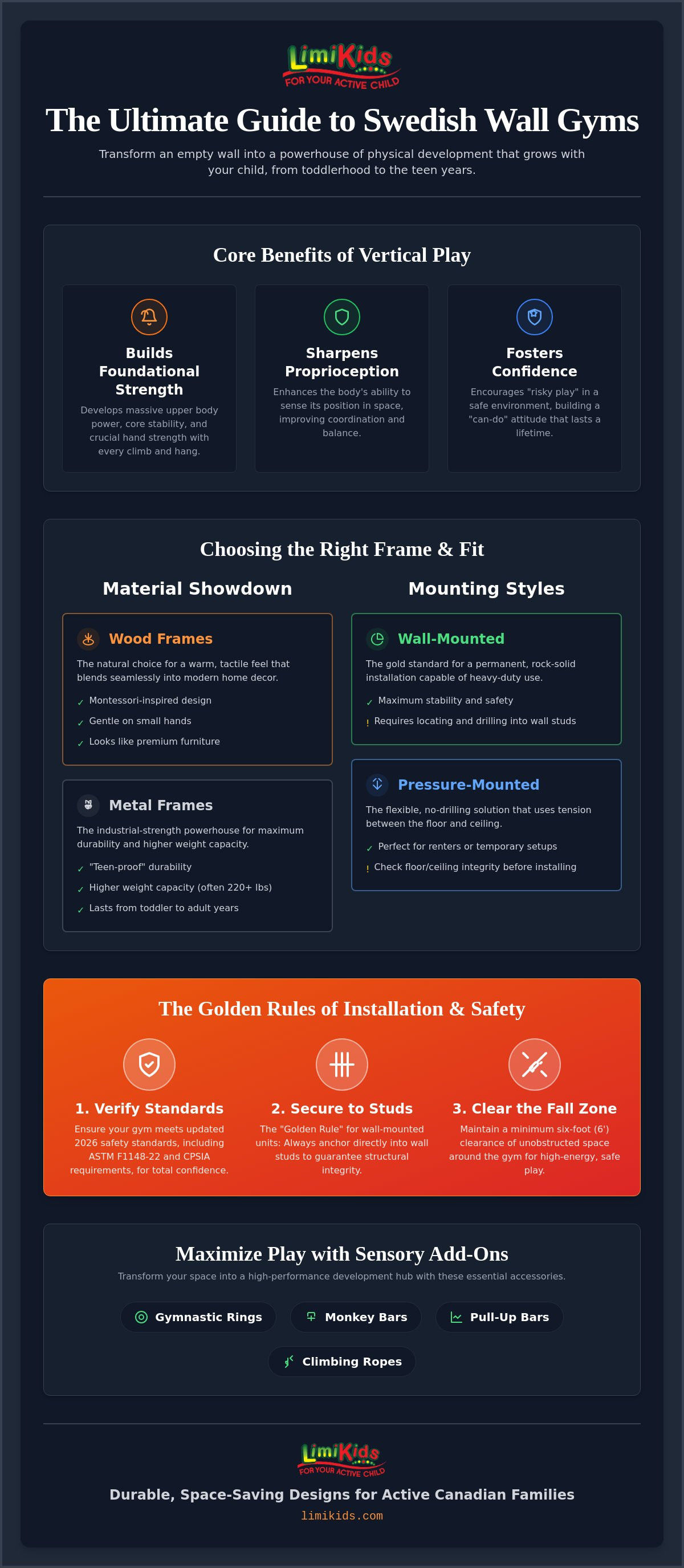
Climbing is a foundational movement that builds more than just muscle. When kids grip those rungs, they are developing massive upper body power and hand strength. This type of play also sharpens their proprioception. That is the body's incredible ability to sense its own position and movement in space. By engaging in "risky play" within the controlled environment of your home, children learn to trust their physical limits. It builds a "can-do" attitude that carries over into the classroom and onto the sports field. They aren't just playing; they are mastering their own mechanics.
Swedish Walls vs. Traditional Playgrounds
Why choose a wall gym over a bulky, standalone jungle gym? It comes down to pure efficiency and accessibility. Consider these advantages:
- Minimal Footprint: A Swedish wall gym for kids uses the "dead" space on your walls. It leaves your floor clear for other activities, making it perfect for smaller Canadian apartments or playrooms.
- Winter Survival: We know how long and dark Canadian winters can feel. When the local park is buried under snow, your living room remains a high-performance hub for movement.
- Aesthetic Integration: Modern gyms are designed to look like high-end furniture. They use premium materials that blend into your decor rather than clashing with it.
Choosing a vertical gym means you are prioritizing long-term physical literacy. You are giving your children a permanent outlet for movement that won't be outgrown by next year. It is an investment in their strength, their confidence, and your peace of mind.
Choosing the Right Swedish Wall: Materials and Mounting
Selecting the right frame isn't just about matching your curtains. It's about deciding how your family will grow over the next decade. When you invest in a Swedish wall gym for kids, you're choosing between two distinct paths: the classic warmth of wood or the industrial strength of metal. Both have their place in a Canadian home, but your choice depends on your child's energy levels and your long-term goals. Grab your measuring tape. It's time to map out your space.
Wooden Swedish walls are a favorite for parents following Montessori principles. They offer a natural, tactile feel that's gentle on small hands. These models blend seamlessly into modern home decor, looking more like premium furniture than playground equipment. However, keep an eye on the "Growth Factor." While wood is beautiful, metal Swedish walls often provide the "teen-proof" durability active families need. Metal frames typically boast a higher weight capacity, often supporting over 220 lbs. This means the gym stays relevant from the toddler years all the way through high school. You can even join in for a few pull-ups yourself.
Before you commit, you must verify your ceiling height and floor clearance. Most Canadian homes feature 8 or 9-foot ceilings, but even a few centimeters can impact your mounting options. You also need a dedicated "fall zone." We recommend a minimum of 6 feet of clear space around the unit. To ensure you're following the best practices for a safe setup, consult this Installation Guide and Safety Standards. It helps you visualize the necessary buffer zones for high-energy play.
Mounting Styles: Wall-Mounted vs. Pressure-Mounted
How you secure the gym is just as vital as the gym itself. Wall-mounted systems are the gold standard for permanent, heavy-duty use. You'll need to locate your wall studs to ensure a rock-solid connection. If you're a renter or don't want to drill into your walls, pressure-mounted gyms are your solution. These use tension between the floor and ceiling to stay upright. They're surprisingly sturdy and leave zero footprints if you decide to move. Explore our collection of kids gym equipment to see which mounting style suits your current living situation.
Weight Limits and Structural Integrity
Don't be fooled by "static" weight limits. A gym might hold 200 lbs of dead weight, but "dynamic" weight is what matters when a child is swinging or jumping. Look for reinforced joints and high-grade fasteners. In a multi-child household, the equipment faces constant stress from different angles. Professional-grade materials ensure the rungs won't flex or creak during a rigorous afternoon session. You're building a foundation for physical literacy; make sure the structure is as strong as your child's ambition.
Maximizing Play: Essential Accessories and Sensory Add-ons
Your base unit is just the beginning. To truly transform your home, you need to think beyond the ladder. A high-quality Swedish wall gym for kids acts as a modular foundation. By adding specialized attachments, you create a multi-dimensional training ground that challenges every muscle group. It's about building a space where your child can swing, climb, and hang until their energy is spent and their confidence is soaring.
Monkey bars are a top-tier addition for developing brachiation skills. Brachiation is the technical term for swinging from rung to rung. This movement does more than build impressive grip strength; it actually aids in lung development and spinal alignment. When you add gymnastic rings, you introduce a stability challenge. Because rings move independently, your child must engage their entire core to stay steady. For those seeking the ultimate motor-planning test, rope ladders and climbing ropes are essential. These require a child to plan several moves ahead, syncing their hands and feet in a complex rhythm of movement.
Versatility is king in a modern Canadian household. Removable slides and dip bars allow the gym to evolve as your children grow. A slide might be a toddler's favorite today, but that same space can house dip bars for a teenager's strength routine in five years. Safety remains the priority through every upgrade. As you customize your setup, always refer to the CPSC home playground safety guidelines. It's vital to stay informed about recent changes. For instance, a June 29, 2026, revision to safety standards now advises against attaching swings to upper body components like monkey bars in home settings. We keep you ahead of these regulations so your play remains fearless.
Sensory Integration and Therapeutic Use
Climbing isn't just physical; it's deeply sensory. For children with ADHD or Autism, a Swedish wall gym for kids provides a crucial outlet for "heavy work." This type of activity provides deep pressure to the joints and muscles, which has a profound calming effect on the nervous system. By creating a dedicated "sensory nook" with ropes and soft mats, you give your child a safe place to regulate their emotions and focus their energy through purposeful movement.
The Best Add-ons for Toddlers
Start them young, but start them safe. Soft-play mats are the non-negotiable foundation for any toddler gym. They provide a cushioned landing for those first brave climbs. Detachable slides are perfect for early motor skill development, offering a rewarding "win" after a successful ascent. Focus on low-rung activities initially. This builds the foundational grip strength and coordination they'll need for higher climbs as they gain confidence. You're not just buying a toy; you're installing a lifelong launchpad for health.
Installation Guide and Safety Standards
Safety isn't a hurdle. It is the foundation of every brave climb. When you install a Swedish wall gym for kids, you aren't just putting up a ladder; you're building a structural anchor for your child's growth. Precision matters. Let's get it right the first time. You've got this, and we're here to guide you through the process.
Step 1: The "Golden Rule" is simple. Never mount to just drywall. You must locate your wall studs. In most Canadian homes, these are spaced 16 inches apart. Use a reliable stud finder to mark the center of the wood. This ensures the weight is carried by the frame of your house, not the plaster. If you have concrete walls, you'll need specific masonry anchors designed for heavy loads.
Step 2: Clear the Fall Zone. You need a minimum 6-foot clearance in every direction from the gym. This prevents accidental collisions with coffee tables or radiators during a high-energy swing. This space is your child's "freedom zone." Keep it clear of toys and clutter.
Step 3: Level and secure. Use a spirit level to ensure the vertical rails are perfectly straight. If the unit is tilted, it puts uneven stress on the fasteners. Tighten everything until it's rock-solid. A shaky gym is a scary gym, so double-check every bolt.
Step 4: The final test. Before the kids touch it, an adult should perform a stress test. Apply steady downward pressure. Check for any creaks or movement. If it doesn't budge under your weight, it's ready for theirs. This final check gives you the peace of mind to step back and let them play.
Check out our full range of indoor home gym for kids options to find the perfect fit for your wall type.
Safety Protocols for Active Play
Regular maintenance is your best friend. Every month, take five minutes to check the bolts. Wood can expand and contract with the Canadian seasons, which might loosen fasteners over time. Also, enforce the "One-Child-at-a-Time" rule for high-level climbing. It prevents accidental kicks and ensures every child has the space they need to move safely. Supervision is key during the learning phase, but as they gain confidence, you can transition to a "spotting" role from a distance.
Required Safety Gear: The Landing Mat
A Swedish wall gym for kids is only as safe as its landing zone. A standard rug is not a safety device. You need a dedicated landing mat. Look for high-density EPE foam that offers superior impact absorption. A good mat should be at least 4 inches thick for vertical play. Folding mats are excellent for space-saving; just tuck them away when the gym isn't in use. Stationary mats provide a more permanent "safe zone" feel. Whatever you choose, make sure it covers the entire fall zone you cleared in Step 2.
The LIMIKIDS Advantage: Quality for Active Families
Since 2008, we've watched thousands of Canadian children transform their living rooms into arenas of achievement. At LIMIKIDS, we don't just sell equipment. We provide the tools for lifelong physical literacy. A Swedish wall gym for kids is a significant investment in your child's future, and we take that responsibility seriously. Our legacy is built on a simple promise: providing high-performance development hubs that fit perfectly into the modern home.
We design our gyms for the high-impact reality of daily play. While plastic alternatives often end up in landfills, our equipment is built for permanence. We use premium materials that withstand the rigours of climbing, swinging, and jumping year after year. Our space-saving designs ensure that even if you live in a compact urban apartment, your child doesn't have to sacrifice their need for movement. You get maximum function without cluttering your floor space. It's about making every square inch of your home work harder for your family's health.
Expertise is what sets us apart. Our dedicated children's fitness team understands the nuances of pediatric wellness and sensory processing. We aren't just retailers; we're consultants who help you navigate the logistics of mounting, weight capacities, and accessory compatibility. When you choose us, you're gaining a partner dedicated to your child's success and your peace of mind.
Why Canadian Parents Trust LIMIKIDS
Logistics shouldn't be a headache. We provide fast, reliable shipping across Canada, ensuring your new gym arrives ready for action. Our equipment is famous for its longevity. It's not uncommon for a LIMIKIDS gym to serve a child from their first toddler steps all the way through their teenage training sessions. We offer expert advice tailored to the specific needs of Canadian households. Whether you're dealing with standard drywall or unique ceiling heights, we have the experience to help you choose the right fit.
Start Your Home Gym Journey Today
Ready to reclaim your furniture and give your kids the outlet they crave? The process is simple. Browse our curated selection of Swedish wall gyms to find the model that matches your home's aesthetic and your child's energy level. If you're feeling stuck, contact our team for a personalized recommendation. We'll help you measure your space and select the perfect accessories to keep your kids engaged for years to come.
Don't wait for the next rainy day or snowstorm to wish you had an indoor solution. Empower your children to move, grow, and succeed right now. Transform your home with a LIMIKIDS Swedish Wall Gym and watch your children reach new heights today.
Build a Legacy of Movement in Your Home
You now have the exact roadmap to transform a simple wall into a high-performance development hub. Remember to prioritize structural integrity by mounting to studs and maintaining a clear fall zone for total peace of mind. Choosing a Swedish wall gym for kids isn't just about finding an indoor outlet; it is about fostering lifelong confidence and core strength through every Canadian season. You're making a choice that prioritizes growth and active discovery over screen time.
We've been a proud Canadian leader in this field since 2008. Our team combines expert-vetted safety standards with high-quality designs that grow with your family from toddlerhood to the teen years. With fast shipping across Canada, your child's favorite new activity is ready to ship. Take the lead and give them the space they need to thrive. We are here to support your journey every step of the way.
Shop Premium Swedish Wall Gyms at LIMIKIDS
Let's turn that pent-up energy into purposeful progress. Your home is officially ready for its most exciting transformation yet!
Frequently Asked Questions
What is the best age to start using a Swedish wall gym?
Children can begin exploring a Swedish wall gym for kids as early as 18 to 24 months. At this stage, focus on low-rung activities and tactile exploration under close supervision. As they grow into their school-age years, they'll naturally transition to more complex climbing and swinging. These gyms are designed to evolve with your child, supporting their physical development from those first brave steps through their teenage training years.
Can I install a Swedish wall gym in an apartment with low ceilings?
Yes, you can absolutely install a gym in an apartment with low ceilings. Many models are adjustable or come in heights specifically designed for standard 8-foot Canadian ceilings. Pressure-mounted options are particularly popular for apartments because they don't require drilling and can be adjusted for a snug fit. Just ensure you measure your exact ceiling height before ordering to guarantee a perfect, secure match for your space.
Are Swedish walls safe for toddlers?
Swedish walls are incredibly safe for toddlers when paired with the right safety protocols. Always use a high-density landing mat to cushion any slips and keep activities limited to the lower rungs during early development. Supervision is non-negotiable for this age group. These structures provide a controlled environment for toddlers to build essential motor skills and grip strength safely within your sight.
What is the weight limit for a typical kids' indoor gym?
Weight limits vary by material, but a typical high-quality metal Swedish wall gym for kids often supports up to 220 lbs. Wooden models might have slightly lower limits, often around 175 to 200 lbs. Always check the manufacturer’s dynamic weight rating rather than just the static limit. This ensures the frame can handle the extra force of a child swinging or jumping without compromising the structural integrity of the unit.
Do I need a professional to install my Swedish wall?
You don't necessarily need a professional, but you must be comfortable locating wall studs and using basic tools. The most critical step is ensuring the gym is anchored into the wood frame of your house, not just the drywall. If you have concrete or brick walls, you'll need a hammer drill and specific masonry anchors. If you're ever unsure about your wall's structural capacity, consulting a local handyman is a smart move for peace of mind.
How much floor space do I actually need for a home gym?
You need a clear "fall zone" of at least 6 feet in front of the gym and about 3 feet on either side. Since the unit itself only projects about 15 to 25 inches from the wall, the actual footprint is remarkably small. This vertical efficiency is what makes them perfect for playrooms or bedrooms. Just keep the surrounding area clear of furniture and sharp corners to ensure every landing is a safe one.
Can a Swedish wall gym help with my child's sensory processing needs?
Absolutely, climbing and hanging provide "heavy work" that sends deep pressure signals to a child's joints and muscles. This input is highly regulating for children with sensory processing challenges, ADHD, or Autism. It helps them organize their nervous system and find a sense of calm through purposeful, intense movement. It’s more than a playground; it’s a therapeutic tool that supports emotional regulation right in your home.
What is the difference between wood and metal Swedish ladders?
The primary difference lies in aesthetics and longevity. Wooden ladders offer a warm, natural look that many parents prefer for Montessori-style playrooms. They feel soft and grippy for small hands. Metal gyms, however, usually offer higher weight capacities and superior durability for high-energy older kids. Metal frames are often considered "teen-proof," making them a better long-term investment for families with multiple children of different ages.